
Sandia’s Will McNamara Speaks about Decarbonization at a Pasadena, CA, Town Hall Meeting

Will McNamara, Energy Storage Policy Analyst at Sandia National laboratories, delivered a presentation on Wednesday, May 8, 2024, at the City of Pasadena (California) District 6 Town Hall meeting to help the city achieve its goal of becoming carbon-free by 2030. Will was introduced by the City’s Vice Mayor Steve Madison and spoke about the role that energy storage plays in decarbonization, particularly the need for long-duration energy storage (LDES) technologies as penetration levels of renewable energy significantly increase. Will provided information about national trends on decarbonization, opportunities for clean energy funding sources through the Department of Energy, and how Sandia provides support for demonstration programs.

Prior to the Town Hall presentation, Will met with the Acting General Manager of Pasadena Water & Power (PWP), which expressed interest in developing an LDES technology pilot project with Sandia’s support. The District 6 Town Hall was a public forum held by the City of Pasadena to educate the public about the city’s decarbonization goals and address public questions and concerns about this initiative.

Will’s presentation was based upon work supported by the U.S. Department of Energy, Office of Electricity (OE), Energy Storage Division.
Staff Scientists at Sandia Develop First Simulated Force Field Parameters for Zincate

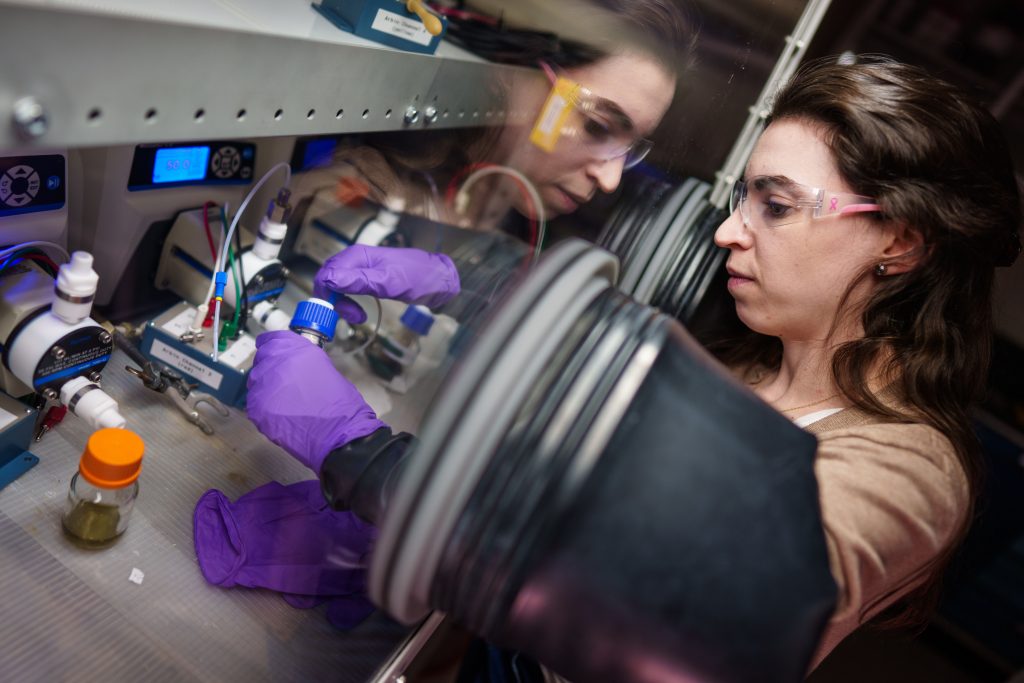
Amalie Frischknecht and Mark Stevens at Sandia developed new parameters to use in molecular dynamics simulations of zincate ions in aqueous potassium hydroxide solutions. The results were published in an article titled “Force Fields for High Concentration Aqueous KOH Solutions and Zincate Ions,” published March 28, 2024, in the American Chemical Society (ACS) Journal of Physical Chemistry B.

Many renewable energy technologies rely on aqueous alkaline electrolytes such as potassium hydroxide (KOH), including fuel cells, electrolyzers, and rechargeable zinc-based batteries. In the case of zinc batteries, zincate ions are also present in the electrolyte and cause problems if they cross the separator from one side of the battery to the other. Molecular simulations are a promising method to understand the details of ion and gas transport through these batteries, but to perform such simulations one first must know the interactions among all the species present, the so-called force field.

In this paper, the authors developed parameters for use in molecular dynamics (MD) simulations that are validated against experimental measurements of density and viscosity. This paper presents the first force field parameters for zincate available in the literature. These new force field parameters will enable future simulations of KOH-based electrolytes and dissolved zincate ions. This will be particularly helpful in understanding how polymer membranes can help to block the undesirable transport of zincate ions across zinc-based batteries while still allowing the high conductivity of hydroxide ions through the membrane needed for good device performance.

The American Chemical Society (ACS) Journal of Physical Chemistry B is a high-quality journal publishing fundamental results in physical chemistry, with an impact factor of 3.3.

Amalie Frischknecht and Mark Stevens are both staff scientists at the Center for Integrated Nanotechnologies at Sandia National Laboratories. This material is based upon work supported by the U.S. Department of Energy, Office of Electricity (OE), Energy Storage Division.

Amalie L. Frischknecht and Mark J. Stevens, “Force Fields for High Concentration Aqueous KOH Solutions and Zincate Ions,” J. Phys. Chem. B 2024, 128, 14, 3475-3484, DOI: 10.1021/acs.jpcb.3c08302.

Sandians Contributed to Industry Education on Energy Storage and a Decarbonized Future

Sandia National Laboratories Energy Storage program team members participated as co-instructors on the “How Grid Energy Storage Meets the Challenges of a Decarbonized Future” tutorial at the 2024 IEEE PES T&D Conference May 6-9, 2024, in Anaheim, CA. This tutorial was organized and led by the IEEE Energy Storage and Stationary Battery (ESSB) technical committee. The Sandia representatives and subject matter experts covering these topics were Babu Chalamala, Ray Byrne, Tu Nguyen, Mike Ropp, Charlie Vartanian, and Chris Searles. Sandia also partnered with Rick Fioravanti from Quanta Technology for this tutorial.

This four-hour tutorial was divided into four sections:

  1. A review of current technologies targeted for this area (e.g., lithium ion, pumped hydro, flow batteries, and long duration energy storage).
  2. Market application challenges and valuations with a focus on the duration needed in a decarbonized scenario and market products that may be required to ensure deployment.
  3. Engineering of energy storage systems, code compliance, and interconnection – including electrification technologies.
  4. System safety and reliability.

In supporting IEEE ESSB, Sandia staff leverages and promotes ES R&D learning and resources. The IEEE is also a productive community for technical information-exchange, and socializing broader DOE initiatives including the LDES Storage Shot.

Sandian Discusses Technologies for Diesel Use Reduction at the IEEE SusTech Initiative Energy and Climate Technologies for the Arctic Workshop

Sandia National Laboratories Energy Storage program team member Charlie Vartanian participated in IEEE SusTech Initiative’s Energy and Climate Technologies for the Arctic Workshop held May 3-4, 2024, at the University of Alaska Anchorage campus. This was the fourth in a series of open workshops held by the IEEE SusTech Initiative. At the workshop, Charlie Vartanian spoke on “Technologies for Diesel Use Reduction in Non-Grid-Connected Communities.” This presentation featured the Cordova Electric Cooperative’s BESS’s success reducing utility diesel fuel use. Sandia previously assisted CEC in the successful planning and deployment of their 1MW BESS.

The presentation also included content prepared by Michael Ropp from Sandia. Mike’s content in the presentation summarized the IEEE 1547 Interconnection Standard. The Energy and Climate Technologies for the Arctic Workshop provided a useful audience and community to share Sandia energy storage R&D program resources and insights on storage applications that improve environmental outcomes including reduced fossil fuel use to serve electric utility customers’ load.

The IEEE SusTech Initiative seeks to contribute technical expertise and solutions to address sustainability challenges, including climate change. The Initiative offers workshops in various formats free of charge throughout the year.

Read more in the BESS Application in a Microgrid – Cordova Electric Cooperative PPT.

Questions: Contact Charlie Vartanian at charlie.vartanian@ieee.org.

Sandian Assist Industry Understanding of Long Duration Energy Storage (LDES) for Integrated Resource Planning (IRP) Summit

Will McNamara from Sandia National Laboratories gave two presentations at the EUCI Integrated Resource Planning (IRP) Best Practices Summit held virtually May 1-2, 2024, hosted by Burbank Department of Light & Power. McNamara, the Sandia Energy Storage Policy Analyst, presented and led discussion on “Parsing Which Long Duration Technologies Will Prevail” and “Assessing the Impacts on IRP of the Inflation Reduction Act.”

His Long Duration presentation explored what LDES technologies are gaining momentum on the path to commercialization and how focused efforts across the industry are aligning to address the array of market challenges that persist. While the Inflation Reduction Act presentation provided an overview of the IRA incentives and expected power market impacts on IRP best practices.

This Summit explored the new IRP paradigm and provided a critical platform to leading utility, power resource planning professionals and related industry experts as they addressed the key elements associated with emerging operational issues. The conference blended presentations from utilities, state regulatory staff/commissioners, non-utility SMEs, service providers and other resource planners.

The event also provided a conduit for McNamara to highlight Sandia’s energy storage R&D Program resources, insights on long duration energy storage, and promote DOE’s Energy Storage Grand Challenge.

Download the EUCI Integrated Resource Planning (IRP) Best Practices Summit brochure.

Questions: Contact Will McNamara at jwmcnam@sandia.gov.

Sandians Assist Industry Education on Energy Storage System Standards

Sandia National Laboratories Energy Storage program team member Charlie Vartanian participated in the EUCI course “Energy Storge System Commissioning” held virtually April 17-18, 2024. Charlie was the lead instructor for “Installation Codes, Standards, and Regulations (CSRs) Applicable to Energy Storage System (ESS) Commissioning”. The Sandia-supported course module included content prepared by Michael Ropp (Sandia ESS Interconnection), Waylon Clark Sandia (Sandia ESS Demonstration Projects and Commissioning), and Chris Searles (Sandia ES Safety Codes and Standards).

The ESS Commissioning course provided the audience of ESS owner/operators (and all other parties involved in the commissioning effort) an excellent foundation of:

  • ESS pre-commissioning requirements
  • ESS commissioning stakeholders and their involvement
  • ESS commissioning project plan elements and their sequence
  • ESS commissioning tests
  • ESS deployment and commencement of operations
  • ESS recommissioning and decommissioning

EUCI provided an extremely interested and engaged audience for the Sandia Energy Storage program to deliver its R&D program resources and insights related to ESS standards and their application. Participation in this course also supported a broader Sandia and DOE OE goal to lower barriers to ESS adoption by filling gaps in ESS Standards.

Learn more about the course here.

Questions: Contact Charlie Vartanian at charlie.vartanian@ieee.org.

Sandia National Laboratories’ Atri Bera Awarded Outstanding Young Engineer

Dr. Atri Bera was recently honored with the Outstanding Young Engineer Award by the IEEE Albuquerque Section, recognizing his significant contributions in developing “software tools to assess the reliability and stability risks associated with high penetrations of renewable generation.” His research and tool development work has been pivotal in addressing critical challenges as the power grid transitions to incorporate a higher proportion of variable renewable energy sources.

Dr. Bera’s work as a Senior R&D Engineer at Sandia National Laboratories has notably advanced the understanding of potential reliability and stability risks posed by renewable energy integration and demonstrated how energy storage solutions can be strategically utilized to mitigate these issues. Furthermore, his research into energy storage valuation has been instrumental in reducing barriers to its broad adoption, making it easier for industry stakeholders to assess the financial benefits.

Additionally, Dr. Bera has been at the forefront of developing innovative software tools that enhance energy storage valuation and improve grid planning, thereby supporting a more resilient and efficient energy infrastructure. This award highlights Dr. Bera’s impactful work and his commitment to advancing renewable energy integration and enhancing grid reliability and stability using energy storage.

Dr. Bera earned his bachelor’s from National Institute of Technology Durgapur in India and his Ph.D. from Michigan State University, both in electrical engineering. He has authored numerous journal articles, book chapters, and reports focused on improving grid performance amidst the large-scale integration of renewable energy through the utilization of energy storage systems. He is actively engaged in a range of IEEE activities, including participation in working groups and task forces, serving in editorial roles, and organizing panels and sessions to share ongoing research in his field.

Vincent Sprenkle Named Director of Grid Storage Launchpad

A nationally recognized leader in electrochemical energy conversion and storage at Pacific Northwest National Laboratory (PNNL), Vince Sprenkle has been chosen to oversee the Grid Storage Launchpad (GSL), a Department of Energy (DOE) Office of Electricity (OE) research and development facility that will open this year on PNNL’s campus in Richland, WA.

For more than a decade, Sprenkle has helped lead the effort to develop and accelerate energy storage technologies to meet the country’s clean energy goals. As director of the GSL, Sprenkle will focus on applying the facility’s cutting-edge capabilities and bringing together research collaborations to help advance grid energy storage solutions to enable the nation’s resilient, reliable, and affordable energy grid.

U.S. Department of Energy Announces Selectees of $15 Million in Awards to Advance the Future of Energy Storage

The U.S. Department of Energy’s (DOE) Office of Electricity (OE) today announced the selectees of $15 million in awards at the Long Duration Energy Storage (LDES) Council Summit on April 8, 2024. These awards are through the Storage Innovations 2030: Technology Liftoff (SI Liftoff) funding opportunity announcement (FOA) to advance energy storage innovations to help deliver clean, affordable electricity to Americans when and where it is needed most.

OE selected three organizations (listed below) for their innovative ideas to tackle key R&D barriers in the domestic energy storage industry. Entities are awarded up to $5 million each for projects that (a) create research partnership to bring together two or more technology stakeholders, and (b) partner with a research institution to solve one or more pre-competitive R&D technical challenge. Projects must enable a long-duration capable (10+ hours) energy storage technology with a pathway to $0.05/ kWh Levelized Cost of Storage (LCOS) by 2030.

Energy Storage Safety and Reliability Forum

Sponsored by OE’s Energy Storage Program, the Energy Storage Safety and Reliability Forum, hosted at the Pacific Northwest National Laboratory’s (PNNL) in Richland, WA. will focus on the current state of energy storage safety and reliability and identify additional R&D efforts to advance the DOE roadmap for energy storage. The forum, May 14 – May 16, 2024, will also examine key challenges, opportunities, and potential solutions for improving the safety and reliability of energy storage systems.