
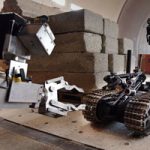
Robot rivals rally to rope in rewards at rodeo
Last week, Sandia hosted the 12th annual Western National Robot Rodeo, a week-long, 11-event competition where eight civilian and military bomb squads from around the region solved challenging, simulated scenarios.

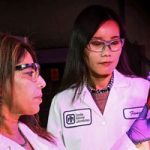
Tafoya named industrial engineering fellow
For her dedication to optimizing business processes and systems, Joan Tafoya recently was named a fellow of the Institute of Industrial and Systems Engineers, which recognized her work solving complex technical problems and instituting lean practices — passions that drew her to Sandia last fall after a 27-year career at Intel.
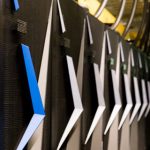
DOE to deploy Arm-based supercomputer prototype at Sandia
Arm microprocessors have been used in numerous applications from vehicle computers to cell phones, but until recently, have not been practical for use in high-performance computing. Astra — one of the first supercomputers to use Arm processors in a large-scale high-performance computing platform — is expected to be deployed at Sandia later this summer.
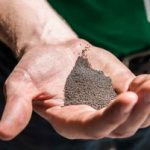
Raising the heat to lower the cost of solar energy
Sandia will receive $10.5 million from DOE to research and design a cheaper and more efficient solar energy system. The work focuses on refining a specific type of utility-scale solar energy technology, called concentrating solar power, which is appealing because it can supply renewable energy — even when the sun is not shining — without using batteries for storage.
Riding bacterium to the bank
What does jet fuel have in common with pantyhose and plastic soda bottles? They’re all products currently derived from petroleum. Sandia scientists have demonstrated a new technology based on bioengineered bacteria that could make it economically feasible to produce all three from renewable plant sources.

Five seconds at F/16, with a broken camera
In May 1998, Sandia photojournalist Randy Montoya captured a photo that has since become legend. The stunning image, nicknamed "Arcs and Sparks," captures the Z machine just as it fires — a mere 100 nanoseconds of roughly 200 trillion watts of x-ray energy, many times all the electrical power generated in the world at any given moment.
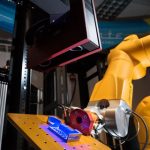
Sandia’s robotic work cell conducts high-throughput testing ‘in an instant’
With 3D printing, you can make almost anything in a matter of hours. However, making sure 3D-printed parts work reliably takes weeks or even months. To speed up the process, Sandia scientists have designed and built a six-sided work cell around a commercial robot that conducts high-throughput testing to quickly determine how well those parts perform.

How microgrids could boost resilience in New Orleans
In a year-long project, researchers at Sandia and Los Alamos national laboratories teamed up with the city of New Orleans to analyze ways to increase community resilience and improve the availability of critical lifeline services during and after severe weather.
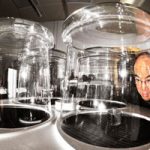
Sandia measurements expert named Asian American Engineer of the Year
“I am deeply both humbled and honored to have been nominated by Sandia and selected by CIE-USA,” senior scientist Hy Tran said of his selection. “This is not so much a personal honor. This honor belongs to Sandia National Laboratories.”

First wind blade from a 3-D printed mold, energy-saving nanoparticles earn Sandia national FLC awards
Sandia’s energy-saving nanomaterial window films and first wind turbine blades made from a 3-D printed mold earn national honors from the Federal Laboratory Consortium