
R&D 100
The venerable R&D 100 contest, slightly more than 50 years old, has a new owner, and the competition continues. Competing in an international pool of universities, corporations and government labs, Sandia inventions captured four R&D 100 Awards this year, as well as two environmental and one business award.
Fuel property put to the test at Sandia’s CRF
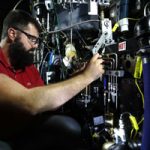
Researchers at Sandia’s Combustion Research Facility are working to understand the fundamentals of phi-sensitivity, a key fuel property that represents how the autoignition reactivity of the fuel varies with the fuel/air equivalence ratio. This will help increase the efficiency and facilitate the development of practical low-temperature gasoline combustion engines.
Lowering the bar for hydrogen-powered technology
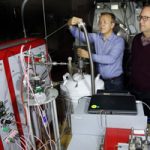
The Hydrogen Materials Advanced Research Consortium, or HyMARC, a multilab collaboration co-led by Sandia, is developing two types of hydrogen storage materials to meet challenging energy density targets set forth by DOE. The newly expanded collaboration is using the most promising strategies to optimize the materials for future use in vehicles.
Hate to wait? Hruby Fellow looks to speed up climate research
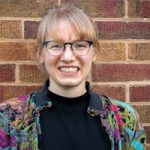
Sandia has awarded Kelsey DiPietro a Jill Hruby Fellowship. The applied mathematician has proposed a way to make computer models more efficient — improving accuracy without increasing time or resources to run them.
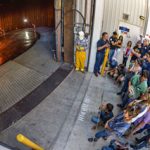
Record-breaking crowds attend Sandia’s New Mexico Family Day
Family and friends walked the usually restricted streets of Sandia’s Albuquerque campus during the Sept. 7 Family Day event, to show support for their loved ones and see where they work. The long tradition of Family Day is an opportunity to show friends and loved ones some of the interconnected teamwork and facilities they don't usually get to see.
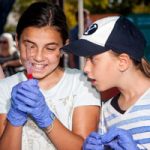
California site celebrates Family Day
More than 2,000 people spread out across Sandia’s California campus for Family Day on Sept. 14, getting a glimpse of the exceptional work done in the national interest by Sandia researchers and professionals from all over the world.
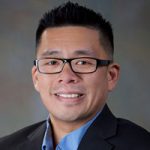
Asian American conference selects Sandian ‘most promising engineer’
Sandia researcher Stanley Chou recently was selected one of three most promising engineers of the year at the 2019 Asian American Engineer of the Year conference in Dallas.
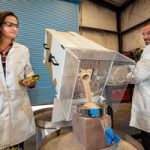
Containing a nuclear accident with ground-up materials
Sandia researchers are developing a promising new way to contain the hot molten mass that develops within a nuclear reactor during a catastrophic accident and prevent the spread of radioactive contamination.
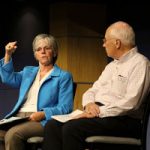
Younger: A Sputnik moment is coming
Laboratories Director Steve Younger and Chief Research Officer Susan Seestrom took the stage at the Steve Schiff Auditorium Aug. 26 to discuss “discovery science” and what it means for Sandia. The talk was the latest installment of the New Research Ideas Forum.
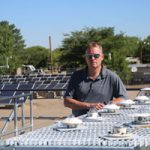
PSEL wraps up nonreflective solar panel testing
Sandia’s Photovoltaic Systems Evaluation Laboratory is in the final phase of a collaborative research project with Nishati, a veteran-run manufacturer of light-weight, portable photovoltaic panels. The collaboration will shift to the PV proving grounds project at the end of the fiscal year.