
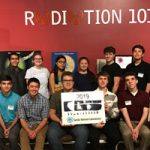
STAR fellows 2019
Family Day memories are captured in photos from past events.

Sandia breaks ground on new California data center
National Nuclear Security Administration officials joined Sandia leadership June 3 to break ground on a new data center at the Sandia/California site. The 8,900-square-foot facility will house information-processing equipment essential for providing connectivity and computing support.
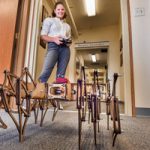
Students compete for best 3D-printed design during Sandia robotics camp
Sandia and R4 Creating hosted the second annual week-long robotics camp in May at the Robotics Vehicle Range. Local students competed in teams to create and print original 3D designs.

Kyle Fuerschbach earns 2019 Kevin P. Thompson Optical Design Innovator Award
Sandia engineer Kyle Fuerschbach has been named the 2019 Kevin P. Thompson Optical Design Innovator Award recipient by the Optical Society. The award recognizes significant early-career contributions to lens design, optical engineering or metrology.

A day in the life of Sandia — 70 years and counting
To mark the 70th anniversary of President Truman’s letter that inspired Sandia to “… exceptional service,” Lab News photographer Randy Montoya spent a full day chronicling the people and work that make the Labs hum from sun up to sundown.

Heroux is SIAM fellow
Michael Heroux, senior scientist at Sandia’s Center for Computing Research, has been selected as a fellow of the Society for Industrial and Applied Mathematics. The SIAM Fellows Program honored Mike for research, leadership and building community in software and algorithms for scientific and high-performance computing.
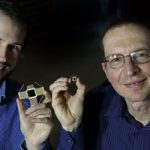
Breakthroughs in neuromorphic computing demonstrate high efficiency, performance
Sandia researchers and collaborators at Stanford University and the University of Massachusetts, Amherst, recently have made breakthroughs in neuromorphic computing, which mimics the way the human brain carries out data-centric tasks.
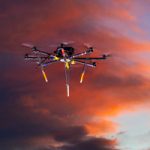
Future hypersonics could be artificially intelligent
A test launch for a hypersonic weapon — a long-range missile that flies a mile per second and faster — takes weeks of planning, and it's uncertain how useful test systems will be against urgent, mobile or evolving threats. But Sandia's hypersonics developers think artificial intelligence and autonomy could slash these weeks to minutes for deployed systems.
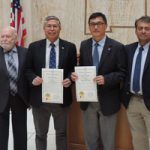
NM Legislature honors Sandia serial innovators
Stan Atcitty and Hongyou Fan have received recognition from the New Mexico Legislature for their distinguished achievements as serial innovators.
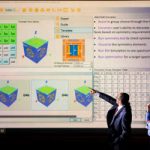
Mirage software automates design of optical metamaterials
Sandia software developers have created the first inverse-design software for optical metamaterials. The new software lets users design science-fiction-like materials with the same efficiency that architects use when they draft building plans.