
Challenge
Hypersonic vehicles, which travel at speeds faster than five times the speed of sound, experience significant thermal and aerodynamic loads. They could be used for multiple potential missions including manned and unmanned civil reentry, planetary entry probes, and defense.
Hypersonic reentry vehicles are subjected to high levels of fluctuating pressures. These intense fluctuations can cause vibration of internal components and lead to structural problems. To design better hypersonic flight vehicles, there is a need to predict pressure fluctuations.
“The collaboration between Purdue and Sandia on hypersonics facilitates bridging the gap between university science research and Sandia engineering for DoD applications.”
Steven Schneider
Professor, Aerospace Sciences Lab
Purdue University
Collaboration
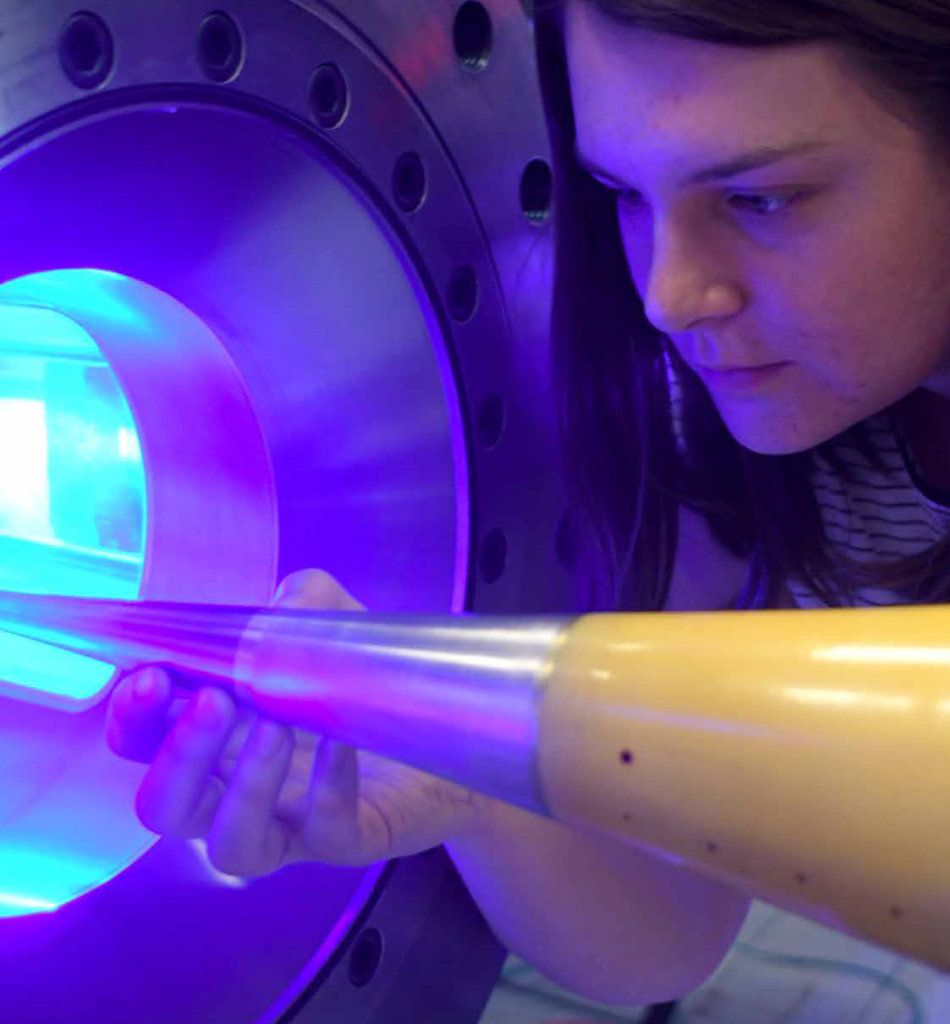
Computers can model how the boundary layer turbulence will be transmitted through the structure and shake internal components, but the models must be compared to measurements from physical testing in a wind tunnel. Purdue University and Sandia National Laboratories are working together on this challenge.
While Sandia has conventional wind tunnels, Purdue developed and operates a “quiet” hypersonic wind tunnel, one of only four in the world. The quiet tunnel is critical for recreating the smooth, or laminar, flow of air over the surfaces of aircraft, spacecraft or missiles within the Earth’s atmosphere. It also helps determine when the flow over the flight vehicle might become turbulent: the point where much higher pressure fluctuations are generated.
Solution
Studying these pressure fluctuations has a big effect on how the structure of hypersonic vehicles is engineered. While vehicles must be designed for survivability, having better predictions and data can help engineers create vehicles that are not overdesigned. Wind tunnel testing also lets researchers refine the physics in their computer models, making them more accurate.
Testing results are already contributing to a better understanding of turbulence and how it creates pressure fluctuations in hypersonic vehicles. Having access to the quiet wind tunnel gives Sandia researchers an opportunity to validate and improve their models at Mach 6. A large new Mach 8 quiet tunnel to be built at Purdue should enable even better simulations.
Impact
Purdue’s research leads the world in laminar-turbulent transition in hypersonic flows and Professor Steven Schneider is an expert in developing mechanism-based methods for estimating hypersonic boundary-layer transition in flight. Due to this partnership, the expertise available at Purdue is shared with Sandia. In addition, a number of Purdue aerospace students have become interns and employees at Sandia, advancing the Labs’ research and engineering capabilities in the area of hypersonics.