
Challenge
Scientists in many disciplines use meshes, or digital representations, to model all kinds of complex parts. For example, a mesh of an airplane wing can be used in computer simulations to learn what might happen in high winds before the new design is prototyped.
Current meshing software can require lots of time-consuming manual labor to clean up the complex objects being modeled. Sandia National Laboratories identified meshing as the single biggest bottleneck in getting simulations completed.
“The UT Austin team appreciates the opportunity to collaborate with Sandia partners on an important project. The results obtained by PhD student Jaime Mora-Paz in the course of his dissertation work and the project with Sandia confirm the suitability of VoroCrust and other polygonal meshing techniques for the simulation of foams.”
Leszek F. Demkowicz
Assistant Director
Oden Institute for Computational Engineering and Sciences
University of Texas at Austin
Collaboration
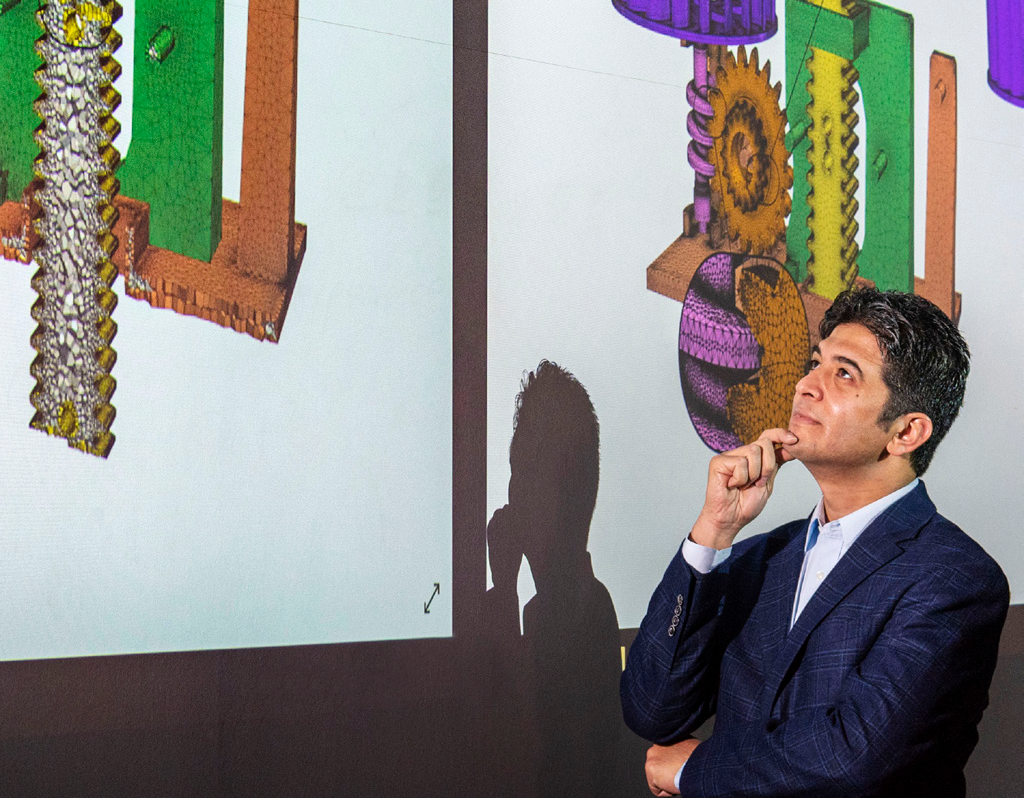
Sandia computer scientist Mohamed Ebeida and his team have been working on VoroCrust, software that uses polyhedral elements called Voronoi cells instead of the more typical tetrahedral or hexahedral cells which help it produce meshes for challenging geometries.
UT Austin faculty and students, including Computer Science Professor Chandrajit Bajaj and Post-doc Ahmed Abdelkader, have worked with Sandia for several years on the development of the VoroCrust algorithm and software.
This collaboration was possible because Sandia and UT Austin are partners in the SAA Program, an initiative Sandia has formed with five universities to promote collaborative research and attract top talent to work on tough problems.
Solution
One specific modeling application problem is simulation of deformation of elastomeric syntactic foams, a material used for stress relief of electronic components. Fulbright Scholar Jaime Mora Paz, as part of his PhD dissertation, demonstrated that initial results concerning 2D meshes do extend to 3D by using VoroCrust and other polyhedral meshes with UT Austin’s new finite element technology—the Discontinuous Petrov-Galerkin method, enabling discretization with polyhedral meshes.
This is an important step in proving that VoroCrust software is robust and can be used with a variety of numerical methods and applications.
In the future, because VoroCrust has the potential to eliminate the need for manual intervention to clean up geometry, it will also be compatible with exascale computing, automating the entire modeling process and improving overall efficiency.
Impact
Over the last few years, Ebeida has co-authored a number of publications with Bajaj and members of his group. One of the papers on VoroCrust was also presented at SIGGRAPH 2020, a top computer graphics conference.
Recently Sandia implemented changes in the VoroCrust code, increasing its speed so that a process that took 12-16 hours can now be done in less than 10 minutes. VoroCrust has also already been used by Sandia scientists to make geological models for deep disposal of nuclear waste as part of the DOE’s Spent Fuel and Waste Science and Technology Campaign that Sandia leads.