
Challenge
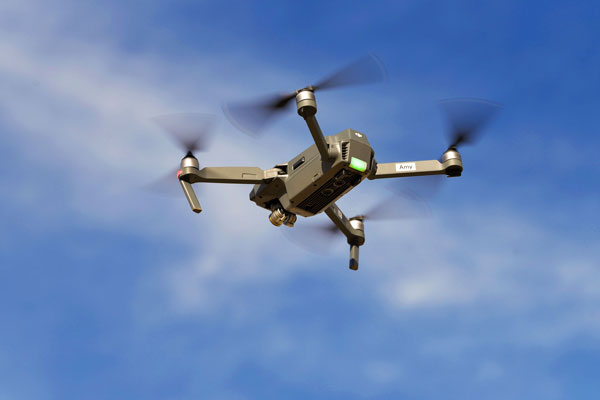
Small unmanned aircraft systems (UAS), more commonly known as drones, are becoming increasingly popular for both entertainment and commercial purposes. Although users are expected to follow height restrictions to avoid potential interference with aircraft, their widespread use raises questions of how to detect, track, and police vehicles that pose a threat.
Ground-based defense systems against these vehicles, such as radar, have limitations when attempting to identify a low-altitude UAS threat through obstacles such as buildings and trees. Organizations working within the government and defense industry have been exploring efficient ways to intercept UAS threats midflight, with some success in deploying nets from single drones.
Solution
In 2017, Sandia robotics experts successfully demonstrated the intercept of a target vehicle, trapping it in the air and safely lowering it to the ground. Since then, Sandia has extended research and testing for a Mobile Adaptive/Reactive Counter UAS System (MARCUS), partnering with various organizations to more robustly address the future of UAS technologies.
Sandia’s 2017 demonstration, which used a swarm of four drones controlled by a ground-based computer system, was part of a two-year Laboratory Directed Research and Development project called Aerial Suppression of Airborne Platforms (ASAP). During this project, Sandia developed algorithms for airborne mobile defense systems in which a computer system would track each aircraft and send commands to the system as a whole, optimally positioning a team of drones to intercept their target. Airborne systems with sensors could dramatically enhance the ability to mitigate threats, even as the technology continues to evolve.
Facing the challenge of developing a novel system with both ground- and aerial-based capabilities, the MARCUS project builds on the understanding that an airborne system, equipped with sensors, would have the ability to intercept small threats and keep them at a safe distance from the public and secure facilities. MARCUS encompasses three phases to address the UAS threat of the future: detect, track, and capture. In the detection phase, computers use information from airborne sensors and ground-based systems to identify possible threats. Additional systems can then be deployed to track the vehicle, gathering information to predict its future movements and to capture it midflight, if necessary.
Collaboration
Sandia is partnering with the North Atlantic Treaty Organization (NATO), the Department of Homeland Security (DHS), the Swiss Federal Department, and a group from the University of New Mexico (UNM) to continue research and testing for the MARCUS project. Collaborating through a Strategic Partnership Project (SPP), the team is working to further develop MARCUS with detection, threat identification, tracking assessment, and neutralization capabilities through the integration of small onboard sensors, software, modeling and simulation capabilities and ground platforms.
Impact
The resulting technology could benefit multiple agencies, including the military, law enforcement entities, event organizers and agencies such as DHS. Improving the overall detection capabilities and effectiveness of counter unmanned aircraft systems (C-UAS) will enable successful responses to UAS threats while enhancing the security of restricted facilities.
Sandia leads the MARCUS project in collaboration with UNM and is supported by the science and technology procurement arm of the Swiss Federal Department of Defence, Civil Protection and Sport. Funding was provided by the NATO Science for Peace and Security Programme and the project incorporated advanced algorithms funded by the DHS Security Science and Technology Directorate. The project was expected to conclude in December 2022.