
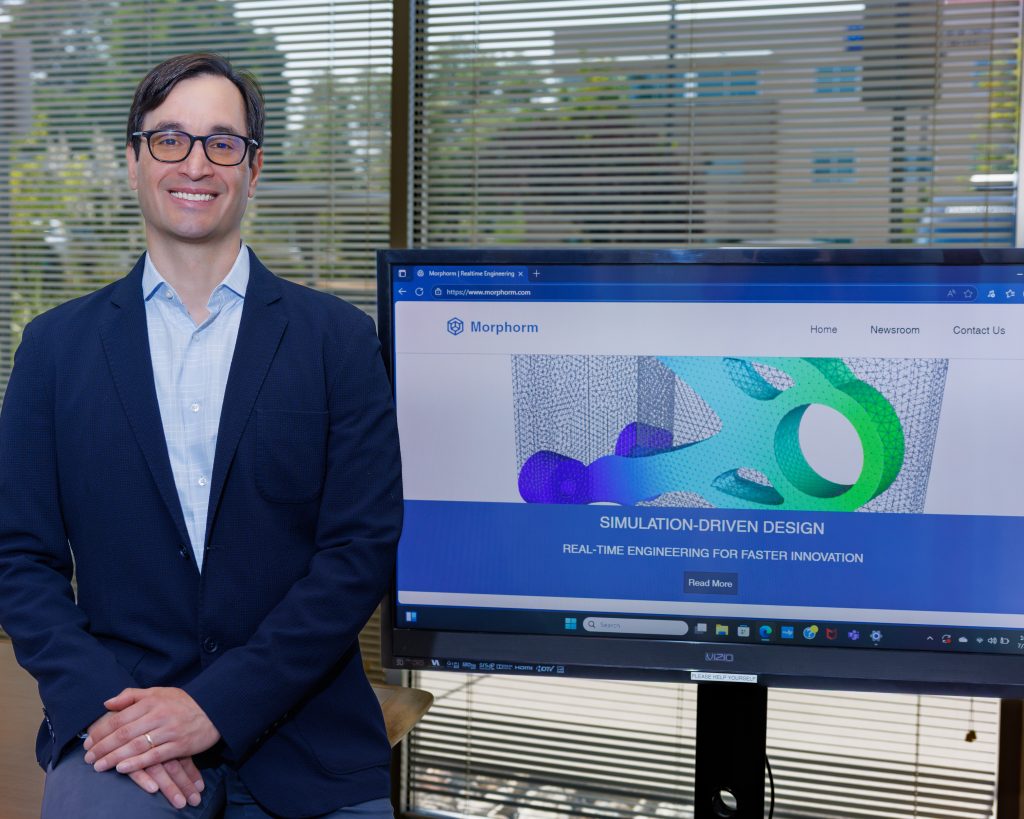
Morphorm is an engineering simulation and optimization company creating software based on Plato open-source software developed by Sandia National Laboratories. Although Plato is freely available, its complexity presents a significant learning curve.
Miguel Aguilo understood that few companies had an expert like himself or Plato co-developer and Sandia Researcher Josh Robbins on staff. Aguilo left Sandia to start Morphorm so he could be the bridge between the Labs and industry for design simulation software which is in demand for semiconductor, sustainable energy, and defense industry applications.
“The TRGR Project has been a pivotal step in transforming advanced lab-developed simulation tools into practical solutions for industry. We’re now able to deliver fast, 3D multiphysics capabilities that directly support innovation in semiconductors, solar energy, and defense.“
Miguel Aguilo
Founder and CEO
Morphorm LLC
Engineers in government and industry require simulation software to optimize critical design parameters for semiconductor materials used in computer chips, solar cells, and other applications. They need software that simulates and optimizes multiple engineering facets including thermal and mechanical.
A successful TRGR Project with Sandia has increased the software’s computational efficiency and enabled completion of a semiconductor simulation solver to characterize the physical behavior of solar cells or modules in three dimensions. In addition, a one-of-a-kind capability to simulate electrical, thermal, and mechanical behavior was added.
These new capabilities are being leveraged. Morphorm is now beginning to test the software under real-world conditions with the goal of advancing the TRL from 4 to 6. Data offered by a manufacturer of solar cells and modules is being used to validate the software. A follow-on project with a U.S. original equipment manufacturer in the defense industry is also being formalized that will build on the computational efficiency enhancements developed in the TRGR Project.