
Challenge
For years, researchers have been trying to develop a wearable diagnostic device that can measure biomarkers indicative of a person’s health status in real time. Microneedles that sample interstitial fluid from just under the skin are a minimally invasive way to accomplish that goal. Unlike larger needles used to draw blood samples, microneedles are only two to three times the diameter of a hair and about a millimeter long. This makes the sampling much more comfortable.
Interstitial fluid shares many similarities with blood so can be used to monitor health, but it hasn’t been studied as much. Sandia National Laboratories is at the forefront of microneedle research and technology, with research begun in 2011 by Ronen Polsky and his team leading to a patent in 2023. This interdisciplinary research, which has combined chemistry, engineering, and biology, is tied to Sandia’s national security mission and has the potential to be used to monitor military service members’ health. Companies are also working to develop health monitoring products for the general public that use microneedles and interstitial fluid.
“Understanding the composition of interstitial fluid is essential for developing next-generation, real-time biosensors. Sandia’s microneedle-based sampling technology provided high-quality interstitial fluid samples that accelerated our early-stage research and platform development.”
Alex Yoshikawa
Co-founder & CEO
Adaptyx Biosciences Inc
Collaboration
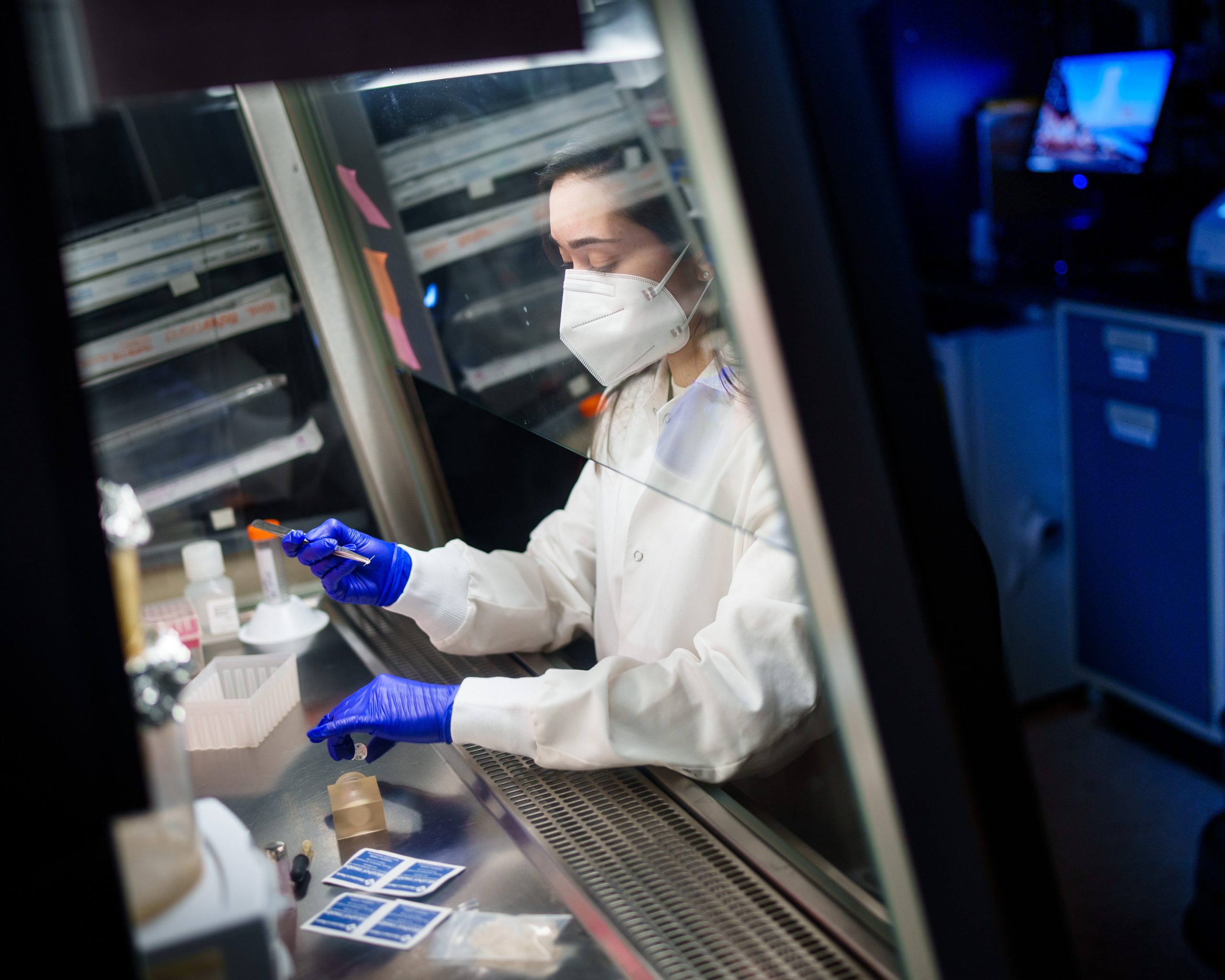
Studying interstitial fluid has been very challenging because extracting samples in the quantities needed to run analytical assays was time consuming and difficult. But then a new method was developed through a Sandia partnership with SRI, an independent nonprofit research institute. This reduced the one- to two-hour collection process down to about 10 minutes. The new technique allowed Sandia to provide industry partner Adaptyx Biosciences with interstitial fluid samples quickly collected from volunteers.
Adaptyx Biosciences has expertise in developing advanced wearable biosensing technology and collaborated with Sandia to accelerate early-stage studies by accessing interstitial fluid samples through Sandia’s microneedle-based collection methods. The collaboration enabled Adaptyx to work with leading scientists in the ISF field while supporting Sandia’s broader translational goals.
Solution
By teaming with Sandia, Adaptyx Biosciences obtained samples of interstitial fluid for foundational physiological studies that are helping the company’s scientists better understand the fluid’s components and inform the development of a real-time, multi-analyte biosensor platform.
Impact
Sandia continues to collaborate with industry and university partners to further this research. This moves the work out of the Labs and expands its use to the broader science community with the potential to benefit people worldwide.