
Challenge
Throughout each day the sun is moving across the sky, and as the seasons change, its path shifts. To maximize concentrating solar power (CSP) performance, heliostats need to track the sun so they are accurately focusing the light from their mirrors on a receiver. The collected energy heats a high temperature fluid, and this thermal energy can be used to generate electricity.
Current passive tracking methods use the calculated position of the sun, which can be limited in accuracy. The mechanical structure of the heliostats can also shift over time, compounding aiming errors. Heliostat operators have to tweak algorithms and manually adjust the heliostats’ azimuth and elevation to keep them focused. Utility scale developers are seeking efficiency gains and cost reductions to maximize return on investment (ROI) and improve the levelized cost of energy (LCOE). A better way to improve aiming accuracy is needed since the current inaccuracies mean CSP plants are not producing as much energy as they could be.
“Having access to the solar tower at Sandia, the only facility of its kind in the US, as well as to the Sandia staff with their expertise in solar energy, gives credibility to the heliostat active tracking technology we’re developing.”
Julius Yellowhair
Founder
Shándíín, LLC
Collaboration
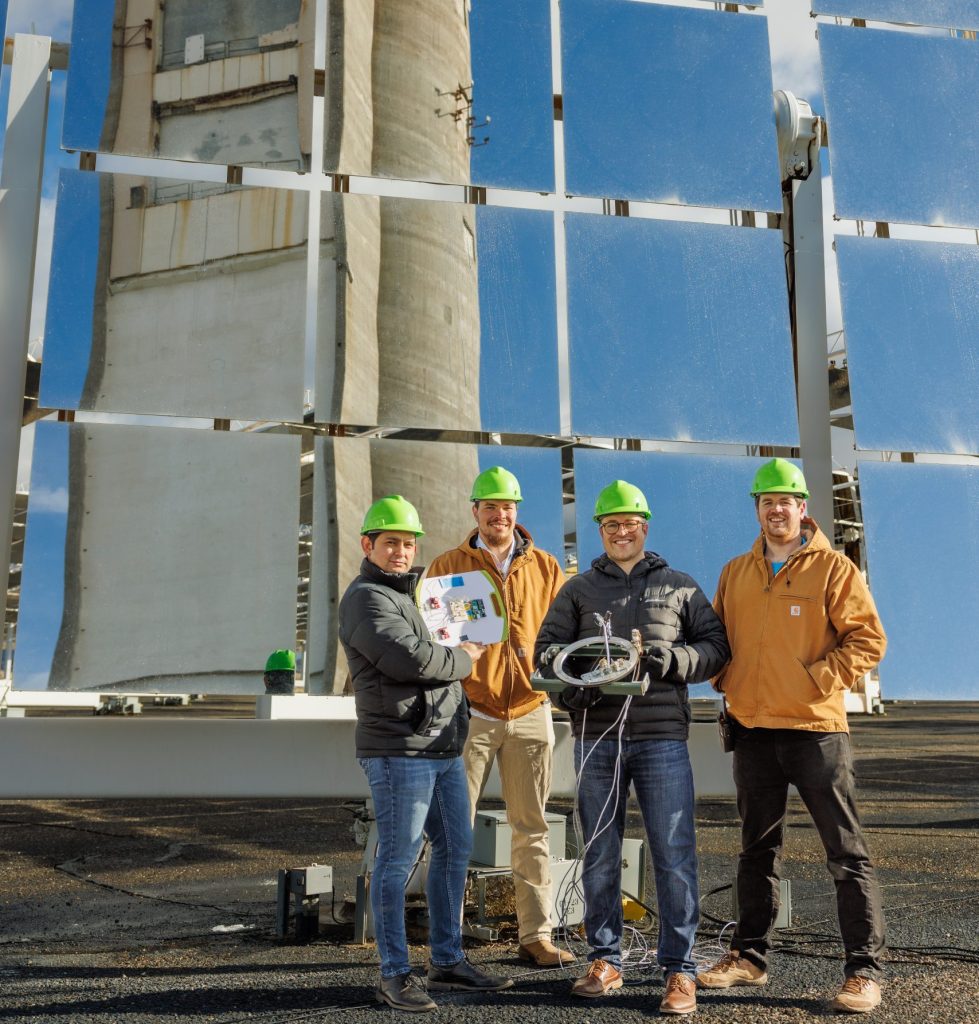
Sandia National Laboratories scientists worked with Julius Yellowhair of Shándíín, LLC and Jim Clair of Skysun, LLC to test a prototype for an active heliostat tracking system. Their concept was for a sensor system that would adjust heliostats throughout the day automatically to improve optical efficiency. They wanted to increase the technology readiness level by building and testing a prototype sensor, including optical and mechanical components, along with required software.
Shándíín brought optical engineering and analysis expertise that helped move Skysun’s concept to the prototype stage. With expertise in CSP and the National Solar Thermal Test Facility (NSTTF) as an ideal site for testing, Sandia developed software to work with the companies’ prototype tracking system. Two sets of field tests were run at the NSTTF with the sensor prototype.
Solution
The Heliostat Active Tracking System is an active autonomous heliostat tracking controller utilizing artificial vision and machine learning to provide constant and real-time heliostat aiming control. The technical advances that resulted from this CRADA and research are now in the patent process, with the two companies and Sandia as co-inventors. The companies are looking into commercializing a product based on the collaborative research.
Impact
Increasing optical and receiver efficiency through more accurate tracking will increase the amount of solar power generated by CSP plants.