
Challenge
Nuclear forensics uses analytical techniques to examine nuclear and other radioactive materials in order to investigate and improve nuclear security practices. Experts may use nuclear forensics methodologies to gain insight into the process history or origin of radioactive materials. Knowing the history of material samples collected or intercepted by inspectors can help in tracing the source of the material and inferring its intended use, such as if it was created for commercial or weapons applications.
But how do you fingerprint these materials to find the clues hidden in the microstructure caused by processing and storage conditions over time?
“Modeling radiation and aging effects in materials is challenging as the process occurs over long time and length scales. The collaboration between Georgia Tech and Sandia has enabled the development of a new methodology to study extended time radiation effects at the atomistic scale.”
– Chaitanya Deo
Professor
Georgia Institute of Technology
Collaboration
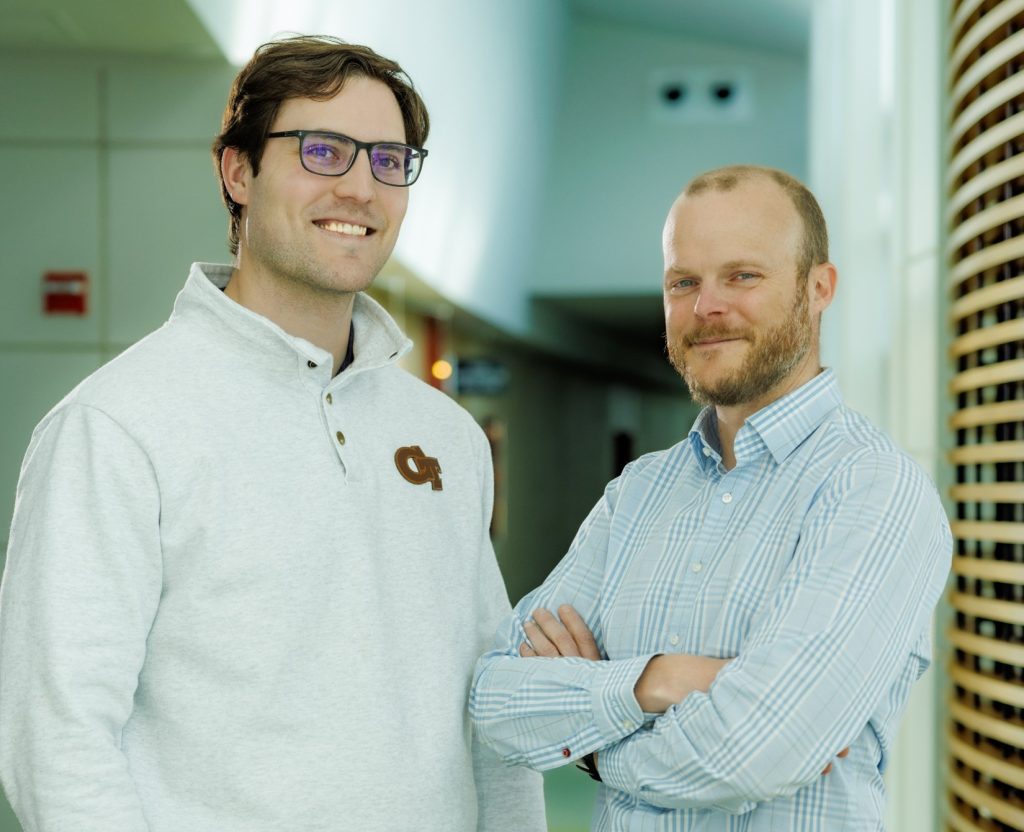
Sandia National Laboratories Researcher Remi Dingreville and Georgia Tech (GT) Professor Chaitanya Deo have a long track record of working together, ranging from co-advising students, some of whom later become postdocs and staff members at Sandia, to successful joint research, with 14 published peer-reviewed papers. The collaboration is possible because GT is an Alliance partner in Sandia’s University Partnerships Network, an initiative Sandia has formed with universities to promote collaborative research and attract top talent to work on tough problems.
Solution
In a joint research project funded by the Department of Homeland Security, Sandia and GT are developing a suite of computational tools augmented with experimental characterization and data science tools to predict forward and reverse relationships between material storage conditions and measurable microstructural characteristics. These will then be applied toward understanding the influence of environment and processing on actinide alloys that are of interest to nuclear forensics. The new methodology provides unique insight on atomistic features that may develop in materials subjected to prolonged energetic particle radiation.
As part of this project, two graduate student fellows and two undergraduate students will be trained in characterization and simulation methods and will spend significant time interacting with Sandia scientists. This will provide valuable research experience.
Impact
The goal of this research project is to improve nuclear forensics science by producing a new capability. This will also enhance national security, one of Sandia’s missions. Joint research with GT has already resulted in significant output in the form of method development, research publications, and graduate student theses in the fields of corrosion and radiation damage in nuclear materials. This project is leveraging the long-standing partnership with GT that provides training to up-and-coming scientists, including those from under-represented groups, and serves as a pipeline for promising students to become Sandians.