
Challenge
Current nuclear fuel uses a maximum of 5% enriched uranium. To better utilize uranium fuel and provide for smaller nuclear reactors, newer reactors are working with up to 20% enrichments, or U(20). However, there is very little documented experimental data available for the region between U(5) and U(20) to provide for the validation of computer models, so there is a need in the nuclear criticality safety (NCS) community to develop international benchmarks.
“We wouldn’t have been able to do the radiological characterization without Sandia personnel and expertise. Without this information the benchmark would be incomplete.”
Robert Busch
Emeritus Principal Lecturer, Chief Reactor Supervisor Department of Nuclear Engineering
University of New Mexico
Collaboration
Sandia National Laboratories and the University of New Mexico (UNM) are partners in the SAA Program, an initiative Sandia has formed with five universities to promote collaborative research and attract top talent to work on tough problems. A new CRADA is allowing the partners to team up on projects to bolster national security and advance science and engineering.
For the first project under the new CRADA, Sandia and UNM worked together to characterize U(20). UNM has an AGN-201 research reactor which uses this enriched fuel. Sandia had the necessary isotopic measurement capabilities and was able to deploy this expertise to UNM. The team included individuals from UNM and Sandia, as well as from BWX Technologies, Inc, Sandia Field Office (NNSA/DOE), Oak Ridge National Laboratory (ORNL), and the DOE Nuclear Criticality Safety Program.
Solution
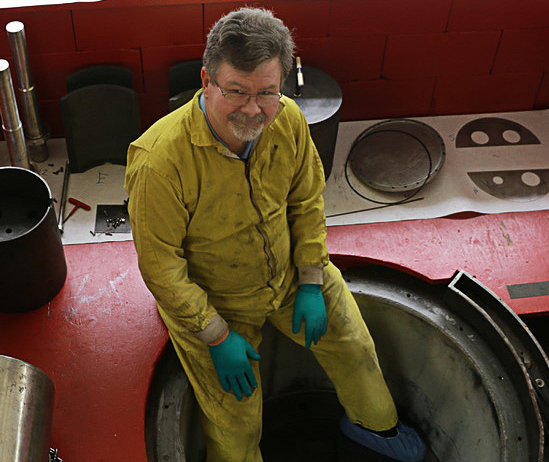
Physical measurements and radiological characterization of the U(20) fuel were done to provide information suitable for benchmarks and validation efforts with higher uranium enrichments. The work involved complete disassembly of the UNM nuclear reactor, radiation measurements of the removed nuclear fuel, and the reassembly of the reactor.
One benefit of the project was that Sandians were able to train UNM personnel on the instrumentation used to perform the measurements, and aid them in the acquisition of similar equipment for future projects.
Impact
Ultimately, results from the testing of UNM’s reactor will be used to support development of benchmarks for the Nuclear Energy Agency’s International Handbook of Evaluated Criticality Safety Benchmark Experiments, which is used to validate nuclear data. The project results will also support a recently funded feasibility study for use of spare AGN-201 fuel plates as an NCS training tool at ORNL.
Sandia’s NCS program was also able to use this as a professional training and development activity for newly qualified and in-training individuals. Another result was that Sandia donated surplus radiation measurement equipment to UNM for future research and training activities. Looking ahead, the umbrella CRADA will be used for future collaborations between Sandia and UNM to tackle issues important to national security.