
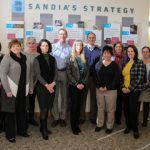
Does strategy matter?
Over the past three years, Sandia developed a strategic direction made up of seven priorities to guide the Labs for the next 20 years. Each priority has a team behind it, working to implement the strategy. The teams have brought these priorities to life and achieved significant accomplishments in each of the seven areas.
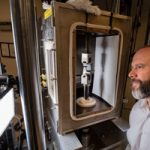
Engineering success through predicting failure
Around the world, materials scientists and engineers are trying different ways to predict fractures in ductile metals, but it’s not clear which approach is most accurate. To compare the different methods, Sandia researchers have presented three voluntary challenges to their colleagues: Given the same basic information about the shape, composition and loading of a metal part, could they predict how it would eventually fracture?
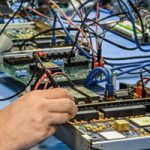
Armoring satellites to survive, operate through attacks
Researchers at Sandia launched a seven-year mission campaign this month to develop the science, technology and architecture needed for autonomous satellite protection systems. The campaign, called STARCS, will fund dozens of Laboratory Directed Research and Development projects.
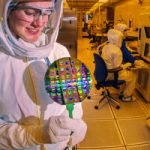
MESA fabs get an upgrade
Sandia has completed phase one of an anticipated three-year upgrade at its plant responsible for making integrated circuits, similar to computer chips. The facility is now fully compatible with industry-standard, 8-inch silicon wafers — thin, round starting materials used for making chips.
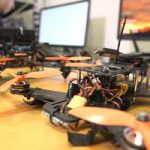
Autonomy New Mexico interns build drones to test hypersonic tech
Sandia is developing autonomy and artificial intelligence for flight systems soaring at more than 3,800 mph. The technologies to get there will initially be tested on drones that shuffle around at about 5 mph.

Hate to wait? Hruby Fellow looks to speed up climate research
Sandia has awarded Kelsey DiPietro a Jill Hruby Fellowship. The applied mathematician has proposed a way to make computer models more efficient — improving accuracy without increasing time or resources to run them.
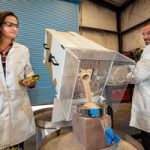
Containing a nuclear accident with ground-up materials
Sandia researchers are developing a promising new way to contain the hot molten mass that develops within a nuclear reactor during a catastrophic accident and prevent the spread of radioactive contamination.

Strategic Priority No. 5
Sandia's Strategic Priority No. 5 is seeking new pathfinder systems to address threats. The goal of this strategic priority is to think beyond Sandia’s traditional boundaries, taking advantage of the Labs' technical depth and breadth across multiple disciplines. Inventing and demonstrating these systems are important steps toward creating the future at Sandia.
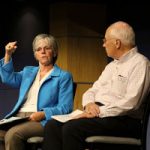
Younger: A Sputnik moment is coming
Laboratories Director Steve Younger and Chief Research Officer Susan Seestrom took the stage at the Steve Schiff Auditorium Aug. 26 to discuss “discovery science” and what it means for Sandia. The talk was the latest installment of the New Research Ideas Forum.
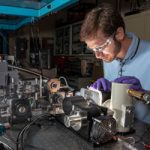
Seeing infrared
Sandia researchers have developed tiny, gold antennas to help cameras and sensors that “see” heat deliver clearer pictures of thermal infrared radiation for everything from stars and galaxies to people, buildings and items requiring security.