
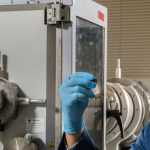
Large supercrystals promise superior sensors
Using an artful combination of nanotechnology and basic chemistry, Sandia researchers have encouraged gold nanoparticles to self-assemble into unusually large supercrystals that could significantly improve the detection sensitivity for chemicals such as explosives or drugs.

Sandia to celebrate 40 years of solar power research
In 1978, Sandia began a unique program of research on concentrating solar power at the newly constructed National Solar Thermal Test Facility. Forty years later, the facility is still the only one of its kind in the United States. Sandia will celebrate the solar tower’s 40th anniversary on July 31.

‘Never allow others to place their limits on you’
For 32 years, Sandia’s Black Leadership Committee has brought science, technology, engineering and math to more than 3,000 middle and high school students through the Hands-On, Minds-On Technologies program. And for materials scientist Olivia Underwood, volunteering with HMTech is one way to make a difference in the community.

Computer science educator garners 2018 Sandia Excellence in Teaching Award
Miguel Baez, Granada High School computer science teacher, has earned the 2018 Sandia National Laboratories Excellence in Teaching Award for his innovative teaching methods and devotion to his students.
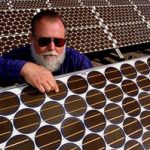
The amazing growth of renewable energy from solar cells: A lesson for how we fund research?
Since 2004, the rate at which solar cell power is installed has doubled every 22 months and is now in excess of 0.1 terawatts per year. Research driving some of this expansion began right here at Sandia more than 40 years ago.
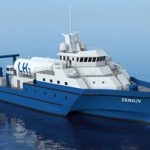
Diesel doesn’t float this boat
Marine research could soon be possible without the risk of polluting either the air or the ocean, thanks to a new hydrogen fuel cell ship design and feasibility study led by Sandia. Hydrogen fuel cells have existed for decades, but the feasibility of a hydrogen-powered research vessel has never been studied or proven. Until now.
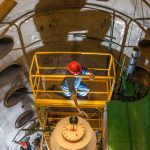
Dry casks take the heat
Sandia researchers have built a scaled test assembly that mimics a dry cask storage container for spent nuclear fuel to study how fuel temperatures change during storage and how the fuel’s peak temperatures affect the integrity of the metal cladding surrounding the spent fuel.
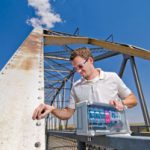
Smarter, safer bridges with Sandia sensors
Sandia and UK-based Structural Monitoring Systems PLC have been working together for 15 years to create transportation systems that can send a signal when they're damaged. They've outfitted a U.S. bridge with a network of sensors that will alert maintenance engineers when they detect a crack large enough to require repair.
Sandia computational researcher wins DOE Early Career Research Program award
Sandia researcher Eric C. Cyr has received a 2018 Early Career Research Program award of $500,000 every year for five years to improve deep neural networks so they more efficiently combine experimental results with the most complex computer models.
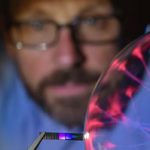
Generating electrical power from waste heat
Directly converting electrical power to heat is easy, but the opposite, converting heat into electrical power, hasn't been so easy — until now. Sandia researchers have developed a tiny silicon-based device that can harness what was previously called waste heat and turn it into DC power.