

Labs director updates New Mexico state legislators on Sandia successes, future
Sandia Labs Director Steve Younger addressed the New Mexico State Legislature’s interim Science, Technology and Telecommunications Committee last month, highlighting the Labs’ accomplishments and commitment to the state.

Exceptional service in the national interest
Two dates are well known to Sandians: the day President Harry Truman wrote a letter calling for “exceptional service in the national interest” and the day Sandia (previously Z Division) separated from its parent, Los Alamos National Laboratory, and became the entity we know it as today.
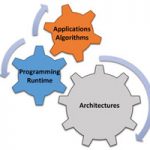
AI center to combine hardware, software for practical gains
Sandia and Pacific Northwest national laboratories and the Georgia Institute of Technology in Atlanta are launching a research center that combines hardware and software design and development to improve artificial intelligence technologies that will ultimately benefit the public.
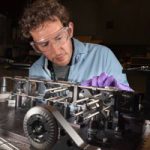
Advanced microscopy reveals unusual DNA structure
An advanced imaging technique reveals new structural details of S-DNA, ladder-like DNA that forms when the molecule experiences extreme tension. This work conducted at Sandia and Vrije University in the Netherlands provides the first experimental evidence that S-DNA contains highly tilted base pairs.
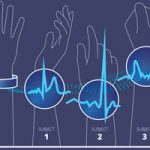
Security in a heartbeat
Sandia is collaborating with a New Mexico small business to test and develop a biometric security system based on the human heartbeat. Sandia signed an agreement with Albuquerque-based Aquila Inc. to develop and test a wearable prototype that can stream in real time an identifying signature based on the electrical activity of a person’s heart.
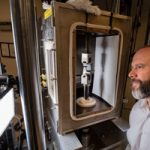
Engineering success through predicting failure
Around the world, materials scientists and engineers are trying different ways to predict fractures in ductile metals, but it’s not clear which approach is most accurate. To compare the different methods, Sandia researchers have presented three voluntary challenges to their colleagues: Given the same basic information about the shape, composition and loading of a metal part, could they predict how it would eventually fracture?
Lowering the bar for hydrogen-powered technology
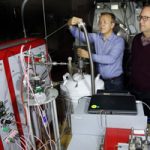
The Hydrogen Materials Advanced Research Consortium, or HyMARC, a multilab collaboration co-led by Sandia, is developing two types of hydrogen storage materials to meet challenging energy density targets set forth by DOE. The newly expanded collaboration is using the most promising strategies to optimize the materials for future use in vehicles.
Sandia debuts small-business partnership program
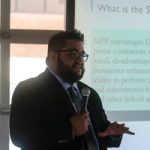
Sandia launched a mentor-protégé program on Oct. 1 to assist small-business development and enhance a company’s ability to build a solid foundation to compete for larger and more federal and industry opportunities. Sandia’s mentor-protégé program was unveiled during a small-business forum at the UNM Lobo Rainforest. More than 50 small-business representatives attended.
Autonomy New Mexico interns build drones to test hypersonic tech
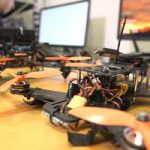
Sandia is developing autonomy and artificial intelligence for flight systems soaring at more than 3,800 mph. The technologies to get there will initially be tested on drones that shuffle around at about 5 mph.
Wrangling big data into real-time, actionable intelligence
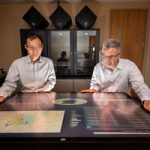
Social media, cameras, sensors and more generate huge amounts of data that can overwhelm analysts sifting through it all for meaningful, actionable information to provide to decision-makers. Sandia researchers are working to lessen that burden by developing the science to gather insights from data in nearly real time.