
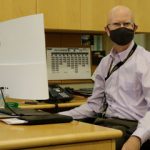
A year of change
Lab News sat down for a conversation with Associate Labs Director Andy McIlroy, head of the Integrated Security Solutions Division, as he starts his second year in that role following a year permanently marked by a new reality for Sandia and the nation.

Rose Gottemoeller: The importance of science diplomacy
Rose Gottemoeller spoke to Sandians in a video conference on July 28 in honor of the 25th anniversary of the Labs’ Cooperative Monitoring Center. The talk was part of Sandia’s National Security Speakers Series.
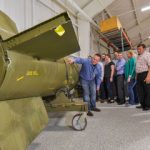
Weapon Intern Program graduates 25th class
Sandia’s Weapon Intern Program has graduated 25 classes in 22 years. The program was created in 1998 to accelerate the learning process and transfer decades of knowledge and experience in all phases of the nuclear weapon lifecycle, from experienced weaponeers to the new generation of stockpile stewards.
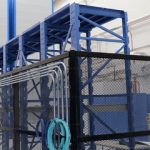
Expanding testing capacity for Sandia weapons modernization programs
The Sandia Programs Engineering and Assembly Research facility, or SPEAR, is the newest facility in nuclear weapons systems engineering at Sandia’s California site, expanding the Labs’ capacity to assemble and electrically test nuclear weapons components and systems.
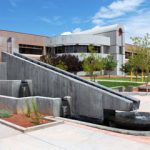
Building Sandia: Home of the MESA Complex
Part three in the Building Sandia architecture series explores the Microsystems and Engineering Sciences Applications Complex, or MESA, which is set apart aesthetically and functionally from other buildings and sites at the Labs.
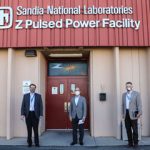
DOE Under Secretary visits Sandia
The Honorable Mark Wesley Menezes, DOE under secretary of energy, visited Sandia’s Albuquerque campus on July 8 to tour facilities and attend briefings showcasing the Labs’ energy program and other national security contributions. He was accompanied
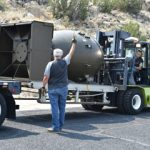
Fat Man sent to Nevada atomic museum
Sandia, DoD and DTRA have moved a Manhattan Project Fat Man weapon shell from 1945 from the Labs' Manzano Mountain storage area to the National Atomic Testing Museum in Las Vegas, Nevada. The weapon is part of an exhibit marking the 75th anniversary of the Trinity nuclear test.
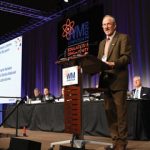
Frank Hansen earns lifetime achievement award
The Wendell D. Weart Lifetime Achievement Award was presented to retired Sandian Frank Hansen at a ceremony in Phoenix on March 10. The award was created by Sandia and Waste Management Symposia Inc. in 2001, in honor of Wendall Weart, who retired from Sandia in 2000, to recognize the recipient’s long-term commitment to solving major nuclear waste challenges.
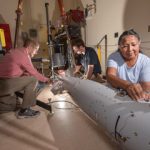
Weapon program meets safety, design requirements
Sandia has successfully completed another milestone in the B61-12 gravity bomb refurbishment program, demonstrating that the Labs is meeting important nuclear safety and use-control requirements. Sandia is the design and engineering lab for non-nuclear components of the U.S. nuclear stockpile, including the B61-12, and is the technical integrator for the complete weapon, assuring that the system meets requirements as a unit.
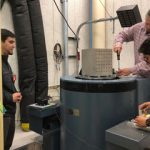
NM Capstone Challenge
Three university teams from New Mexico experienced firsthand what it might be like to tackle a national security project at Sandia through the NM Capstone Challenge. The teams had six months to develop an integrated sensing device capable of monitoring multiple environmental conditions during ground transportation of an asset or payload.