
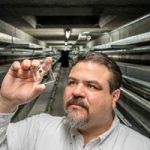
Portable gas detection shrinks to new dimensions
A sensor for detecting toxic gases is now smaller, faster and more reliable, thanks to researchers at Sandia. The sensor’s performance sets it up for integration into a highly sensitive, portable system for detecting chemical weapons. The sensors can also rapidly detect airborne toxins.

Family Day at Sandia
Family Day has been a part of Sandia culture since 1959, when 15,000 participants in New Mexico, 3,100 at the California laboratory and 300 from the Salton Sea Test Site came to Sandia sites to see where people performed important work for the nation.
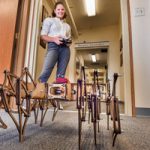
Students compete for best 3D-printed design during Sandia robotics camp
Sandia and R4 Creating hosted the second annual week-long robotics camp in May at the Robotics Vehicle Range. Local students competed in teams to create and print original 3D designs.

Kyle Fuerschbach earns 2019 Kevin P. Thompson Optical Design Innovator Award
Sandia engineer Kyle Fuerschbach has been named the 2019 Kevin P. Thompson Optical Design Innovator Award recipient by the Optical Society. The award recognizes significant early-career contributions to lens design, optical engineering or metrology.
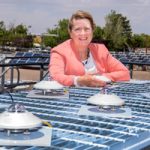
Global collaboration to study photovoltaic performance, reliability
An international community of research institutions, led by Sandia, to advance photovoltaic research and expand solar markets formally launched its work on May 14 in Munich, Germany. The organization provides a unique platform for studying photovoltaic performance and reliability in multiple, diverse environments and climates.
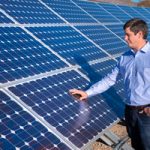
Rooftop solar panels get boost from Sandia tool
Homeowners and businesses may now have an easier time getting solar panels on rooftops thanks to software developed at Sandia. The new software can run a detailed, second-by-second simulation that shows utility companies how rooftop solar panels at a specific house or business would interact with a local electrical grid throughout the year.
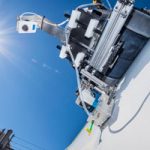
Don’t set it and forget it — scan it and fix it with tech that detects wind blade damage
Drones and crawling robots outfitted with special scanning technology could help wind blades stay in service longer, which may help lower the cost of wind energy at a time when blades are getting bigger, pricier and harder to transport, Sandia researchers say.

Pilot program prepares future leaders
Thirty Sandia employees, working in departments ranging from engineering to security, recently finished a deep dive into leadership skills through the Future Leaders Pathway program. The seven-month pilot program provided an opportunity to build partnerships, identify personal strengths, and reflect about career goals and personal motivations.
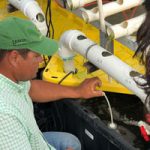
Workshop strengthens Caribbean resilience
Sandia and DOE hosted the Advancing Caribbean Energy Resilience workshop at the Universidad Ana G. Mendez’s Gurabo campus in Puerto Rico, where researchers, engineers, policy makers and utility representatives met to discuss how to enhance and improve energy resilience throughout the Caribbean.
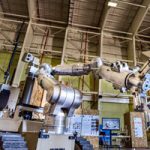
New robots, new tricks
Bomb squad teams from coast to coast challenged their emergency preparedness skills during Sandia’s five-day Robot Rodeo and Capability Exercise last month. Twelve scenarios involving vehicles, simulated terrorist events and timed obstacles were set up from May 13-17 around Sandia and Kirtland Air Force Base for the military and civilian teams.