

Pilot program prepares future leaders
Thirty Sandia employees, working in departments ranging from engineering to security, recently finished a deep dive into leadership skills through the Future Leaders Pathway program. The seven-month pilot program provided an opportunity to build partnerships, identify personal strengths, and reflect about career goals and personal motivations.

Employees become entrepreneurs at inaugural Idea Sprint
Sandia hosted its first Idea Sprint at the Lobo Rainforest, where a couple dozen Sandia employees dove head first into entrepreneurial training. UNM’s Innovation Academy provided instructors for the two-day program that focused on product design, customer needs and communication.

UNM collaboration bolsters national security, science
Sandia and the University of New Mexico are joining forces to bolster national security and advance science and engineering under an agreement signed earlier this month. The umbrella Cooperative Research and Development Agreement allows the Labs and university to explore research collaborations among scientists, faculty and students in several areas, including ongoing projects.
Breakthroughs in neuromorphic computing demonstrate high efficiency, performance
Sandia researchers and collaborators at Stanford University and the University of Massachusetts, Amherst, recently have made breakthroughs in neuromorphic computing, which mimics the way the human brain carries out data-centric tasks.

Sandia, NMSU ink research deal
Sandia signed an MOU with New Mexico State University on April 10 that outlines how the institutions intend to collaborate for the next decade. The agreement seeks to foster research in areas of national security, including water, energy and critical infrastructure.

Sandia lends expertise to hydrogen center
Sandia is building on longstanding partnerships to help found a new global center focused on safety and best practices for the use of hydrogen in the global energy transition. The American Institute of Chemical Engineers, in partnership with Pacific Northwest National Laboratory, recently launched the Center for Hydrogen Safety.
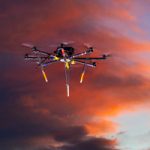
Future hypersonics could be artificially intelligent
A test launch for a hypersonic weapon — a long-range missile that flies a mile per second and faster — takes weeks of planning, and it's uncertain how useful test systems will be against urgent, mobile or evolving threats. But Sandia's hypersonics developers think artificial intelligence and autonomy could slash these weeks to minutes for deployed systems.
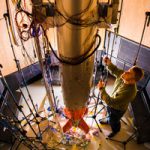
B61-12 team reaches milestones in nuclear deterrence mission
Sandia’s B61-12 nuclear weapons team has accomplished several milestones, including the gravity bomb’s final design review and the first production completion of several components for the life extension program. Sandia and LANL presented the B61-12 design for final review to an independent peer-review panel of 12 military and civilian experts last fall.
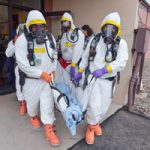
Annual Sandia simulation strengthens emergency response
Scores of Labs employees in Albuquerque, joined by outside emergency response personnel, were immersed in a simulated crisis April 17 as part of the annual emergency management full-scale exercise.
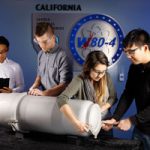
W80-4 Life Extension Program achieves major milestone
The W80-4 Life Extension Program achieved a major milestone last month when the joint DOE and Department of Defense Nuclear Weapons Council approved the program to enter Phase 6.3, development engineering. The approval follows multiple briefings by the W80-4 leadership team to program stakeholders at NNSA headquarters and the Pentagon.