
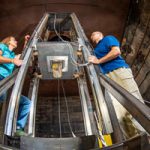
Sandia abuses batteries for better energy storage
Lithium-ion batteries are most commonly found in electric cars, computers, medical equipment and aircraft. And they are getting more powerful all the time. The constant push for more storage and power drives the need for extensive battery testing, and Sandia's new drop tower has created yet another way to learn more about how these batteries respond to stress.
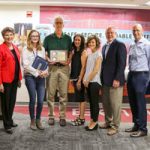
Three Sandia teams win NA-50 Awards of Excellence
Jim McConnell, associate administrator for NNSA’s Office of Safety, Infrastructure and Operations, presented three Sandia project teams with NA-50 Awards of Excellence during a July ceremony at Sandia’s Albuquerque campus.
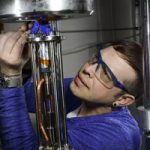
Hydrogen materials service advanced by new multilab consortium
Researchers at Sandia and Pacific Northwest national laboratories are leading a collaborative effort to investigate how hydrogen affects materials such as plastics, rubber, steel and aluminum. The Hydrogen Materials Compatibility Consortium, or H-Mat, will focus on how hydrogen affects polymers and metals used in diverse sectors, including fuel cell transportation and hydrogen infrastructure.
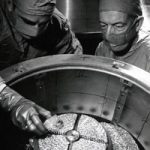
Man on the moon
On July 20, 1969, nearly 650 million people watched as Neil Armstrong took “...one small step for a man, one giant leap for mankind,” when the Apollo 11 mission landed the first man on the moon. This year marks the 50th anniversary of that mission, and Sandia was part of the team.
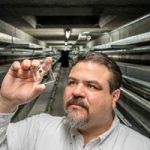
Portable gas detection shrinks to new dimensions
A sensor for detecting toxic gases is now smaller, faster and more reliable, thanks to researchers at Sandia. The sensor’s performance sets it up for integration into a highly sensitive, portable system for detecting chemical weapons. The sensors can also rapidly detect airborne toxins.
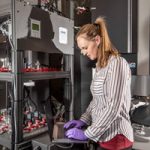
Thwarting oil-pipeline corrosion by identifying nanoscale villains
Researchers at Sandia, the DOE Center for Integrated Nanotechnologies and the Aramco Research Center in Boston have found that a particular form of nanoscale corrosion can cause variations in material longevity that unpredictably decrease the working life of steel pipes.
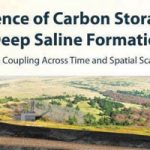
Sandia author examines carbon storage in deep saline formations
A new book co-authored and co-edited by Sandia experimental geochemist Anastasia Ilgen provides a comprehensive look at carbon storage in deep saline formations. The volume, published by Elsevier, is entitled Science of carbon storage in deep saline formations: Process coupling across time and spatial scales.
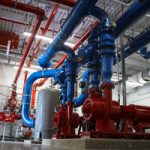
Building health through better buildings
Sandia is the first corporate campus to receive the new Building Health Leadership Award, which recognizes its Leadership in Energy and Environmental Design v.4 Campus effort. Sandia is the largest DOE site named a LEED v.4 Campus.
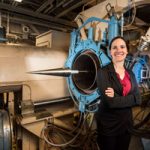
High-speed experiments improve hypersonic flight predictions
When traveling at five times the speed of sound or faster, the tiniest bit of turbulence is more than a bump in the road, said Katya Casper, the Sandia aerospace engineer who, for the first time, characterized the vibrational effect of the pressure field beneath one of these tiny hypersonic turbulent spots.
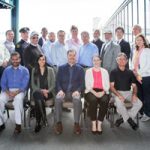
Sandia lends expertise to hydrogen center
Sandia is building on longstanding partnerships to help found a new global center focused on safety and best practices for the use of hydrogen in the global energy transition. The American Institute of Chemical Engineers, in partnership with Pacific Northwest National Laboratory, recently launched the Center for Hydrogen Safety.