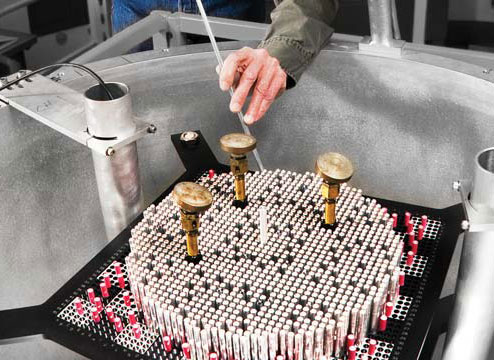
Page • The Mode Stirred chamber is essentially a large microwave oven. It consists of a metal room that serves as a high-Q chamber and a metal paddle wheel to "stir" the chamber modes. Mixing the modes in this manner allows test objects, in a single orientation to be exposed to EM...
Search
Multi-Robot Cooperative Behavior
Page • Challenge Operators often face complex tasks and missions, such as picking up a large heavy item, or taking an X-ray of a vehicle that would be complicated for one robotic system to complete independently. Having multiple robotic systems capable of working together under the control of one operator, can simplify...
Nanodevices and Microsystems
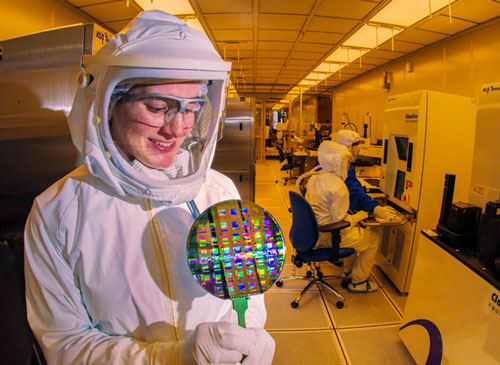
Page • Smelling incipient seizures with sensors Cofounding a new microelectronics research center Testing new technology and research on orbit Precisely controlling materials, devices and information is critical to enabling science, technology, and industry. At Sandia, we are enabling new and increasingly powerful capabilities for critical national systems through our research increasing...
National Solar Thermal Test Facility (NSTTF)
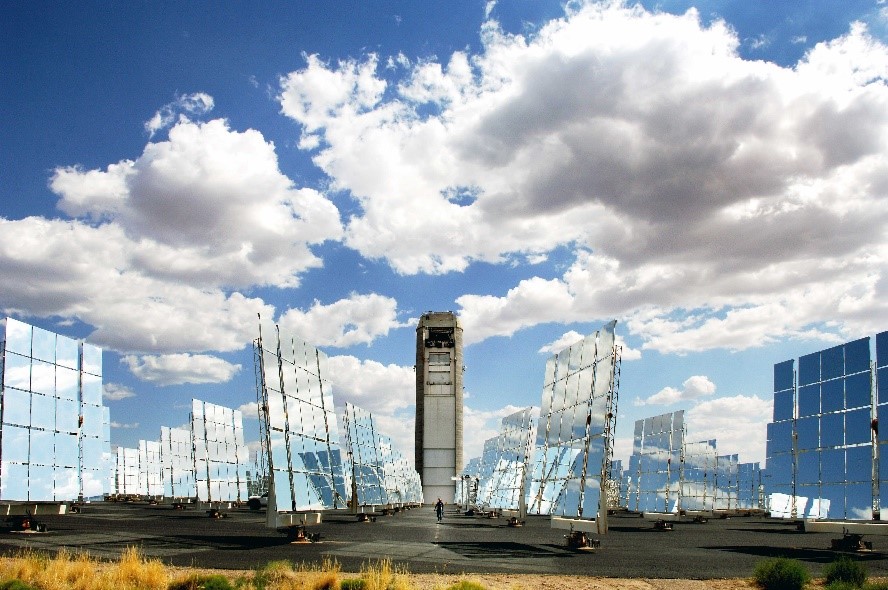
Facility • Operated by Sandia for the U.S. Department of Energy (DOE), the National Solar Thermal Test Facility (NSTTF) is the only large-scale concentrating solar power (CSP) and solar thermal test facility in the United States.
Neural Control of Prosthetics
Page • Researchers in High Consequence, Automation, & Robotics are working on ways to improve amputees’ control over prosthetics with direct help from their own nervous systems. Neural interfaces operate where the nervous system and an artificial device intersect. Interfaces can monitor nerve signals or provide inputs that let amputees control prosthetic devices...
Neuromorphic computing for nuclear deterrence solutions: Sandia partners with German startup SpiNNcloud
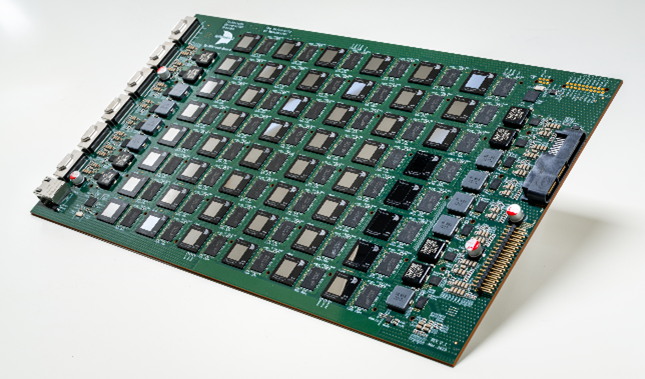
News Article, May 8, 2024 • New server board integrating 48 SpiNNaker2 chips through a seamless energy-proportional infrastructure.(Image courtesy of SpiNNcloud) Sandia National Laboratories has announced a partnership with AI and neuromorphic computing company, SpiNNcloud. Leveraging a next generation system, SpiNNaker2, this partnership seeks to advance neuromorphic architecture. Funded through NNSA’s Advanced Simulation and Computing (ASC) program,...
Neuromorphic computing for nuclear deterrence solutions: Sandia partners with German startup SpiNNcloud
Post, May 8, 2024 • New server board integrating 48 SpiNNaker2 chips through a seamless energy-proportional infrastructure.(Image courtesy of SpiNNcloud) Sandia National Laboratories has announced a partnership with AI and neuromorphic computing company, SpiNNcloud. Leveraging a next generation system, SpiNNaker2, this partnership seeks to advance neuromorphic architecture. Funded through NNSA’s Advanced Simulation and Computing (ASC)...
Neuromorphic computing widely applicable, Sandia researchers show
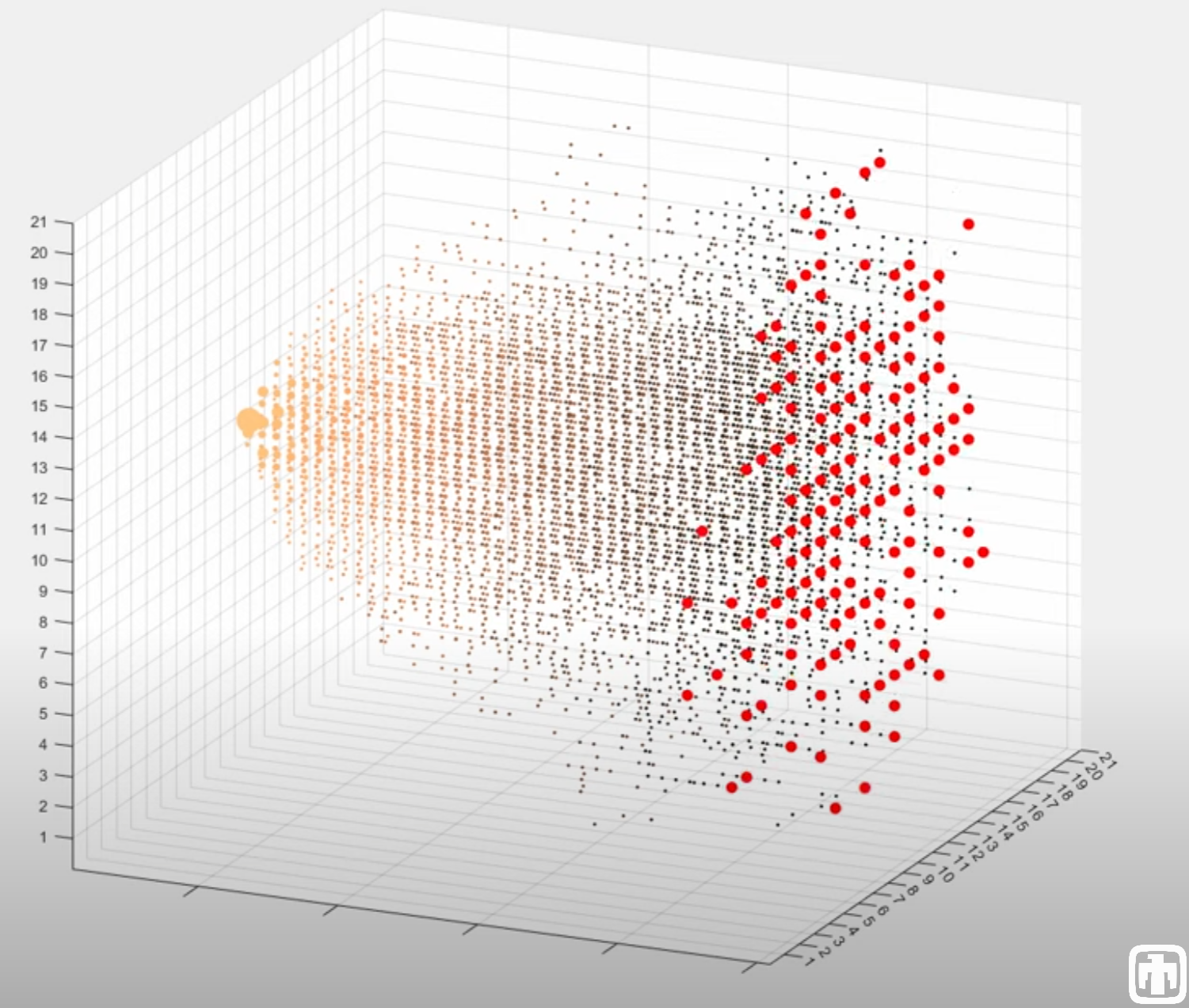
News Article, April 10, 2024 • With the insertion of a little math, Sandia researchers have shown that neuromorphic computers, which synthetically imitate the brain’s logic, can solve more complex problems than those posed by artificial intelligence and may even earn a place in high-performance computing. Read more about Neuromorphic computing
New 2.5D neuromorphic discovery platform will enable AI-enhanced co-design
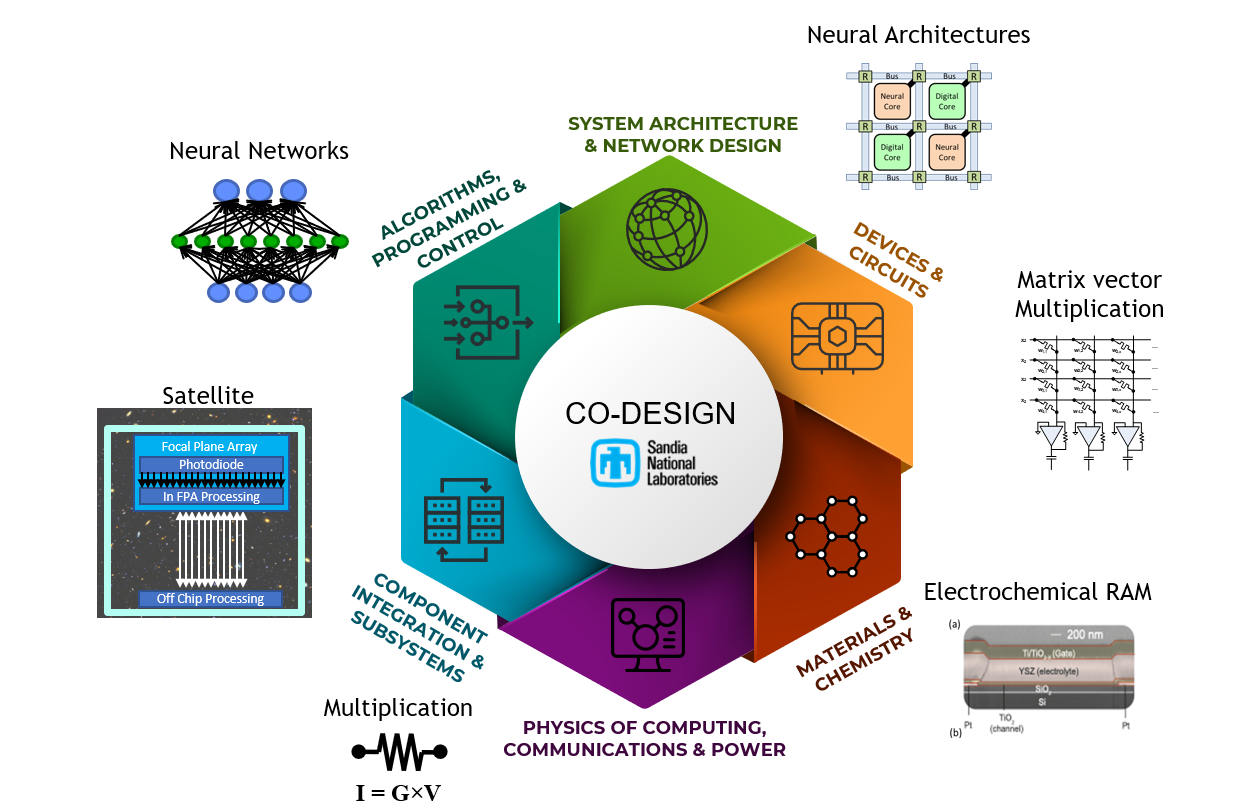
News Article, June 7, 2023 • AI-enhanced co-design will be enabled through Sandia’s 2.5D neuromorphic discovery platform. Novel material and device concepts previously took years for iteration. Discoveries in this LDRD project will now allow them to be iterated on in weeks thanks to a new easy fabrication substrate platform for novel devices. The team designed...
New Mexico Artificial Intelligence Consortium (NMAIC)
Page • New Mexico AI Consortium Groundbreaking collaboration propelling NM to forefront of AI What is the New Mexico AI Consortium? The New Mexico Artificial Intelligence Consortium (NMAIC) is a groundbreaking collaboration between the state's leading national laboratories, universities, and colleges. Its mission is to propel New Mexico to the forefront of...
New technology for heterogeneously integrated devices allows for underfilling of complex geometries using driven fluids
News Article, June 7, 2023 • Underfilling is a widely used manufacturing process that helps stabilize and reinforce solder joints in electronic parts. However, heterogeneously integrated (HI) devices are challenging to underfill using standard capillary flow methods, due to large areas with narrow gaps—trenches that act as strong flow barriers, and high bump density that cause...
Nuclear Energy Systems Laboratory (NESL)/Brayton Lab
Facility • NESL focuses on creating a thermal-to-electric power conversion technology in a configuration called the recompression closed Brayton cycle that uses supercritical carbon dioxide as the working fluid.
Nuclear Energy Work Complex (NEWC): Cyclindrical Boiling Facility (CYBL) and SURTSEY
Facility • NEWC focuses on performing high-quality and real-world testing of nuclear power components, including prototypic spent fuel assemblies and storage systems.
Nuclear Facilities Resource Center (NUFAC)
Facility • NUFAC provides designing, operating, and experimentation with nuclear reactors.
One-Control Many
Page • As unmanned systems (UMS) are increasingly used in the battlefield, advantages provided by strategy, tactics, and training must be translated into UMS control systems. It’s a challenge to effectively control large numbers of UMS. The human operator must focus on high-level perception, tactics, and strategy while the system automates lower-level...
Optimizing machine learning decisions with prediction uncertainty
News Article, May 9, 2023 • Digital background depicting innovative technologies in (AI) artificial systems, neural interfaces and internet machine learning technologies While ML classifiers are widespread, output is often not part of a follow-on decision-making process because of lack of uncertainty quantification. Through this project, the team developed decision analysis methods that combined uncertainty estimates...
Other Facilities and Capabilities
Page • Other Facilities and Capabilities High Voltage Breakdown TestingWe can perform high voltage standoff testing with DC and pulsed voltages. DC testing can be conducted up to 200 kV. Pulsed voltage from 140 – 400 kV can be attained, with a typical lightning waveform – unipolar, 1.2 microsecond risetime and 50...
Out of the desert, a quantum powerhouse rises
News Article, April 23, 2024 • They knew it was an ambitious goal. But by the time they announced it in 2022, Sandia and The University of New Mexico — two of the state’s largest research institutions — had been working out their strategy for more than a year. Read more about quantum powerhouse
Partnership Mechanisms
Page • We routinely partner with other organizations to help transition our scientific discoveries and technologies to the marketplace. We also form collaborative research partnerships with industry, universities, and government agencies so that collectively, we can change the world for the better. Licensing We offer a variety of licenses covering the breadth...
Partnership Opportunities
Page • Sandia placed a high value on its interactions with other federal agencies, universities, and private industry. Several contract vehicles exist to partner with Sandia to purchase services, transfer technology through Cooperative Research and Development Agreements or to license Sandia-developed technology. Our staff will work with you to develop the appropriate...
People
Page • Sandia excels in innovative fundamental materials science research – developing and integrating the theoretical insights, computational simulation tools and deliberate experiments that provide foundational, predictive understanding of the performance of Sandia’s current and future mission-critical materials in order to provide the solid technical basis for Sandia’s engineering decisions and enabling...
Perception & Decision Tools
Page • High Consequence, Automation, & Robotics (HCAR) specializes in the development of advanced perception technologies and decision tools that enable robotic and unmanned systems to perform more complex and autonomous tasks, such as simultaneous localization and mapping of a building. Our perception capabilities include 3-D geometric modeling and texture mapping, 3-D...
Photovoltaic System Evaluation Laboratory (PSEL)
Facility • Sandia’s Photovoltaic Systems Evaluation Laboratory (PSEL) enables performance characterization of photovoltaic (PV) cells, modules, and systems. PSEL research is conducted on behalf of the Department of Energy (DOE) and other government sponsors, in direct collaboration with industry and academic partners.
Physical Science
Page • Recycling products from the inside out Detecting battery failures quicker Studying subterranean storage of hydrogen Sandia’s research in physical science creates innovative, science-based, solutions to our nation’s most challenging problems. Our work for the DOE’s Office of Basic Energy Sciences (BES) includes materials science and engineering, chemical sciences, geosciences, and...
Plasma Research Facility (PRF)
Facility • The PRF offers collaborators access to cutting edge diagnostic and computational capabilities and the expertise that is needed to set up and execute experiments and analyze data generated during the collaborative endeavor.
Results 151–175 of 267