

Three Sandia Labs researchers earn national honors in leadership and technology
Three Sandia researchers were honored for their leadership and technical achievements at the 2019 Black Engineer of the Year STEM Global Competitiveness Conference. Warren Davis, Quincy Johnson and Olivia Underwood received their awards during the conference in Washington, D.C. The annual meeting recognizes black scientists and engineers and is a program of the national Career Communications Group, which advocates for corporate diversity.
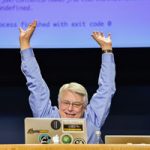
‘Agile Manifesto’ co-author launches clean code training at Sandia
Well-known software developer, author and instructor Robert C. Martin says “clean code” is software code that is simple, easy to read and understand, and easy to change. Martin gave nine talks over two days to launch a series of newly available Clean Code training videos for employees.
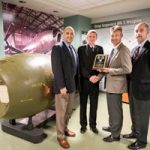
Vice Admiral Johnny Wolfe visits Sandia
Vice Admiral Johnny Wolfe, director of Strategic Systems Programs for the Navy, visited Sandia last week and formally recognized Sandia and its staff for their key role in the development and production of the W76-1/Mk4A Life Extension Program.
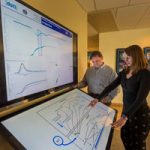
Modeling terrorist behavior with Sandia social-cultural assessments
A team of Sandia social-behavioral scientists and computational modelers recently completed a two-year effort, dubbed “Mustang,” to assess interactions and behaviors of two extremist groups. The purpose of their study was to inform U.S. and U.K. decision-makers about the groups' possible reactions to specific communications.
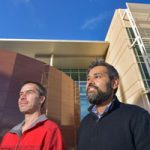
Quantum computing steps further ahead with new Labs projects
Quantum computing is a term that periodically flashes across the media sky like heat lightning in the desert: brilliant, attention-getting and then vanishing from the public’s mind with no apparent aftereffects. Yet a multimillion-dollar international effort to build quantum computers is hardly going away. Now, three new Sandia projects (and a fourth a year underway) aim to bring the wiggly subject into steady illumination.
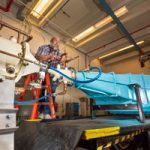
‘Friendly’ EMP improves survival for electronics
An EMP emitted by a nuclear weapon exploded high above the U.S. could disable the electronic circuits of many devices vital to military defense and modern living. Fortunately, military equipment is designed to be immune to various levels of EMP, and the validity of those designs has been tested and improved by a “friendly” EMP generator at Sandia.
Larry Luna elected American Society of Mechanical Engineers fellow
Sandia engineer Larry Luna has been elected a fellow of the American Society of Mechanical Engineers for significant achievements during more than 30 years of service and leadership. ASME fellows constitute about 3.5 percent of the organization’s more than 95,000 members. Larry was specifically recognized “for his contributions to the national security of the United States,” according to ASME.
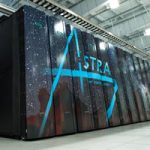
Astra supercomputer at Sandia Labs is fastest Arm-based machine on TOP500 list
Sandia’s Astra is the world’s fastest Arm-based supercomputer according to the just released TOP500 list, the supercomputer industry’s standard. With a speed of 1.529 petaflops, Astra placed 203rd on a ranking of top computers announced at SC18, the International Conference for High Performance Computing, Networking, Storage, and Analysis, in Dallas.
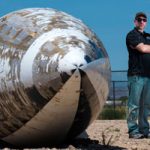
Responders provide technical expertise in case of nuclear weapons accidents
The Accident Response Group provides technical expertise in assessing and safely resolving nuclear weapons accidents or "broken arrows." ARG brings together diverse experts from Sandia and other national labs, each with its own area of expertise. As the nuclear engineering lab, Sandia's focus is on the whole weapon.
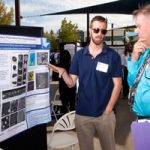
Sandia hosts next generation of nuclear experts
Seven years ago, the NNSA established the Nuclear Science and Security Consortium, a collaboration among universities and national laboratories whose purpose is to train the next generation of nuclear security experts. This year, Sandia/California hosted the group’s fall workshop and advisory board meeting.