
Arctic coastlines underlain by ice-rich permafrost are eroding at unprecedented rates as warming air and more powerful storm waves undermine frozen soils. This shoreline loss threatens everything from local communities and pipelines to strategic military sites, making reliable forecasts vital for national security and infrastructure planning.
To meet this need, Sandia researchers have developed the Arctic Coastal Erosion (ACE) model, which brings together detailed storm-resolving weather and ocean with a three-dimensional physics-based simulation of thawing, freezing, and soil collapse in permafrost.
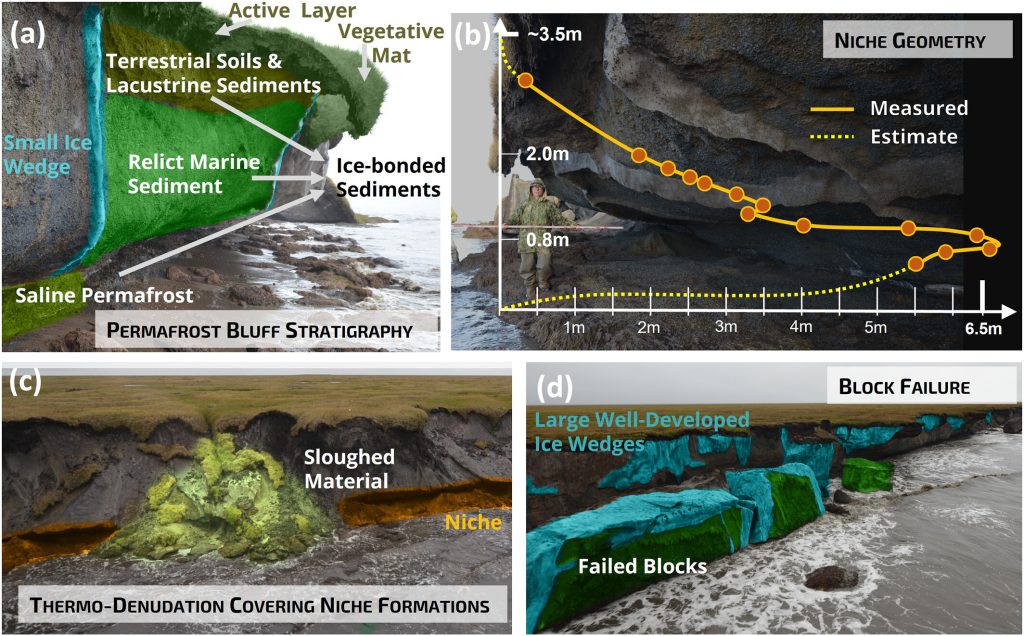
Key improvements include new rules that let the model remove eroded soil, a refined representation of how ice-rich soils deform and fracture, and realistic wave-pressure forces at the shoreline. The team calibrated ACE against observations collected in summer 2018 at Drew Point, Alaska, where they measured gradual surface slumping (thermo-denudation) and sudden block failures (thermo-abrasion). After tuning soil composition and strength based on lab tests, the model reproduced daily shoreline retreat to within 12 centimeters and predicted block-collapse events within two hours of when they actually occurred.
With this first successful demonstration, ACE can now be adapted to other sections of the circum-Arctic coast. Accurate erosion forecasts will help defense planners, energy companies, and northern communities anticipate land loss, protect critical facilities, and maintain secure Arctic operations as the climate continues to warm.


Sandia researchers linked to work
- Bayat, E.
- Frederick, J. M.
- Tezaur, I.
Sponsored by
The Department of Energy, Office of Science
Associated Publications
Bayat, E., Bull, D. L., Frederick, J. M., Mota, A., Jones, B. M., Tezaur, I., Flanary, C., Bristol, E. M., Ward Jones, M., Choens, R. C., and Jones, C. A., (2026). “The Arctic Coastal Erosion Model: Overview, Developments, and Calibration at Drew Point, Alaska,” Journal of Advances in Modeling Earth Systems (JAMES), 18:3, e2025MS005045. https://doi.org/10.1029/2025MS005045
August 24, 2026