
The Energy Exascale Earth System Model version 3 (E3SMv3), developed by Sandia researchers and collaborators as part of a large national lab effort, is a state-of-the-science tool designed to advance our understanding of the Earth and energy systems.
This model simulates interactions between the atmosphere, land, rivers, oceans, and sea ice to predict Earth system changes and their impacts. E3SMv3 includes major improvements, such as enhanced representations of atmospheric chemistry, clouds, aerosols, sea ice, and vegetation dynamics. It also introduces refined marine and land grids to improve the accuracy of how these components interact.
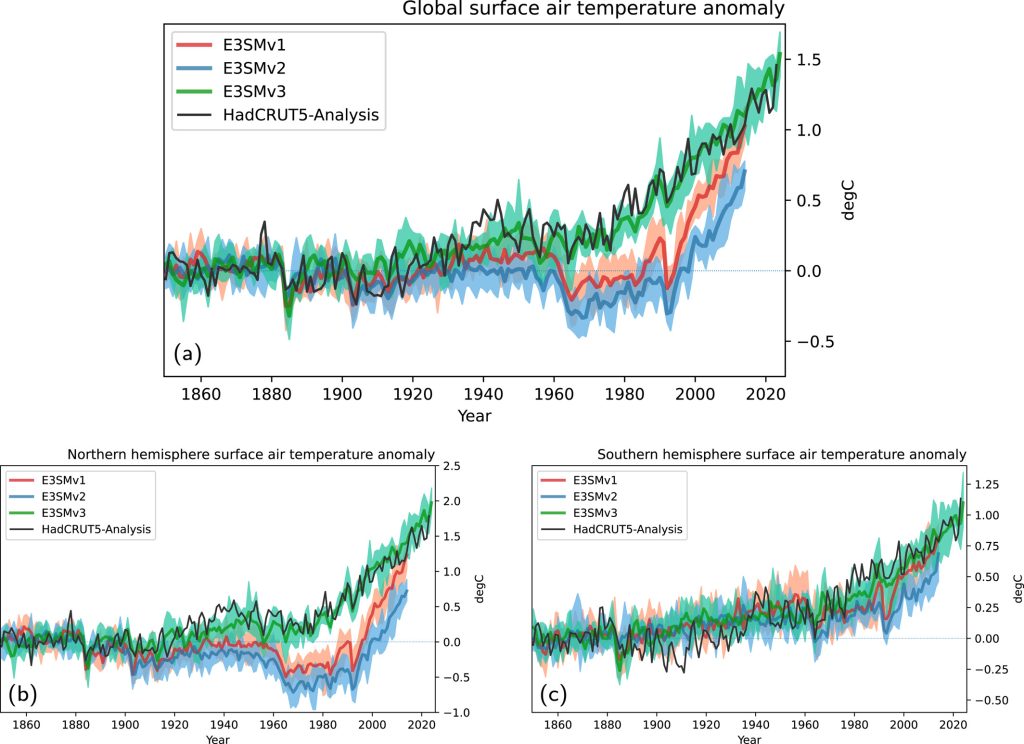
E3SMv3 was evaluated through simulations of past and historical conditions, totaling over 5,000 years. The model successfully resolved a major issue leading to unrealistic cooling trends during the mid-20th century. E3SMv3 now provides more accurate predictions of surface temperatures, ocean heat content, and sea ice changes, closely matching observed data.
These improvements mean stronger, more reliable forecasts of extreme weather, sea-level rise, freshwater availability, and Arctic conditions, which are critical inputs for defense readiness, infrastructure resilience, and strategic decision-making in a changing climate.


Sandia researchers linked to work
- Andrew M. Bradley
- James G. Foucar
- Oksana Guba
- Andrew G. Salinger
- Mark A. Taylor
Sponsored by
The Department of Energy, Office of Science, Office of Biological and Environmental Research
Associated Publications
Golaz, J.C., et al. (2026). “The Energy Exascale Earth System Model Version 3: 2. Overview of the Coupled System,” JAMES, 18:4 e2025MS005302. https://doi.org/10.1029/2025MS005302
August 24, 2026