nnsa

6 Results
Current Filters Clear all

Accelerating navigation algorithms

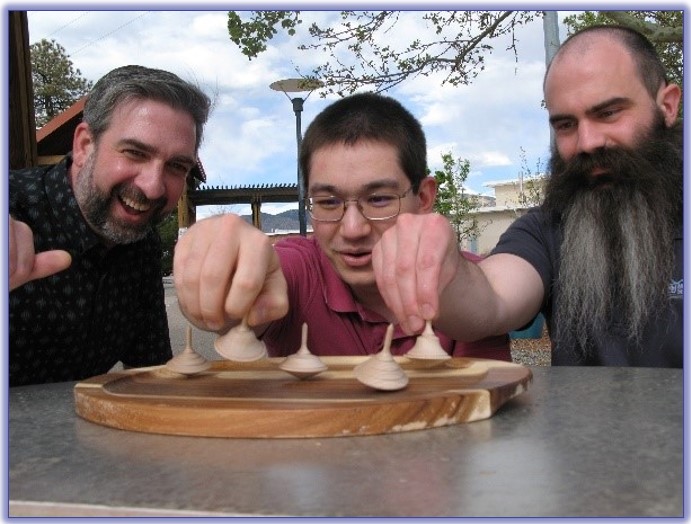
News Article, July 14, 2025 • Thinking creatively about rotations, the team discovered new numerical methods for solving differential equations on rotation groups with increased precision. Here, Mike Walker (left), Daniel Foreman (center), and Michael Sparapany (right) spin toy tops. (Photo by Jennifer Sanderson) One Laboratory Directed Research & Development (LDRD) team took on a critical...

Advancing turbulence models for hypersonic flows using machine learning 

News Article, July 14, 2025 • Sandia researchers utilized machine learning techniques to address the limitations of Reynolds-averaged Navier-Stokes (RANS) turbulence models in predicting hypersonic turbulent flows, with a particular emphasis on inaccuracies in wall heating predictions for flows involving shock boundary layer interactions. This research has led to the development of neural-network-based machine learned turbulence...

Advancing understanding of acoustic signals in underground tunnel structures

News Article, July 14, 2025 • Sandia researchers are using remote data to determine the structure of underground tunnels. Specifically, their research focuses on understanding acoustic resonance in these structures, specifically how changes in tunnel configurations affect the acoustic signals observed from a distance. The potential benefits of this work were presented in May 2024 at...

Confirming dismantlement of nuclear warheads while protecting sensitive information

News Article, July 14, 2025 • When it comes to nuclear arms control, verification is essential. By detecting unique metastable radionuclide signatures in non-nuclear material disposition pathways, an LDRD research team created a reliable verification measure to confirm dismantlement of nuclear warheads without disclosing sensitive information. Researcher Peter Marleau led an LDRD team that developed a...

Improving assurance of high-consequence systems using formal methods and automated reasoning 

News Article, July 14, 2025 • Error from imperfect computer representations of numbers when visualizing a sphere at 1km and 20,000km distance from an observer. Computers typically represent numbers one of two ways: fixed-point (via integers) and floating-point numbers. Floating point provides improved efficiency and productivity, but errors can accumulate if not managed carefully. Error from...