
Research at the DIII-D National Fusion Facility addresses a critical need for materials that can survive the punishing environment inside a future Fusion Pilot Plant, an energy source with major implications for long-term national security and energy resilience.
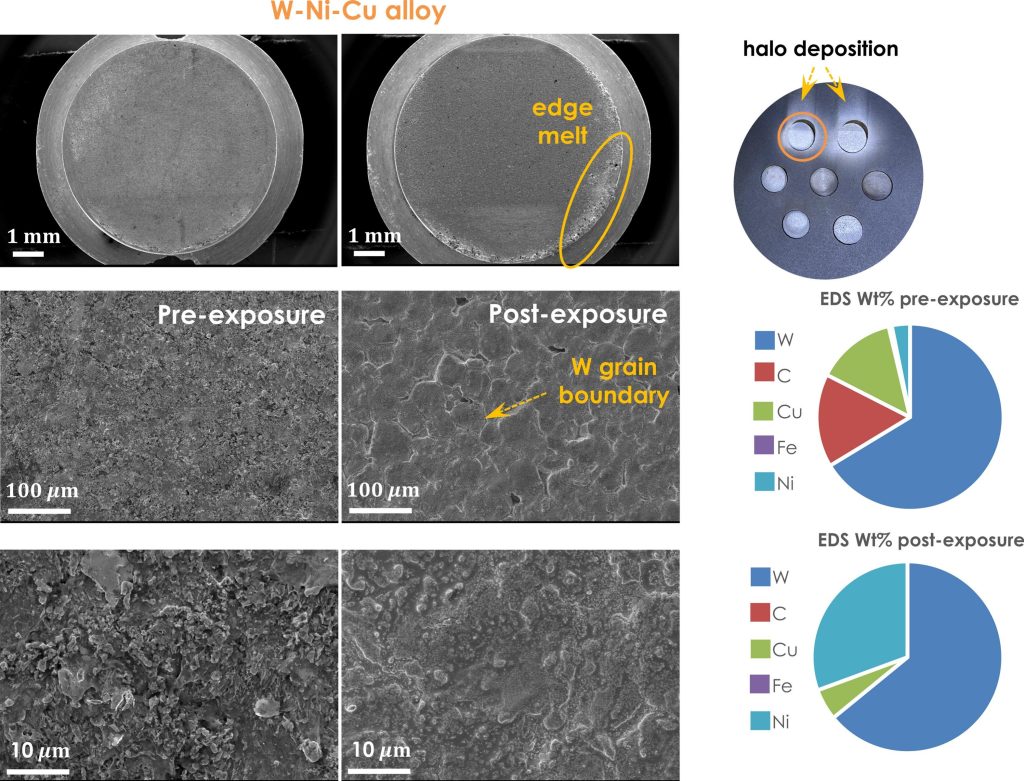
Over the first year of a two-year campaign, researchers used a specialized test module (the Divertor Materials Evaluation System [DiMES]) to expose 17 new candidate materials to high-temperature tokamak plasmas. By running repeated, carefully controlled “reference” plasma shots, including sweeping the plasma strike point across the test samples, they ensured each material saw a uniform dose of heat and particles. Samples were shaped and pre-heated to mimic the extreme exposure conditions expected for reactor plasma facing components, and were examined before and after exposure with imaging and elemental-analysis tools to reveal surface damage, cracking, droplet formation, and other failure modes.
Key findings provide a down-selection of the most robust plasma-facing components. A liquid-lithium porous structure, when heated to about 350°C, released vapor evenly and resisted the formation of molten droplets under high-power conditions. Among several “dispersoid-strengthened” tungsten alloys, only the version strengthened with titanium carbide held together without cracks. Ultra-high-temperature ceramics (titanium diboride and zirconium diboride) showed almost no damage in milder plasma conditions, while silicon-carbide (SiC) fiber composites suffered edge arcing even though chemical-vapor-deposited SiC remained intact. Thick, spray-coated layers of tungsten and SiC also survived without peeling, although SiC coatings lost tiny grains and tungsten coatings released more implanted deuterium gas. Other tungsten-based alloys were tested with mixed results.
Together, these experiments are mapping which materials can best handle the extreme heat fluxes and particle bombardment inside a fusion pilot plant, a crucial step toward building compact, reliable fusion reactors for secure, carbon-free power.


Sandia researchers linked to work
Jonathan Coburn
Sponsored by
The U.S. Department of Energy, Office of Science, Office of Fusion Energy Sciences
Associated Publications
Coburn, J., et al. (2026) “Overview of advanced plasma-facing materials testing for Fusion Pilot Plants at DIII-D,” Nucl. Mater. and Energy. 46:102064. https://doi.org/10.1016/j.nme.2026.102064
September 21, 2026