
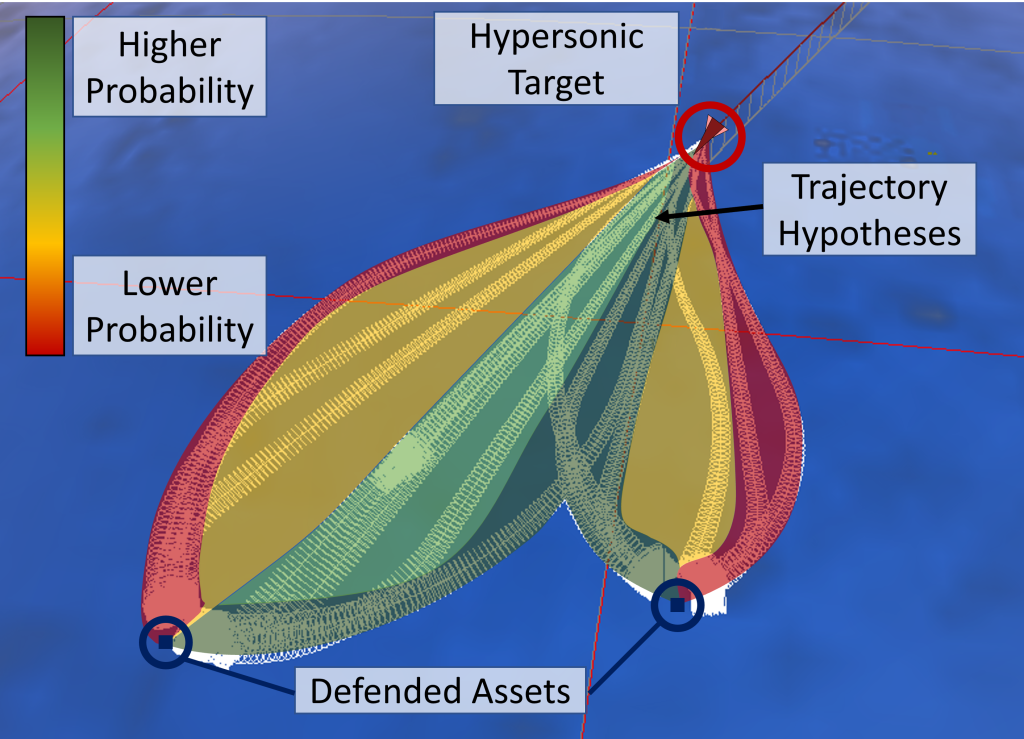


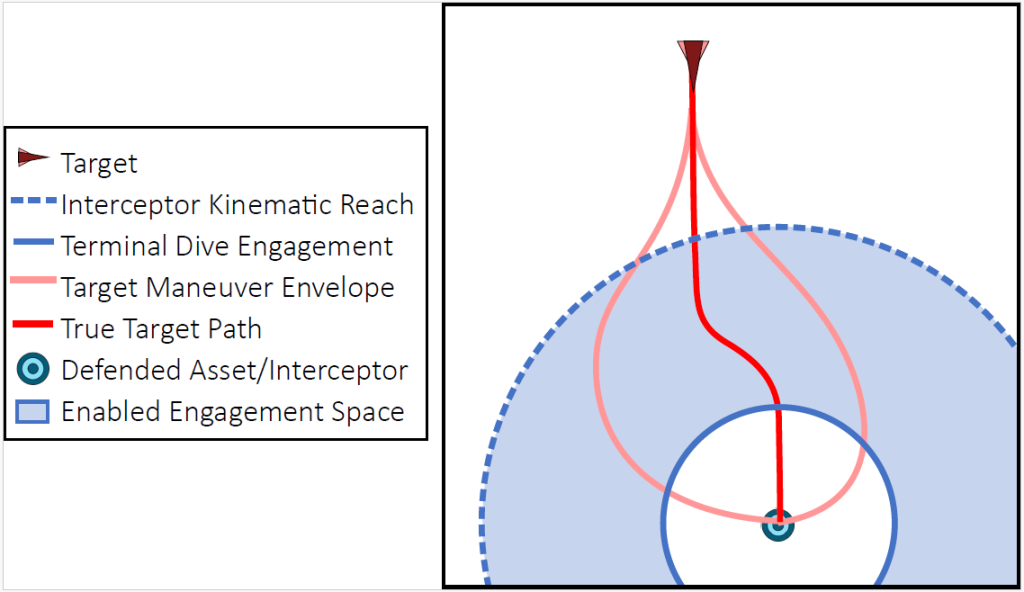
Hypersonic weapons pose a challenge to missile defense systems due to their extreme speed, unpredictable maneuvers, and aimpoint ambiguity. To meet this threat, Sandia Laboratory Directed Research & Development researchers developed a fire control algorithm that forecasts multiple possible flight paths, selects probabilistic intercept points during launch, and continuously updates guidance commands for multiple simultaneous interceptors in flight.
Using the high-fidelity Ascent simulation environment, the team evaluated the algorithm in a realistic point defense scenario with varying numbers of interceptors. Results demonstrated the algorithm’s computational feasibility and showed how it compares to existing methods. The findings also provide valuable insights into hypersonic trajectories and maneuvers, identifying which are most challenging to counter. This strategically positions Sandia in supporting national priorities, including Golden Dome and space-based interceptors.
The Missile Defense Agency is interested in this work for two future projects, specifically since the algorithm is interceptor-independent and adaptable to various missile defense systems. Future efforts will explore alternative interceptor models, scenarios with multiple defended assets, and refined weighting schemes.
May 13, 2026