
Sandia researchers examined how “cold” electrons, which have very little energy, can cause certain molecules made of nitrogen and oxygen such as N₂O₃ and N₂O₄ to break apart. These molecules are important to chemistry that occurs in high‐energy environments such as plasmas, combustion chambers, and atmospheric re-entry flows. Examining the chemistry in these areas helps improve the safety, reliability, and performance of technologies that keep the nation secure.
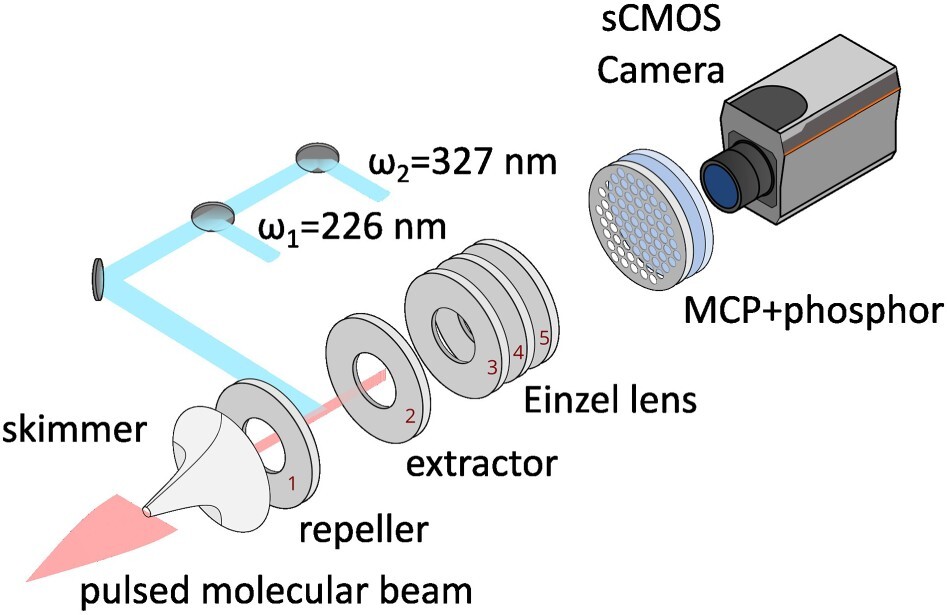
The team created a stream of molecules made of nitric oxide (NO) and nitrogen dioxide (NO₂), which naturally form pairs called dimers. They then used two different laser pulses to excite NO molecules into special high-energy states, allowing electrons to jump directly onto nearby dimer molecules like N₂O₃ or N₂O₄. This process, which happens with almost no extra energy, always caused the dimers to break apart right away – so no whole dimer ions were seen – and mostly produced NO₂⁻ ions.
By measuring how fast the NO₂⁻ fragments were moving, the researchers found had a certain amount of energy (between 0.2 and 0.7 eV). This matched what you’d expect from fragments in their lowest electronic state but still holding some internal energy from vibrations and rotations (up to about 1.1 eV).
Because the NO₂⁻, NO, and NO₂ fragments are created in very energized states, the way they react afterward in plasmas containing nitrogen oxides (NOₓ) can change a lot. This can affect how fast reactions happen, what byproducts are made, and what signals can be detected in environments of national-security interest.


Sandia researchers linked to work
- Frank, J.H.
- Chandler, D.W.
- McCaslin, L.M.
Sponsored by
The Division of Chemical Sciences, Geosciences and Biosciences; Office of Basic Energy Sciences (BES); U.S. Department of Energy (DOE)
Associated Publications
Lin, H. W., Smoll, E. J., Jr, McCaslin, L. M., Frank, J. H., and Chandler, D. W. (2026). “Near-zero-energy dissociative electron attachment of the dimers N2O3 and N2O4,” Molecular Physics. https://doi.org/10.1080/00268976.2026.2617350
August 24, 2026