
The Presidential Early Career Awards for Scientists and Engineers (PECASE) is the highest honor bestowed by the U.S. government on outstanding scientists and engineers beginning their independent careers. The PECASE awards aim to encourage innovation, raise awareness about careers in science and engineering, and connect research with national goals.
Four Sandia researchers won these prestigious awards in 2024.
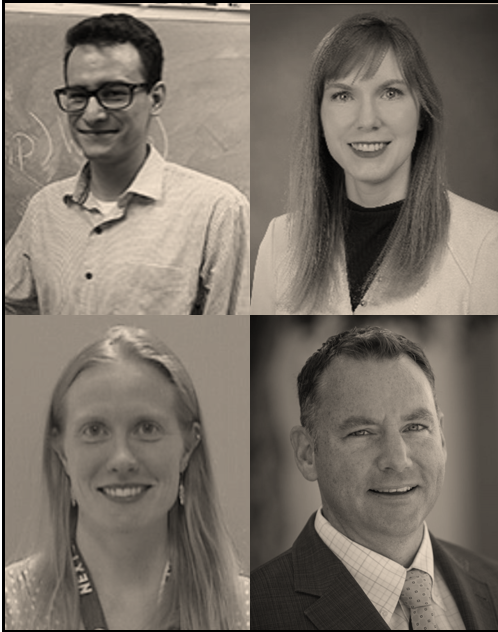


Daniel Ruiz (top left) joined Sandia in 2017 as a Truman Fellow and received his PECASE award from NNSA. Through his research, he has been studying magneto-inertial-fusion technologies to achieve high fusion yields in the laboratory. His contributions are key to Sandia’s advocacy for a future pulsed-power facility for long-term stewardship of our nation’s nuclear deterrent. Ruiz is the lead designer for several experiments at the Z facility and is dedicated to community outreach by mentoring students, organizing sessions at scientific meetings, peer-reviewing articles in journals, and reviewing proposals for national science programs.
Caroline Winters (top right) is currently a researcher at the Thermal Test Complex, focusing on Fire Science and Technology. She develops tools to measure temperatures in challenging conditions and combines knowledge from material science, engineering, and lasers. Winters, who began at Sandia in 2015 as a graduate student intern, leads teams to support important projects related to nuclear safety and extreme environments.
Gwen Voskuilen (bottom left) has been recognized for her contributions to next-generation high-performance computer architecture and was awarded a PECASE from NNSA. Her research centers on innovative processor and memory system technologies, in addition to advancements in computer hardware simulation. Voskuilen joined Sandia in 2014 after receiving her PhD in Computer Engineering from Purdue University.
Peter Bosler was awarded a PECASE award from DOE. His research focuses on simulation methods for multiscale applications, where complex interactions across various scales affect the dynamics. For example, the characteristics of individual raindrops can affect cloud properties, leading to small storms or large cyclones. Modeling these scales is mathematically and computationally challenging.
August 13, 2025