
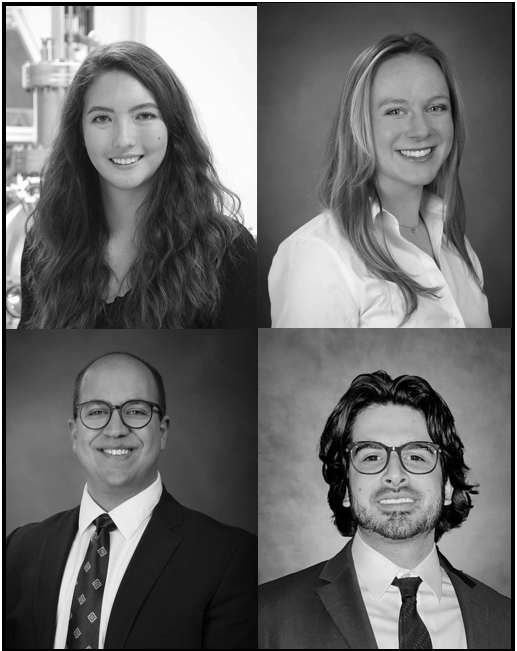
The Harry S. Truman Postdoctoral Fellowships and Jill Hruby Postdoctoral Fellowships are three-year distinguished positions at Sandia created to attract nationally recognized PhD scientists and engineers. They each conduct groundbreaking research that support Sandia’s national security mission.
Hruby Fellow Samantha Jaszewski (top right) is researching computer memory based on ferroelectric materials, specifically hafnium oxide, during her fellowship. Hafnium oxide, present in computer chips, can enable further miniaturization of components and increase computing efficiency while lowering energy needs. It also has the potential to withstand harsh radiation environments, important for national security applications. Her goal is to understand the material’s performance under radiation and its fundamental limits. She graduated from Boston College with a bachelor’s in chemistry and completed her doctorate in materials science and engineering at the University of Virginia in 2023. Inspired by her adviser, former Sandian Jon Ihlefeld, Jaszewski pursued a fellowship at Sandia to explore working at a national lab.
Hannah Stroud (upper right) is researching the incorporation of roughness features into fluid and ablation models to enhance reentry vehicle performance. With bachelor’s, master’s, and doctorate degrees in aerospace engineering from Texas A&M University, her graduate research focused on how forces from fluids can remove material from structures. Her current work at Sandia involves understanding the aerodynamic effects of rough surface geometries produced during the ablation process, which is crucial for developing better hypersonic systems. Inspired by her internship experience at Sandia, Stroud sought the fellowship to choose her research path and learn from leading experts.
Matthew Barry (bottom right) is developing a machine-learning framework for multiscale modeling of atomic systems during his fellowship. This framework will enable development of reduced-order material structure-property relationships to speed up or bypass expensive physics simulations, facilitating the design and discovery of novel multifunctional materials for national energy and defense missions. Building on tools from his PhD, he and his team at Sandia are enhancing these tools to study specific materials. With prior fellowship experience from the National Science Foundation and NASA, Barry values the freedom to explore research topics and apply his findings to Sandia’s missions. He holds a master’s in mathematics and a doctorate in mechanical engineering from Georgia Tech.
Jonathan Paras (bottom left) is making breakthroughs in metal manufacturing at Sandia. His fascination with metals began in high school and led him to study materials science and engineering at MIT, where he completed his bachelor’s and doctoral degrees. Paras’ research focuses on the thermodynamic behavior of metal alloys at high temperatures to predict their response under extreme conditions and design new manufacturing processes. Inspired by the metallurgical research of the Manhattan Project, he aims to revolutionize conventional manufacturing.
August 14, 2025