
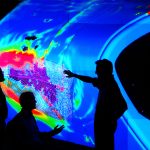
Out of tragedy, a safer space
In 2003, the nation called on Sandia to determine what caused the space shuttle Columbia to disintegrate over Texas and Louisiana upon its reentry to the Earth's atmosphere.
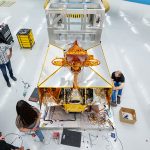
NASA’s VIPER mission gets vital help from Sandia
The Labs’ one-of-a-kind Superfuge lends its might to test items at forces up to 300 times Earth’s gravity.
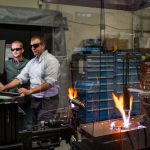
It is rocket science: New heat shields, faster
Engineers combine computer modeling, laboratory experiments and flight testing to better understand how heat shields behave under extreme temperatures and pressures, and to predict their performance much faster than before.
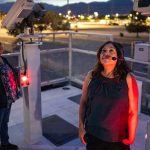
Space-based nuclear detonation detection mission endures
The final Global Burst Detection system in a series launches. The team begins preparing the next series as part of a mission that has lasted more than 60 years.
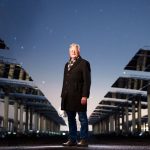
Asteroid hunting using heliostats?
A Sandia scientist puts the Labs’ field of mirrors to work on the nightshift to detect near-Earth objects.

Sandia tests heat shields for space
In support of two NASA missions, Sandia’s solar tower harnessed the power of the sun to expose aerospace materials to intense heat, replicating the harsh conditions of faster-than-sound flight and atmospheric reentry.
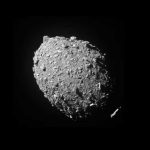
Deflecting doom: How Sandia research could save Earth from asteroids
Free-floating experiments at Z machine provide data to prepare for the unimaginable.
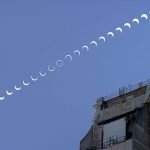
There goes the sun: annular solar eclipse
The Oct. 14 annular eclipse as seen at the National Solar Thermal Test Facility.
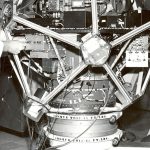
Happy 60th birthday to Vela, watchman for nuclear detonations
Labs historian recounts the story behind the satellites launched to explore the feasibility of detecting nuclear detonations in outer space.
Beyond Bennu: How OSIRIS-REx is helping scientists study the sonic signature of meteoroids
Scientists hope data will improve detection of hypersonic objects.