
Program brings together inventors, entrepreneurs and mentors
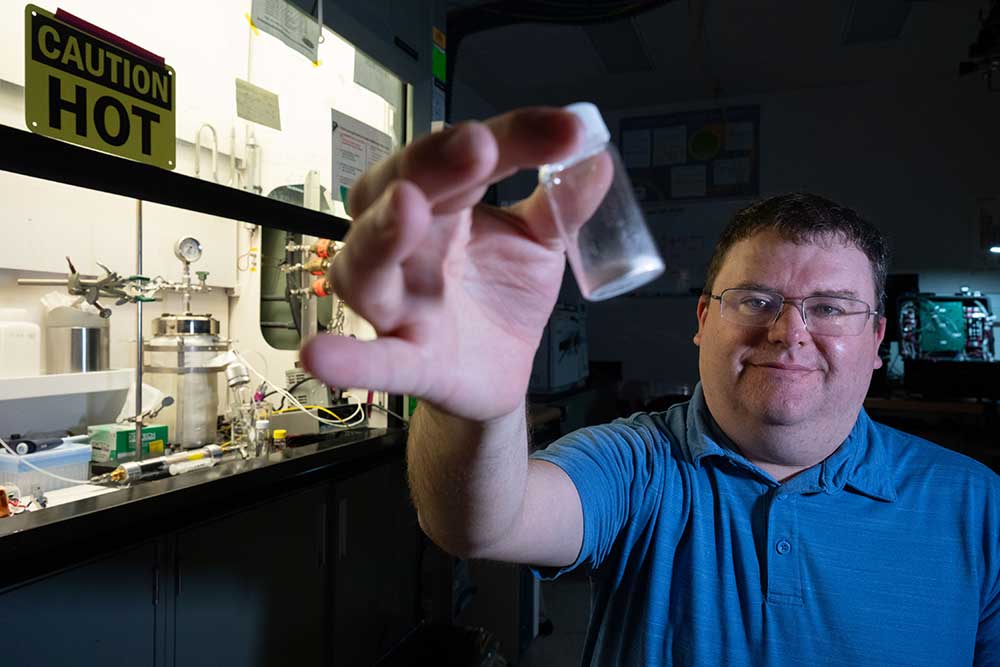
Take a deep breath. Exhale. Now imagine you just completed a noninvasive test for disease and infection with rapid results.
Thanks to Sandia and its work with the Homeland Security Startup Studio, this may one day become a reality for the medical industry and beyond.
“There’s a ton of information in your breath about the state of your body,” said chemical engineer Scotty Bobbitt, lead researcher on the project. “Someday, you’ll go to the doctor and do a breath test just like they take your blood pressure. That’s the future I’m envisioning.”
Scotty isn’t the only one picturing the potential.
The Homeland Security Startup Studio, sponsored by the Technology Transfer and Commercialization Branch under the Department of Homeland Security, chose the technology he and his research partners developed to be part of the innovative program for 2025.
The program brings together entrepreneurs, mentors and inventors to help move cutting-edge technologies from lab to market.
“I recommended this technology, and it got picked up by entrepreneurs involved in the startup studio,” said Bob Sleeper, Sandia licensing executive. “It’s one of our defined missions — to take our inventions and commercialize them for the greater good of our country. We like making that impact and seeing that technology get out there. That’s why we do what we do.”
A breath of fresh air
The original Laboratory Directed Research and Development project studying breath analysis came about during the COVID-19 pandemic with the concept of developing a rapid, noninvasive test.
“There are biomarker molecules in your breath that are produced by different metabolic processes, and you can measure those and tie them back to disease or infection,” Scotty said.
The study involved developing porous crystals known as metal-organic frameworks, or MOFs, as highly selective sorbents to capture targeted volatile organic compounds, or VOCs.
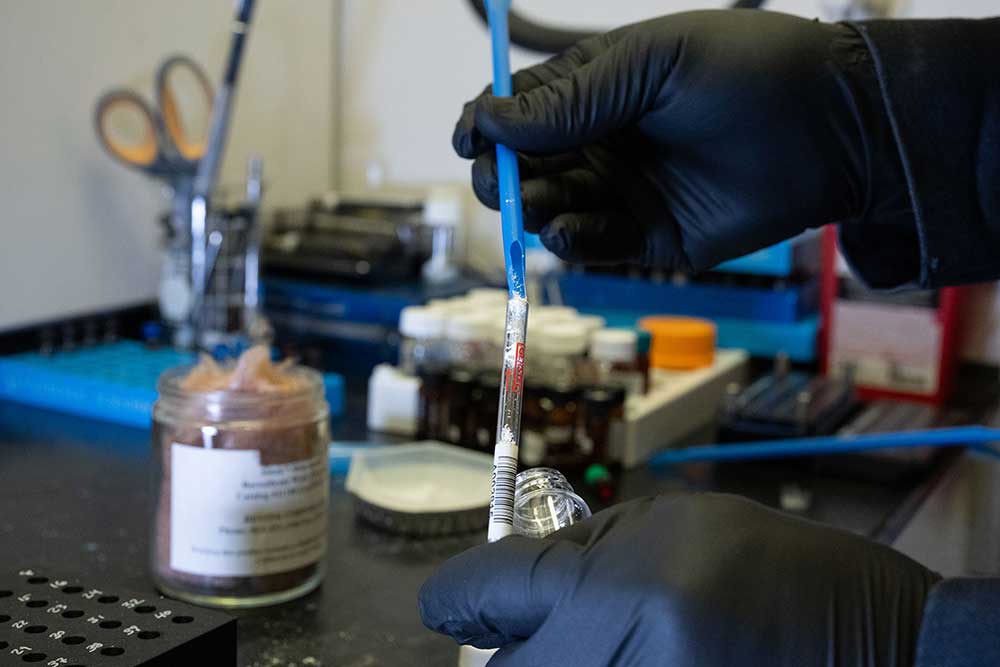
“MOFs are my favorite materials,” Scotty said. “They’re fascinating because they’re made from metal nodes connected by organic linkers, and you can put them together in a modular way, like Tinkertoys, and tailor the selectivity or the performance of the material to what you want.”
But there’s a catch when it comes to breath. Not only can the level of VOCs be low, but researchers also had to contend with humidity. Water in the breath competes with the target VOCs, so the research team focused on developing hydrophobic materials and used a preconcentrator sorbent to more effectively capture VOCs for detection.
“I would test the MOFs against known concentrations of known chemicals to see which MOF would hold on to what compound better,” said chemist Jason Sammon, who was part of the research team. “We would test this over a variety of relative humidities using a system in the lab that can generate chemical standards in a vaporous form.”
A winning combination
While the pandemic spurred the research, Scotty worked with the startup studio’s entrepreneur team to determine what applications might make the best entry point in the market.
“The concept of breath analysis is very broad,” he said. “You could apply the same concept to virtually anything because lots of diseases result in VOCs in your breath.”
The startup studio team Scotty has been working with consists of a health insurance director, a physician and a medical technologist who bring broad expertise from the medical landscape. During the process of the startup studio, which ran from February through May, the team identified sepsis as one of the life-threatening conditions that this technology could help detect.
This became the basis for the final presentation in June for the studio’s Converge 2025 competition that showcased the final pitches for breakthrough technologies. The team earned the Judge’s Choice award for their entrepreneurial pitch to use Sandia’s technology to detect sepsis.
“The judges are really looking at market fit, next steps and future road map,” said Kristi Rose, project manager for FedTech, which runs the startup studio for DHS. “Winning Judge’s Choice was due to the team having a great relationship with the tech transfer office at Sandia and also the great relationship they have with the inventor, Scotty.”
Since completion of the startup studio, the team of entrepreneurs incorporated as BioChem Medical and is actively negotiating a license with Sandia, writing government funding proposals and seeking private investors. While the startup studio officially ended, Scotty continues to meet with them and learn about their progress in obtaining funding.
“It’s such a cool program because a lot of times we invent something but there’s no clear mechanism to get it out into the world,” Scotty said. “It’s very valuable to have something like this that brings people together.”
Waiting to exhale
In addition to having the ability to detect COVID-19, influenza, sepsis, lung cancer, kidney failure and a host of other infections, the MOF technology could one day be used to detect fentanyl.
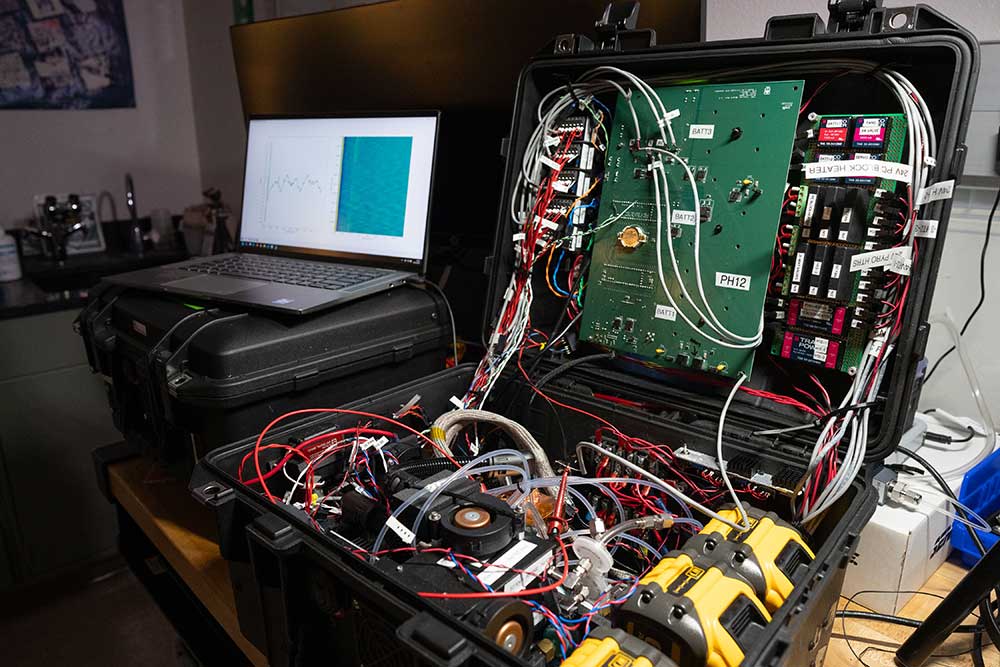
The research team, also composed of Mike Chandross and Dorina Sava Gallis, is working to integrate existing Sandia inventions with the MOF VOC sensor technology to create a portable solution — about the size of a shoebox — that could allow first responders to quickly determine if someone has fentanyl in their system so they can receive life-saving treatment.
“These detection systems are important for the Department of Homeland Security for fentanyl, for diseases and for the overall health of our country,” Bob said, reflecting on licensing opportunities. “This would be the first real commercialization of Sandia’s MOF technologies.”
Jason echoed how great it feels to watch Sandia’s research of MOFs be considered for helping both in a diagnostic sense and in the interest of national security.
“It’s really neat to see that tech maturation from testing these little MOFs in my lab and getting data to having the potential to be turned into a product that will help people and provide other diagnostic capability,” he said.
The technology is currently patent pending, and Scotty is looking forward to seeing how far it can go while working with the BioChem Medical team he connected with during the startup studio.
“One of the neat things about this project is this was led by molecular-level simulation, so it started very fundamental with theory and then moved up through benchtop synthesis and lab tests,” Scotty said. “And now, hopefully — fingers crossed — it becomes a real product. A lot of times people in simulations work at a very low Technology Readiness Level, and we’re a bit far removed from the real-world application of things. Seeing something all the way through from a model on a computer to potentially a real product is gratifying.”