
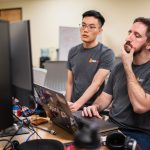
Cyber Residency Program
A medically inspired rotation program offers a tailored, hands-on learning experience for cyber defenders right out of college and from other areas of the Labs.
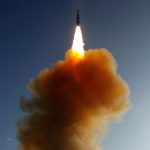
Hitting a bullet with a bullet
In 2008, the nation called on Sandia to help the Navy figure out how to shoot down a defective 5,000-pound satellite that was dangerously close to reentering Earth’s atmosphere.
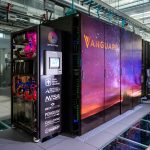
Not the largest supercomputer, but maybe the most interesting
Sandia and tech company NextSilicon abandon design norms to pursue the frontiers of computing technology.
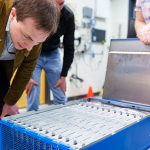
Brain-inspired computers are shockingly good at math
New research shows the potential for energy-efficient supercomputing.

Sandia-led team awarded $10M by DOE to explore materials fatigue, self-healing with AI
“This isn’t just an advance in materials science. It’s an opportunity to modernize how we practice science itself,” says project lead Rémi Dingreville.

The road to El Capitan and El Dorado ran through the Tri-Lab Center of Excellence
How a social network proved to be the missing link in building the world’s fastest supercomputer.
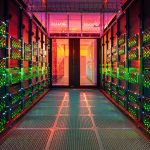
Three national security laboratories, one AI model
Sandia, Los Alamos and Lawrence Livermore national laboratories have proven that it's possible to share a large language model without compromising sensitive data from each lab.
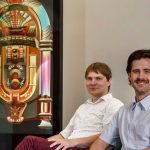
Predicting the (un)knowable
A Sandia team develops a method to make quantum computing more fruitful.
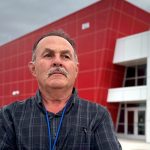
Unseen, unsung, undeniably important
For Sandia’s Facilities Control System, the reward isn’t the spotlight, but in keeping the Labs running day and night.
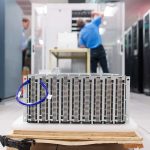
Brain-based computing for ND solutions
Sandia and German startup SpiNNcloud have deployed a first-in-the-world, large-scale SpiNNaker2 neuromorphic system at the Labs.