
Six teams compete in Sandia’s inaugural Innovation Faceoff
Staff can watch the
Innovation Faceoff event in the
Digital Media Library.
The team was on the verge of something exciting, but time was running out. They had invented a groundbreaking navigation technology. They had placed it inside a first-of-its-kind 3D printed glide body. They were about to test both in a high-stakes flight. And the shell of the glide body would not close. The navigation system’s mass of wires and sensors were too big.
Like a traveler sitting on their overstuffed suitcase with a taxi waiting to rush them to the airport, the team pressed and mashed in vain. Finally, they brought out mallets and smacked the glide body shut.
Since announcing its goal to accelerate innovation in September 2023, Sandia made several changes: slashing more than 400 requirements from policies, encouraging intelligent risk taking, and celebrating and sharing what was learned on projects that didn’t go as planned.
The keynote speaker at the Labs’ annual all-managers meeting in summer of 2024, Ryan Leak, recommended another approach.
“Have fun and make it competitive,” Sandia Chief Research Officer Doug Kothe said, recalling Leak’s advice.
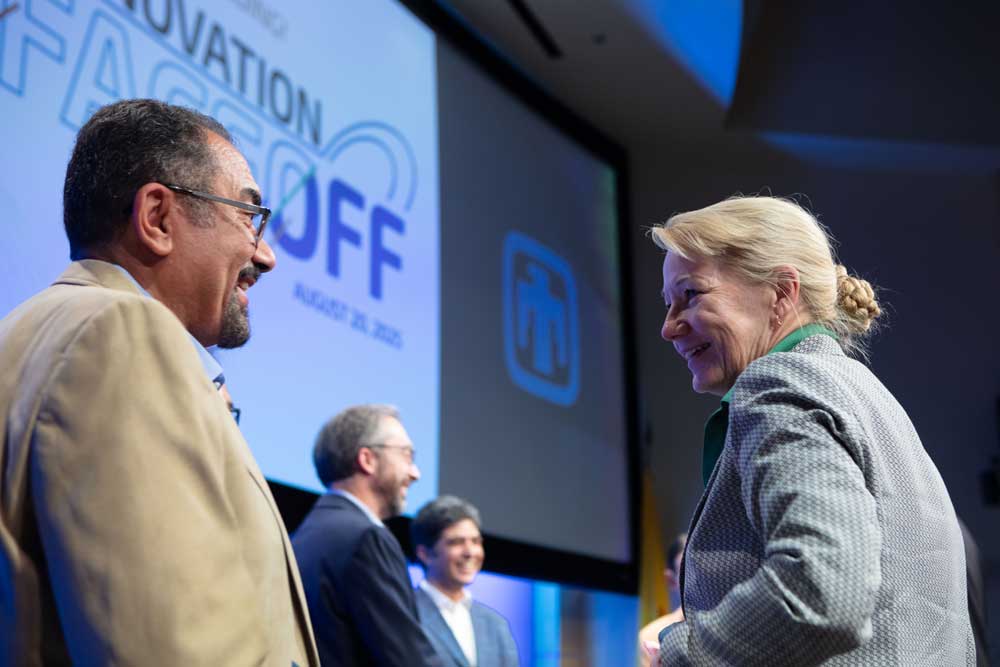
This spirit spurred Sandia’s first Innovation Faceoff, a competition in which six teams had eight frenetic months to push their research in a novel direction before presenting their results to the Labs on Aug. 20.
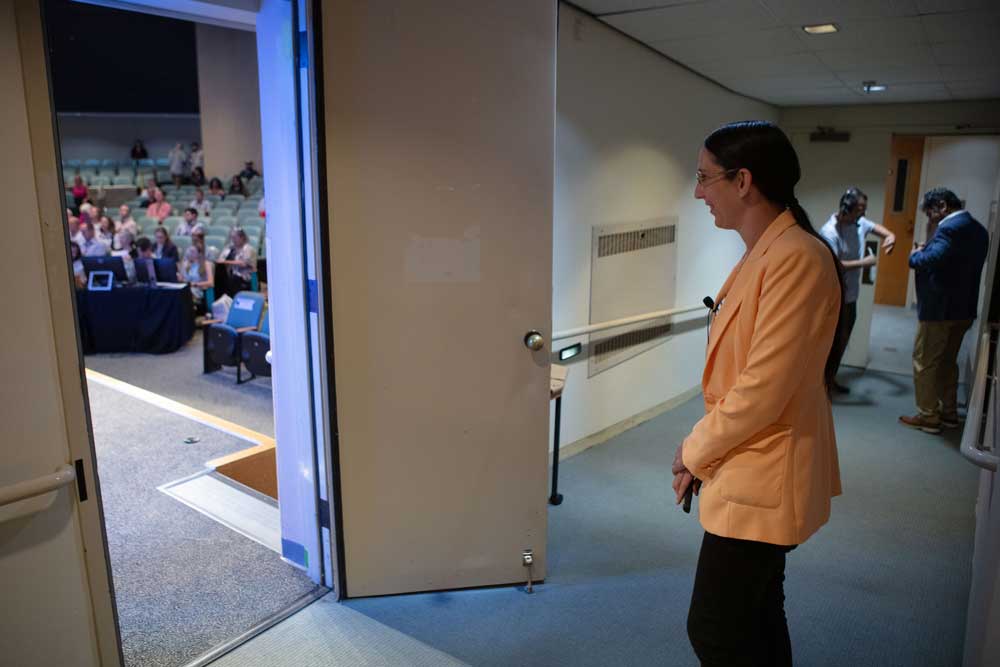
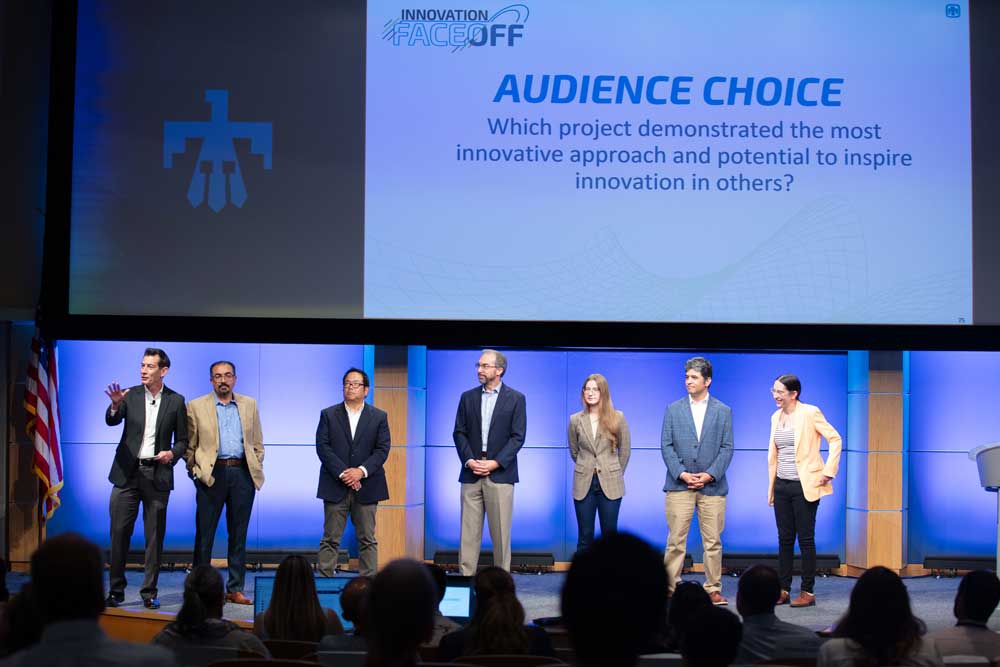
That deadline was only the first ticking clock. A representative from each team had six minutes to present their project to a panel of judges with the threat that those who ran long would be shooed off stage. Then, they had four minutes to answer questions from a panel of five judges. At event’s end, winners were crowned.
“It really supports Sandia’s effort to go fast,” Doug said.
The Judges’ Choice and Online Audience Choice awards were claimed by Megasonic Navigation in Advanced Manufactured Aeroshells, a team that made the bold choice to fly one unproven technology inside another and resorted to the mallets to seal them.
As physicist Ihab El-Kady explained in his Faceoff presentation, the team invented a self-contained navigation technology that mitigates GPS vulnerabilities by relying instead on sensing dynamic and static pressure strains. The team conducted preliminary testing in Sandia’s hypersonic wind tunnel and employed AI to analyze vast amounts of data quickly and simulate various scenarios, allowing informed decisions throughout the project. Moving at the break-neck pace demanded by the competition, they proved the system in real-world conditions using SkyFox, a first-of-its-kind 3D printed glide body. Adding to the uncertainty, the glide body was making its maiden flight and being dropped from a balloon.
“It became a nightmare,” Ihab told the judges, while appearing to revel in the mounting risks the project embraced. “Murphy’s Law says everything that can go wrong will go wrong at the worst moment in time. And that’s exactly what happened.”
After smacking the glide body shut, the team tested both navigation system and glide body the week before the Faceoff, but the first attempt smashed into the Utah desert and was buried 20 meters underground. A second test, just five days before the event, was recovered in pristine condition.
Fast as the initial testing cycle was, Ihab expected to go even faster the next time.
“We think we can get this under 90 days, so it’ll be the most rapid flight test that Sandia has ever seen, and the cheapest possible,” Ihab said. “It’s a national accomplishment.”
The project exemplified important elements of innovation according to Ashley Matsko, a cybersecurity and mission computing project manager who came to Steve Schiff Auditorium to watch the Faceoff as a fan.
“The Megasonics team wasn’t afraid to mess up and learn as they went, and there was an element of, ‘just do it,’” Ashley said. “I could see from their project how some of the things Sandia is doing around digital engineering and advanced manufacturing are translating into delivering quicker.”
While the Megasonic project wowed Ashley and the judges, all six Faceoff competitors shared novel research, technology or both.
“Ingenuity, courage, tenacity, teamwork — our Innovation Faceoff teams demonstrated what the Labs are all about,” Labs Director Laura McGill said. “This is why Sandia is such an incredible place to work.”
Ihab was impressed by Proteus+, which used large language model generative agents, AI stand-ins for people dubbed LGAs, to model how disinformation spreads in an online social network.
Proteus+ collected data on how human subjects behave in online disinformation scenarios, had LGAs self-organize into friend groups on a micro social network, then observed how the LGAs spread disinformation. The disinformation was culled from flat earth Reddit posts surrounding a pair of SpaceX launches.
“I myself am a spinning ball believer, which is what the flat earth community calls round earthers like ourselves,” said Proteus+ presenter Emily Kemp, who was selected by applause as the Faceoff’s New Mexico Audience Choice Award winner.
The behavior of the social network’s 100 LGAs in spreading and reacting to claims such as “space launches are not real” varied based on the level of disinformation present, indicating that Proteus+ LGAs aligned with human behavior and can be used to model disinformation campaigns and their mitigations.
“AI is the next frontier,” Ihab said. “Wading into AI and using that problem as an exemplar was a smart thing to do. Emily is going to have a very impressive career at Sandia. She gave me a run for my money.”
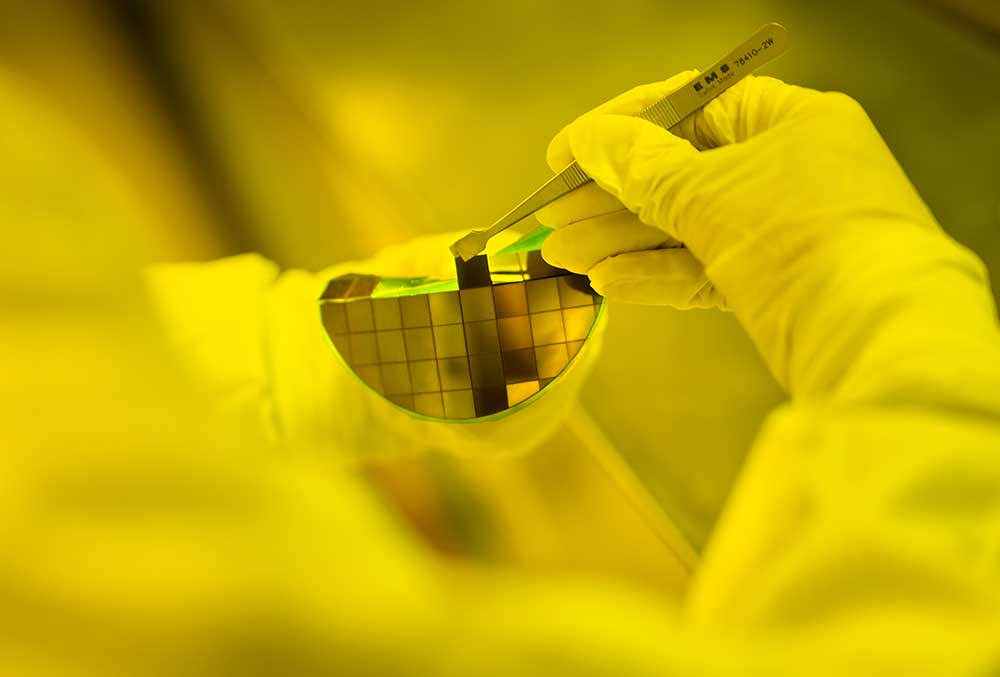
Chloe Doiron, whose team claimed the California Audience Choice Award for developing an imaging capability that worked through obstructions — similar to technology that can show cancer through tissue — saw the Faceoff as showcasing the broad expertise that differentiates Sandia, even among national labs.
“You could see the wide range of problems being addressed,” Chloe said. “That’s always true at Sandia, and it was really represented in the Faceoff.”
“The whole day was fun,” said Mohamed Ebeida, whose Vorocrust Wild team invented an automated boundary layer meshing solution that cuts the meshing process used to create models that are critical to real-world engineering from months to minutes while achieving orders-of-magnitude-lower simulation error.
After overcoming a litany of challenges to develop and test the new technology, Mohamed’s final hurdle was explaining in six minutes what his team accomplished. At the practice run the day before the Faceoff, his time elapsed and he was cut off part way through the presentation. Mohamed went home that night and hacked down his remarks. The next day, he completed his presentation in 5:58, with two seconds to spare.
“It’s not easy to stand up there with everyone watching; and the competitors really impressed,” Doug said. “Makes me proud to be a Sandian and to see such talent here.”
Facing off
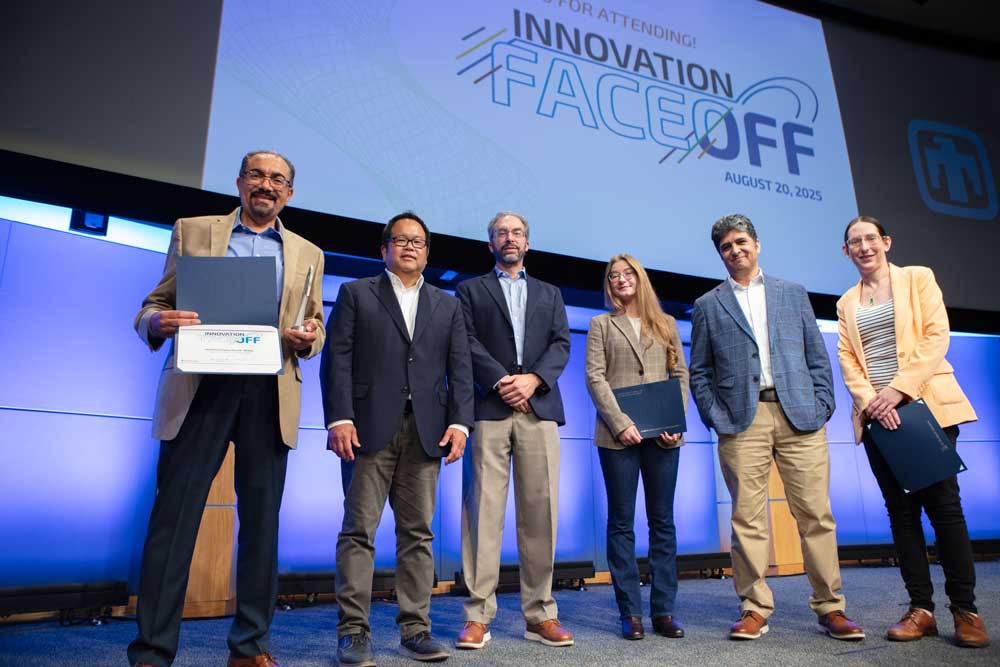
The six teams that competed in Sandia’s inaugural Innovation Faceoff were:
Megasonic Navigation in Advanced Manufactured Aeroshells
Winner of the Judges’ and Online Audience Choice awards
Invented a Megasonics self-contained navigation technology that mitigates GPS vulnerabilities by relying instead on sensing dynamic and static pressure strains. The system was tested using a first-of-its-kind 3D printed glide body.
Ihab El-Kady and Mark Noel (principal investigators), Alex Abeyta, Jessica Buckner, Spencer Brann, Emily Dreyer, Katya Casper, Aaron Otto, Aly El-Osery, Agustin Paulino, Mark Ensz, Jeffrey Steinfeldt, Frank Farrow, Anita Montoya, Mathew Kelly, Luke Alan Moy, Luke Martin McDivitt, Jonathan Murray, Michael Robinson, Craig James Robertson, Samuel Oxandale, Hales Stephen Swift, Gregory Ten Eyck, Alyias Thomas, Tyson Robert Plagge, Ericka Solano, Jackson Stack Unger and Bennett Wehr.
High-speed Secondary Electron Detection
Developed a novel, high-speed electron detector for failure analysis applications.
Craig Nakakura (principal investigator) Frank Alcorn, Jessica Duree, Suhas Kumar, Jeff Sniegowski and Alec Talin.
Z Machine SF6 Substitution
Devised a method for identifying gases that could replace sulfur hexafluoride as the insulating gas on Sandia’s Z machine.
David Osborn (principal investigator), Jared Echternach, Max Flynn, Jonathan Frank, Erxiong Huang, Leonid Sheps, Timothy Zwier and Adam Steiner.
Proteus+
Winner of the New Mexico Audience Choice Award
Modeled how disinformation spreads on a social network using large language model generative agents.
Emily Kemp (principal investigator), Jonathan Compton, Caitlin Lancaster, Elizabeth Morris, Madison Salmon and Lauren Treiman.
Vorocrust Wild Team
Fashioned an automated boundary layer meshing solution that cuts the meshing process used to create models critical to real-world engineering from months to minutes with orders of magnitude lower error.
Mohamed Ebeida (principal investigator), Duncan McGregor, Liam Moynihan, Shawn Pautz, Jeff Sharpe and Nick Winovich.
Wavefront shaping for diffraction-limited focusing through Disordered Media
Winner of the California Audience Choice Award
Created an imaging capability that works through obstructions.
Chloe Doiron (principal investigator), Alexander Cerjan, Caitlin Friedman and Sueli Skinner-Ramos.