
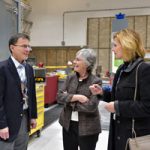
NNSA administrator visits Sandia, Jan. 29
Lisa Gordon-Hagerty, DOE undersecretary for nuclear security, visited Sandia/New Mexico on Jan. 29. During the visit, Gordon-Hagerty toured some of Sandia's facilities and met with early career staff members to discuss the role of the national labs’ next-generation researchers.

Three Sandia Labs researchers earn national honors in leadership and technology
Three Sandia researchers were honored for their leadership and technical achievements at the 2019 Black Engineer of the Year STEM Global Competitiveness Conference. Warren Davis, Quincy Johnson and Olivia Underwood received their awards during the conference in Washington, D.C. The annual meeting recognizes black scientists and engineers and is a program of the national Career Communications Group, which advocates for corporate diversity.
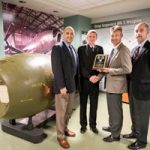
Vice Admiral Johnny Wolfe visits Sandia
Vice Admiral Johnny Wolfe, director of Strategic Systems Programs for the Navy, visited Sandia last week and formally recognized Sandia and its staff for their key role in the development and production of the W76-1/Mk4A Life Extension Program.
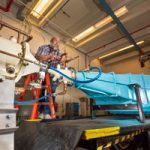
‘Friendly’ EMP improves survival for electronics
An EMP emitted by a nuclear weapon exploded high above the U.S. could disable the electronic circuits of many devices vital to military defense and modern living. Fortunately, military equipment is designed to be immune to various levels of EMP, and the validity of those designs has been tested and improved by a “friendly” EMP generator at Sandia.
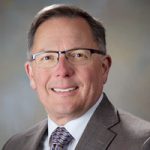
Larry Luna elected American Society of Mechanical Engineers fellow
Sandia engineer Larry Luna has been elected a fellow of the American Society of Mechanical Engineers for significant achievements during more than 30 years of service and leadership. ASME fellows constitute about 3.5 percent of the organization’s more than 95,000 members. Larry was specifically recognized “for his contributions to the national security of the United States,” according to ASME.
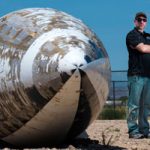
Responders provide technical expertise in case of nuclear weapons accidents
The Accident Response Group provides technical expertise in assessing and safely resolving nuclear weapons accidents or "broken arrows." ARG brings together diverse experts from Sandia and other national labs, each with its own area of expertise. As the nuclear engineering lab, Sandia's focus is on the whole weapon.
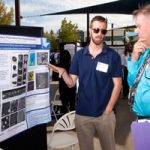
Sandia hosts next generation of nuclear experts
Seven years ago, the NNSA established the Nuclear Science and Security Consortium, a collaboration among universities and national laboratories whose purpose is to train the next generation of nuclear security experts. This year, Sandia/California hosted the group’s fall workshop and advisory board meeting.
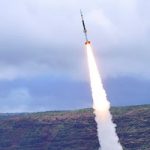
Sandia delivers first DOE sounding rocket program since 1990s
Sandia has developed a new rocket program, called the High Operational Tempo Sounding Rocket Program, or HOT SHOT, and integrated it for its first launch earlier this year under NNSA direction. The new program could help cut research and development time for new weapons systems from as many as 15 years to less than five.
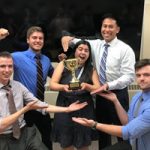
Sandia interns sprint to the challenge
Four intern teams competed for eight weeks this summer in Sandia’s fourth annual Nuclear Weapons Summer Product Realization Institute. During the NW SPRINT, nontraditional teams develop innovative concepts using new technologies, and identify and address gaps in those technologies. It also serves to create a recruiting pipeline.
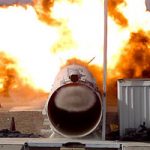
Blast tube tests at Sandia simulate shock wave conditions nuclear weapons could face
Sandia researchers are using a blast tube configurable to 120 feet to demonstrate how well nuclear weapons could survive the shock wave of a blast from an enemy weapon, and to help validate the modeling.