
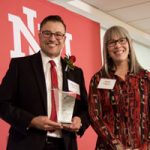
Kenneth Armijo wins UNM Zia award
Sandia mechanical engineer Kenneth Armijo, who leads bilingual family science events by night and researches solar energy and assists small businesses by day, received the prestigious Zia Award from his alma mater, the University of New Mexico.

Sandia helps girls develop a taste for STEM subjects
The 2018 San Joaquin Expanding Your Horizons conference assembled 550 girls in the 6th through 12th grades to encourage interest in science, technology, engineering and math. The girls came from nearby San Joaquin and Stanislaus counties to attend the Sept. 22 conference at the University of the Pacific in Stockton, California.
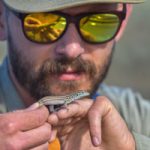
Slithering science
As part of Sandia's ecology program, wildlife biologists set up and check herpetofaunal traps around Sandia lands to gather data on species in the area. The data, combined with other baseline monitoring, are used to to observe long-term habitat changes.
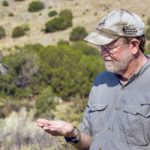
The early biologist catches the bird
Its heart beating rapidly, a wild gray flycatcher sits in the palm of a steady hand, waiting for just the right moment to make its escape. The moment lasts mere seconds, but it’s filled with emotion, from fear to connection to protection. Moments like this don’t happen for most people, but for a handful of biologists in Sandia's ecology program, they do.
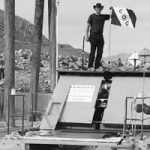
Detecting quark nuggets, a candidate for extreme ball lightning and dark matter
Thirteen years ago, Chief Technology Officer and Vice President of Science and Technology Pace VanDevender retired from Sandia to become an 18th-century style “gentleman physicist.” He wanted to understand two mysteries before he died: puzzling electromagnetic signals observed on the Los Alamos-Sandia FORTE satellite and extreme ball lightning.
Q&A with 2019 Truman Fellows
Sandia will welcome two new Truman Fellows in October. Pauli Kehayias and Thomas O’Connor will join the Labs for the next three years to apply breakthroughs they have made in their respective fields to Sandia applications.
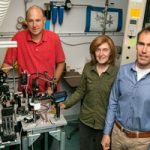
Cracking the code to soot formation
The longstanding mystery of soot formation, which combustion scientists have been trying to explain for decades, appears finally solved, thanks to research led by Sandia.
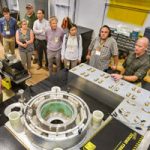
Visitors study physics of Earth, exoplanet minerals under pressure
Sandia’s materials science team has engineered a platinum-gold alloy believed to be the most wear-resistant metal in the world. It’s 100 times more durable than high-strength steel, making it the first alloy in the same class as diamond and sapphire, nature’s most wear-resistant materials.
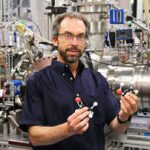
Researchers discover new source of formic acid over Pacific, Indian oceans
Insights from experiments at Sandia designed to push chemical systems far from equilibrium have led an international group of researchers to discover a new major source of formic acid over the Pacific and Indian oceans.
‘Never allow others to place their limits on you’
For 32 years, Sandia’s Black Leadership Committee has brought science, technology, engineering and math to more than 3,000 middle and high school students through the Hands-On, Minds-On Technologies program. And for materials scientist Olivia Underwood, volunteering with HMTech is one way to make a difference in the community.