
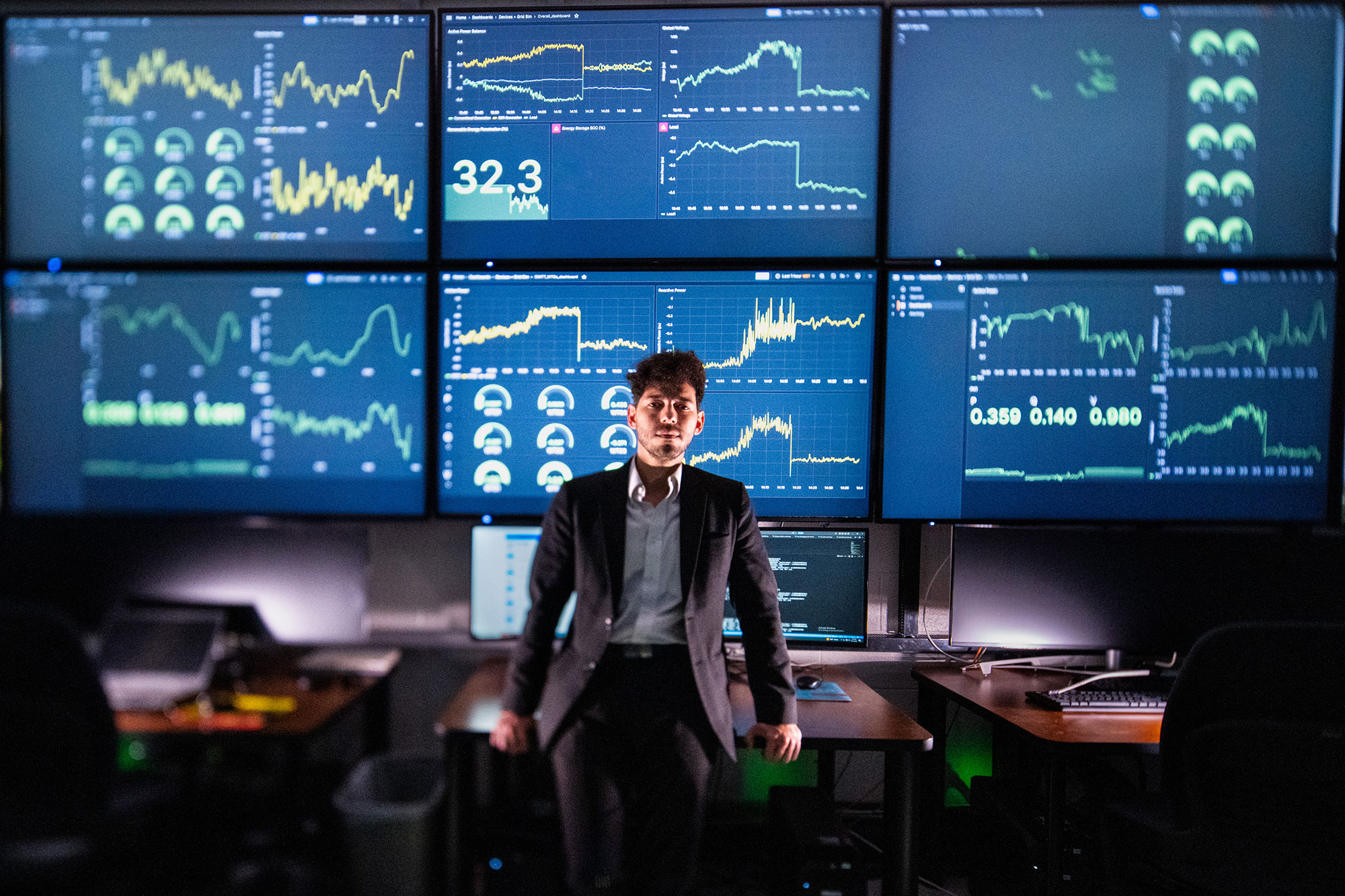
As artificial intelligence drives rapid growth in data centers, utilities are facing a new challenge: keeping voltage steady as electricity demand grows, shifts quickly and becomes harder to predict. As demand grows and more distributed energy resources such as batteries, rooftop solar and backup generators come online, utilities have more moving pieces to coordinate and less margin for error in keeping voltage steady for critical loads.
A Sandia team is working to help manage voltage and support a resilient grid with AI-driven controls that can respond in real time to fluctuations in electricity demand and supply. The work has moved from computer simulation to laboratory testing with real grid hardware and field demonstrations at two sites in Lubbock, Texas. The same approach could be applied to strengthen power resilience for critical defense infrastructure.
“The way we generate electricity and the loads being placed on the grid are evolving, but the backbone of the grid that connects these is staying the same,” Sandia engineer Rachid Darbali-Zamora said. “We need more control to ensure everything can be integrated into the grid in a more reliable manner. A key goal is keeping voltage within operating limits as conditions change from second to second.”
Reliable electric power is also a national security issue, especially for critical infrastructure at home and abroad.
“In scenarios of national conflict or war, adversaries will target energy infrastructure to disrupt both military and civil functions,” senior manager Charlie Hanley said. “The Sandia-developed DERMS system helps to defeat such adversarial attacks through the application of agile and secure technologies that adapt to real-time developments and keep critical systems — and mission functions — operating. Sandia’s deep understanding of related threats, vulnerabilities and mitigations gives us the unique capability to design and test such AI systems in real settings, thereby providing technology solutions to address critical issues of national security.”
While frequency is typically managed at the bulk power system level, distribution grids need fast local voltage regulation to maintain power quality for sensitive loads. For defense and other critical infrastructure, maintaining power quality can be as important as maintaining power itself.
A new kind of grid control for resilience and continuity
Traditionally, utilities manage voltage by installing or upgrading equipment such as capacitor banks and line voltage regulators.
“Those are traditional, conventional devices that are more mechanical — switching on and off,” Rachid said.
Sandia’s approach aims to provide more continuous, coordinated voltage support by using hardware and capabilities already built into many grid-connected devices. Those devices include inverters, which connect resources such as solar panels and batteries to the electric grid to provide steadier voltage and improved power quality. By coordinating many devices at once, the controller can respond quickly to disturbances, including those caused by deliberate disruption of energy infrastructure.
“To provide these services, we’re leveraging inverters that are already in the grid,” he said. “That means the utility doesn’t have to make as many upgrades. It can also reduce reliance on slower, mechanical switching when the grid is under stress.”
The software platform is a distributed energy resource management system, or DERMS, which forecasts changes in electricity use and available power, coordinates grid-connected devices and automatically responds to disturbances to support a more resilient grid. AI helps the controller coordinate device actions in near real time while respecting equipment limits and operating constraints.
“Our team wanted to deliver something that is powerful and intelligent, but also realistic for utilities to adopt,” Rachid said. “AI helps us make sense of all the moving pieces on a modern distribution grid and do it in real time.”
Testing AI controls against real-world disturbances at Sandia’s Distributed Energy Technologies Laboratory
Rachid said the team started with a basic premise: One-size-fits-all grid controls don’t work everywhere.
“Every location is unique,” he said, with different hazards, critical services and mixes of grid-connected resources.
To create a controller that can coordinate devices and adapt to local needs, the researchers first built and tested their approach in simulation before validating it with real hardware.
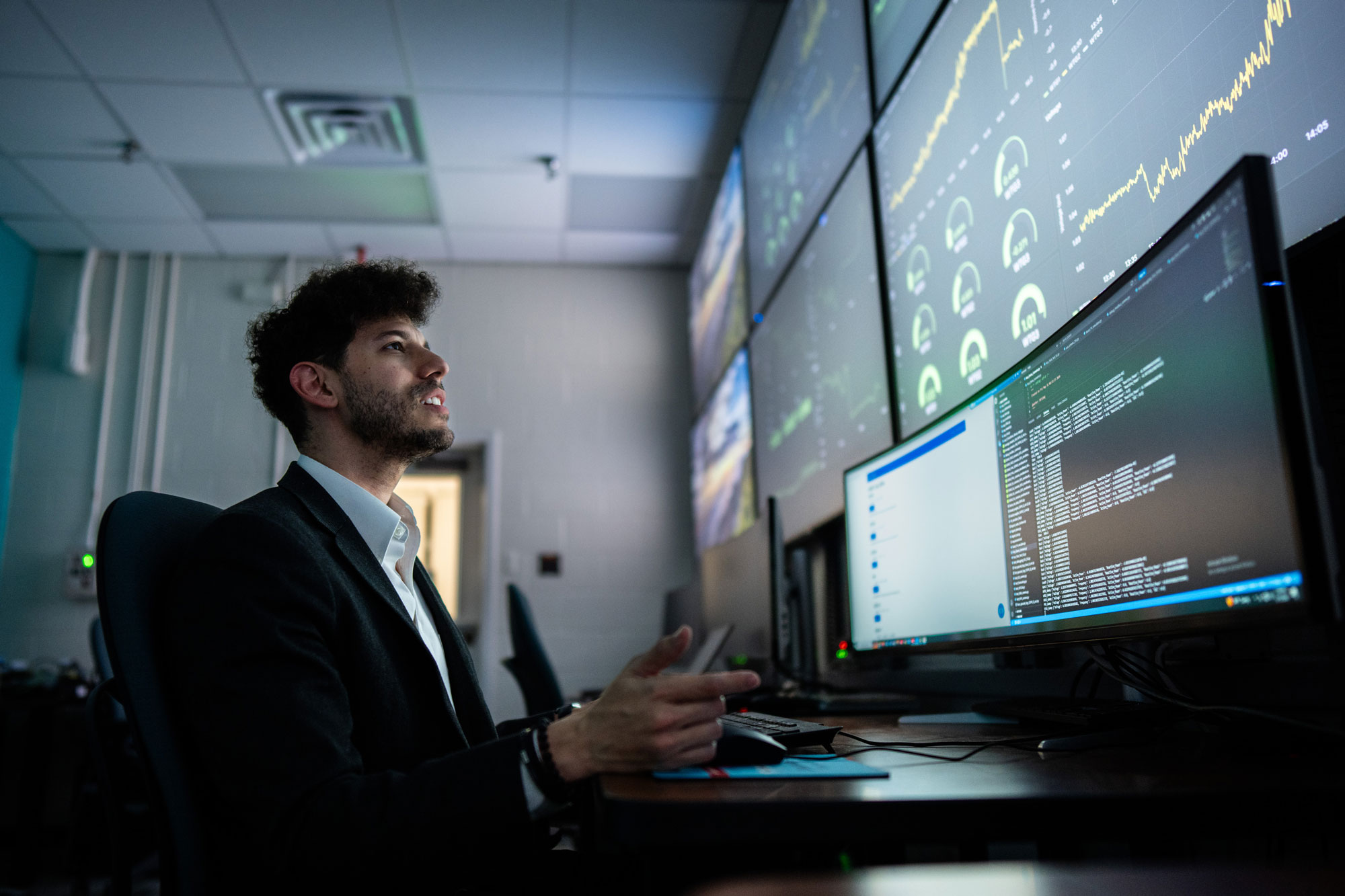
The next step took place at Sandia’s Distributed Energy Technologies Laboratory using a method called power hardware-in-the-loop, or PHIL. This method lets researchers connect real grid equipment, such as commercial power inverters and battery hardware, to a real-time grid simulation. The setup makes it possible to test how control software performs under realistic conditions without connecting to the actual electric grid. This kind of test-and-iterate validation is especially important for national security applications, where controls may need to perform through rapidly changing conditions and adversarial disruptions.
In the lab experiments, the team linked the AI-driven controls to commercial inverter hardware and other
grid-connected devices while a digital real-time simulator created changing grid conditions. This enabled researchers to evaluate how quickly the controller could respond to rapid shifts and disturbances, including the kind of voltage swings utilities work to prevent. The tests also challenged the controller with fast-changing scenarios so the AI could update coordinated setpoints as conditions evolved.
The lab tests served as a reality check before field deployment. Rachid said computer simulations can miss communication issues that show up when software exchanges data with real equipment.
“Simulations capture dynamics, but they don’t really capture, for example, communication challenges,” he said.
By testing with real hardware in the loop, the team could see whether the controller still performed well when messages arrived late or data links slowed.
“These experiments were critical,” Sandia researcher Jon Berg said. “They allowed us to evaluate how the system behaves with real hardware, not just models. That gives us and our partners confidence that the technology is ready for real-world deployment.”
From lab to field demonstrations
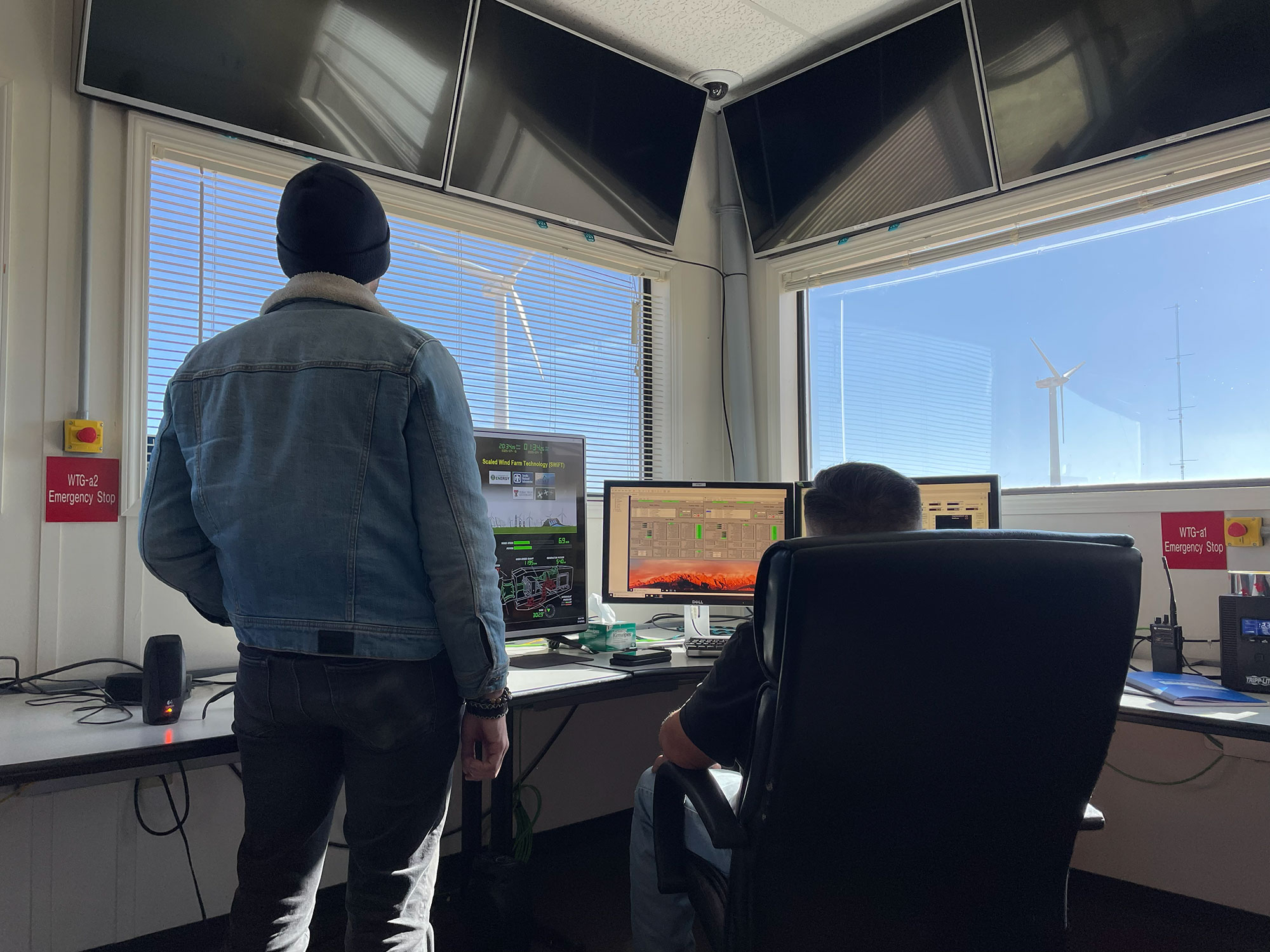
After validating the controls in the lab, the team tested the system at two sites in Lubbock: Sandia’s Scaled Wind Farm Technology facility, known as SWiFT, and the Texas Tech University GLEAMM microgrid.
At SWiFT, the researchers connected the DERMS controls to operating equipment to see how the controller performed under real-world conditions as system conditions changed. Demonstrating performance on operating equipment helps build confidence for future use at mission-critical sites that cannot tolerate extended downtime.
The team then deployed the software platform at the GLEAMM microgrid, which includes a data center. There, the controller coordinated grid-connected devices in real time to help keep voltage steadier and maintain power quality for critical loads.
(Photo by Craig Fritz)
To measure impact, the team ran side-by-side field tests with the controller turned on and off.
“We ran an entire day with the controller and an entire day without the controller,” Rachid said. “When you compare the voltage graphs from those two, you can visually see that the voltage in the system is improved with the DERMS controller.”
At the site, voltage typically runs about 5% above normal, and the coordinated controls helped bring it closer to the value utilities aim to maintain.
For utilities and microgrid operators, that kind of control could help manage a more complex distribution grid without relying only on slower mechanical equipment or major infrastructure upgrades. For national security purposes, it can also provide an additional layer of resilience by enabling agile response as conditions evolve during an emergency or deliberate attack.
“These demonstrations prove that AI can meaningfully improve how microgrids and distributed resources operate,” Sandia researcher Miguel Jimenez-Aparicio said. “The field data reinforces what we observed in PHIL testing. This technology can deliver real benefits to utilities, communities and critical infrastructure.”
Accelerating the path to deployment with Energy I-Corps
Now that DERMS has been tested successfully in the lab and demonstrated in the field, the team is also working to move the software toward real-world use.
The project was selected for the DOE Energy I-Corps Phase II program, which connects researchers with potential users to better understand operational needs and identify features that would make the tools practical to deploy.
Through interviews with utilities, microgrid developers and industry partners, the team gathered feedback on what organizations need most: tools that make it easier to coordinate grid-connected devices and integrate new equipment without adding major operational burdens.
Building on that progress, the project was recently accepted into Energy I-Corps Phase III, a competitive follow-on effort aimed at accelerating commercialization and supporting additional field deployments with partners.
“Our Energy I-Corps experience made the impact of this work even clearer,” Sandia researcher Jorge Leon-Quiroga said. “Utilities want solutions to complex problems using intelligent tools. By pairing Sandia’s technical capabilities with customer insights, we’re positioning this technology to make a meaningful difference in the evolving energy landscape.”
The work also reflects what the DOE’s Genesis Mission is designed to accomplish: apply AI to tackle the nation’s most complex science and technology challenges. By combining AI-enabled coordination, hardware-in-the-loop validation and field demonstrations, the team is expanding a repeatable capability for designing and testing agile grid controls that can help defeat disruptions and keep critical systems operating.