
DOE funding will support new analytical tools to evaluate safety, safeguards and production challenges for next-generation reactor fuels
Sandia has been selected for $3.38 million in DOE funding to develop analytical tools that could help advance the production and deployment of nuclear fuels for next-generation reactors.
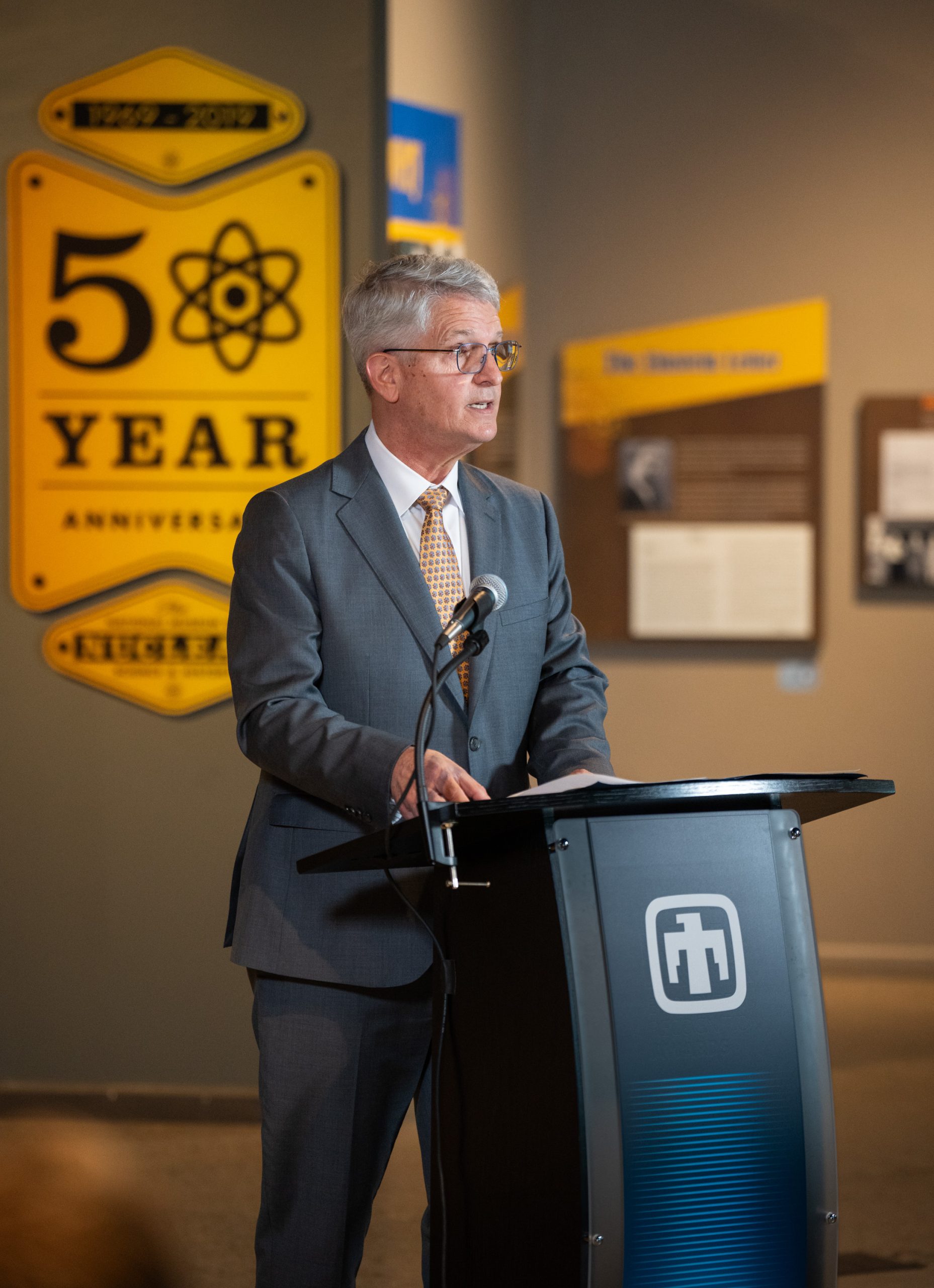
DOE’s Under Secretary for Nuclear Security and NNSA Administrator Brandon Williams recognized the selection Oct. 30 during a news conference at Albuquerque’s National Museum of Nuclear Science & History, joined by Sandia Deputy Laboratories Director for Integrated Security Missions Deborah Frincke.
Sandia’s selection is among eight projects announced under DOE’s High-performance Optimized Recycled Nuclear Isotopes for Gen IV reactors, or HORNIG, program, which provides up to $50 million to advance next-generation nuclear fuels. The program is administered by DOE’s Advanced Research Projects Agency-Energy, known as ARPA-E.
“Sandia National Laboratories has a long history of solving some of our nation’s toughest technical challenges, and its expertise will be essential to advancing America’s nuclear renaissance,” Williams said. “This investment will build on Sandia’s capabilities to help fuel developers overcome the barriers to commercial-scale manufacturing and turn promising nuclear fuel technologies into practical solutions. It’s exactly the kind of partnership we need to strengthen America’s energy security, accelerate advanced nuclear deployment, and deliver on President Trump’s vision for American energy dominance.”
Sandia’s project, Transuranic Reactor-fuel Pathways for Sociotechnical Analysis, Technoeconomics, and Harmonization, known as TRU-PATH, will develop an analytical platform to evaluate safety, nuclear safeguards and other considerations associated with scaling up production of advanced reactor fuels.
The research will help fuel developers identify technical requirements, economic considerations and other constraints that could affect manufacturing and deploying these fuels on a commercial scale.
While some HORNIG projects will focus on aspects of fuel design, fabrication, testing and qualification, Sandia’s work will examine the broader considerations involved in bringing these emerging fuel technologies toward practical application.
“This project is purpose-driven to look at what brings the nation the safest and most secure energy solutions,” Deborah said. “Sandia’s role focuses on designing a safety and security framework for recycling transuranic fuel and leverages our long history of nuclear research.”
Through the TRU-PATH project, Sandia researchers will support efforts to better understand how advanced nuclear fuels could be produced and deployed safely and securely. The work contributes to broader DOE efforts to advance nuclear energy technologies and strengthen domestic nuclear fuel capabilities.