Search

Results 1–25 of 243

2020 Rising Stars Workshop Supports Women in Computational & Data Sciences

News Article, January 1, 2021 • Rising Stars in Computational & Data Sciences is an intensive academic and research career workshop series for women graduate students and postdocs. Co-organized by Sandia and UT-Austin’s Oden Institute for Computational Engineering & Sciences, Rising Stars brings together top women PhD students and postdocs for technical talks, panels, and networking...

Rising 2020 Stars

Advanced Computing Systems

Research Area • The CCR has a legacy of leadership in high-performance computing (HPC) at extreme scales. First-of-a-kind platforms, such as the Intel Paragon, ASCI Red (the world’s first teraflops computer), and Red Storm (co-developed by Cray), helped form the basis for one of the most successful supercomputer product lines ever—the Cray XT...

Advanced Memory Technology (AMT)

Project • Under the Advanced Simulation and Computing (ASC) program, computer simulation capabilities are developed to analyze and predict the performance, safety, and reliability of nuclear weapons and to certify their functionality. Historically, the performance of many critical NNSA mission applications have been limited by memory bandwidth and latency. Memory bandwidth has...

Advanced Tri-lab Software Environment (ATSE)

Project • The Advanced Tri-lab Software Environment (ATSE) is an integrated software environment that provides a software ecosystem for leading-edge prototype high-performance computing (HPC) systems. By leveraging vendor software alongside open-source software throughout the stack, ATSE continually pushes forward the computing environment experience for the Advanced Simulation and Computing (ASC) program on...
ATSE program logo

AGILE

Project • The AGILE program aims to achieve significant performance advancements for large-scale data-analytic applications, as well as other classes of data intensive applications. The program seeks to develop new, innovative, energy-efficient, and reliable computer architectures. A fundamental challenge in today’s computer systems is that they struggle to efficiently handle sparse and...

Albany

Project • Albany is an implicit, unstructured grid, finite element code for the solution and analysis of partial differential equations. Albany is the main demonstration application of the AgileComponents software development strategy at Sandia. It is a PDE code that strives to be built almost entirely from functionality contained within reusable libraries (such...

Alegra

Project • The ALEGRA application is targeted at the simulation of high strain rate, magnetohydrodynamic, electromechanic and high energy density physics phenomena for the U.S. defense and energy programs. Research and development in advanced methods, including code frameworks, large scale inline meshing, multiscale lagrangian hydrodynamics, resistive magnetohydrodynamic methods, material interface reconstruction, and code...

Alina Kononov

Staff Page • Quantum Computer Science. Alina develops and applies cutting-edge methods to model excited electron dynamics in materials. Her current projects involve advancing modeling capabilities for warm dense matter and exploring prospects of early fault-tolerant quantum computing for simulating excited electrons. Previously, her doctoral research focused on first-principles modeling of ion-irradiated surfaces...
Alina Kononov

Allen C. Robinson

Staff Page • Computational Multiphysics. Biography Dr. Allen C. Robinson is a distinguished member of the technical staff at Sandia National Laboratories. Since starting work at Sandia in 1983 his interests have included shaped charge modeling and subsonic jet flow, Rayleigh-Taylor instability in solids and parallel computing for shock physics modeling. He has...

Amelia Henriksen

Staff Page • Senior Member of the Technical Staff. Biography I am a senior member of the technical staff in the machine intelligence and visualization department here at Sandia National Labs. I received my PhD in Computational Science, Engineering and Math from UT Austin in 2021 and went straight to Sandia as the...
Picture of Dr. Amelia Henriksen

Andrew G. Salinger

Staff Page • Computational Sciences & Math. Biography My research involves the integration of technologies to build application codes for the solution and analysis of systems governed by partial differential equations. Currently, my main focus is promoting the software modernization of E3SM, DOE's Earth system model, to improve the quality of the model...

Andrew J Younge

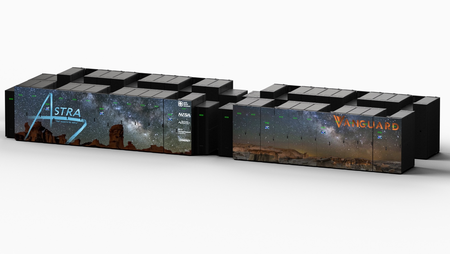
Staff Page • Scalable Computer Architecture. Biography Andrew J. Younge is the R&D Manager of the Scalable Computer Architectures department at Sandia National Laboratories. His research interests include high performance computing, virtualization & containers, distributed systems, and energy efficient computing. Andrew currently serves as the PM of Sandia's Vanguard program and contributor to Astra, the...
Andrew J Younge

Anh Tran

Staff Page • Scientific Machine Learning. Biography Anh Tran joined Sandia National Laboratories (Albuquerque, NM) as a postdoctoral appointee in January 2019 and became a staff member at the Center of Computing Research since September 2020. He has worked at the Uncertainty Quantification and Optimization department, as well as the Scientific Machine Learning...
Image of Anh Tran

Ann Speed

Staff Page • Cognitive & Emerging Computing. Biography I have been doing research on how to make analysts more effective for several years - mostly in the visual search domain by conducting human subjects experiments in what I call "near operational" environments. I'm also increasingly interested in the overlap, and gap, between laboratory-based...

Anthony Gruber

Staff Page • John von Neumann Fellow. Biography I am a mathematician interested in basic and applied research questions that arise in the contexts of data science, nonlinear partial differential equations, and scientific machine learning.  Lately, my focuses are primarily on (1) developing structure-informed surrogate models for the efficient approximation of large-scale systems,...

ASCEND

Project • ASCEND (Applied mathematics and Scientific Computing Ecosystem for the New Digital era) is a portfolio of projects funding by the DOE, Office of Science, Advanced Scientific Computing Research (ASCR) program, that consists of research and development in computational and applied mathematics seeking to address foundational research gaps in the digital...

Astra – An Arm-Based Large-Scale Advanced Architecture Prototype Platform

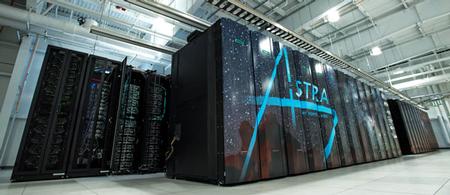
News Article, June 1, 2018 • Astra, one of the first supercomputers to use processors based on the Arm architecture in a large-scale high-performance computing platform, is being deployed at Sandia National Laboratories.  Astra is the first of a potential series of advanced architecture prototype platforms, which will be deployed as part of the Vanguard program...
Astra Supercomputer

Astra Supercomputer is Fastest Arm-Based Machine on Top 500 List

News Article, November 1, 2018 • Sandia’s Astra is the world’s fastest Arm-based supercomputer according to the just released TOP500 list, the supercomputer industry’s standard. With a speed of 1.529 petaflops, Astra placed 203rd on a ranking of top computers announced at SC18, the International Conference for High Performance Computing, Networking, Storage, and Analysis, in Dallas. A petaflop is a unit...
Astra Supercomputer

Astra Supercomputer Team Wins NNSA Defense Programs Award of Excellence

News Article, October 1, 2019 • The Astra Supercomputer Team was recently awarded an NNSA Defense Programs Award of Excellence “For excellence in design, acquisition, and integration of the Astra prototype System.” These prestigious annual awards are granted to National Security Enterprise teams and individuals across the NNSA complex to recognize significant contributions to the Stockpile...
NNSA Defense Programs - Awards of Excellence

Automated Ensemble Analysis in Support of Nuclear Deterrence Programs

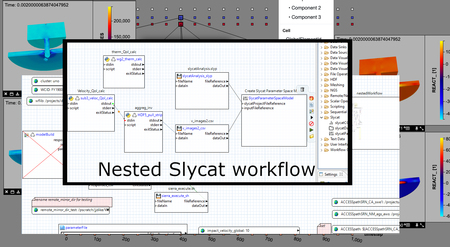
News Article, June 1, 2021 • Managing the modeling-simulation-analysis workflows that provide the basis for Sandia’s Nuclear Deterrence programs is a requirement for assuring verifiable, documented, and reproducible results. The Sandia Analysis Workbench (SAW) has now been extended to provide workflow management through the final tasks of ensemble analysis using Sandia’s Slycat framework. This new capability...
An unsupervised ensemble analysis sub-workflow sits atop a larger NGW computational simulation workflow. In the background, a solid mechanics parameter study is being analyzed in Slycat.