
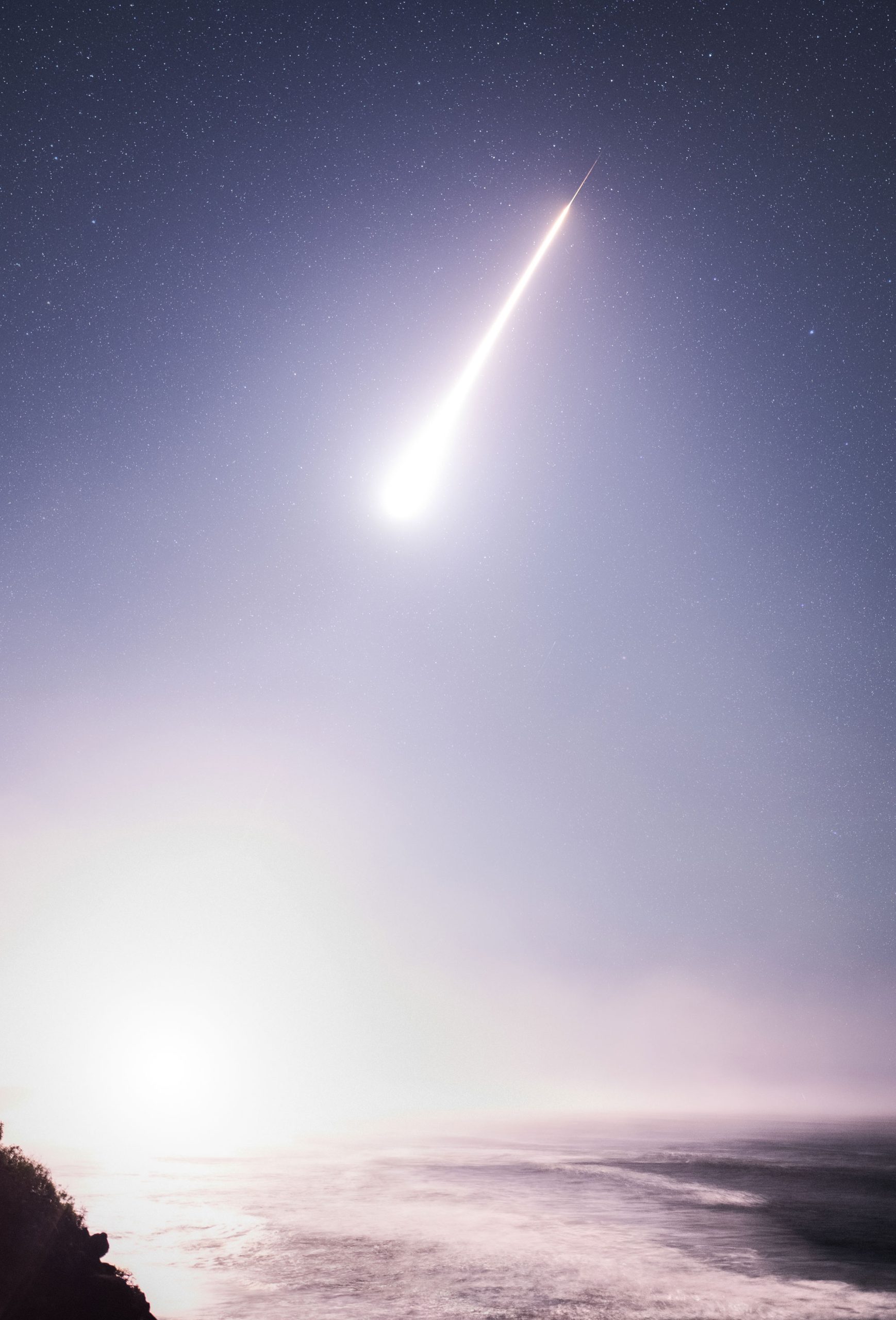
A sounding rocket flight test is giving Sandia engineers real-world reentry vibration data they can use to improve modeling and help drive nonnuclear component designs for the United States’ first new nuclear weapon under development in nearly 30 years.
“The Atrax sounding rocket flight test is helping us improve credibility and confidence in our modeling and simulation tools in preparation for the W93 warhead,” Sandia aerospace engineer Ross Wagnild said. “Getting confidence in our toolset earlier allows more time to inform the design of components.”
Engineers and scientists are developing the W93 warhead for the sea-based leg of the triad, alongside a reentry vehicle that safeguards and carries the warhead to its target.
Sounding rockets are suborbital vehicles used to carry experiments and instruments, allowing researchers to collect data in flight without the scope of a full program test. In Atrax, the goal was to measure reentry conditions, where aerodynamic forces and structural response can interact in complex ways and are difficult to replicate on the ground.
Challenging environments
“Vibration during reentry is a mechanical environment challenging to some of our components,” said Peter Coffin, an engineer who analyzes structural dynamics. “This test helps us understand our models so that we can better predict those environments as we move forward on new vehicles.”
The test measured the environment, providing significant data and removing unknowns and uncertainties in areas such as aerodynamic loads that drive internal mechanical vibration.
The characterization of these flight environments leveraged modeling and simulation capabilities that have been under development within NNSA’s Advanced Simulation and Computing program and experimental ground test and diagnostics development capabilities funded by NNSA’s Engineering and Technology Maturation program.
“There are a number of different physics that happen in a series that get us from launching a rocket off the ground toward a target and then the system actually functioning at the target,” Ross said. “We model those various physics in a reentry environment.”
Design decisions
With flight data now in hand, scientists and engineers do not have to rely on estimates to feed into the models.
“The goal is to help us better evaluate the survivability of nonnuclear components of our weapon systems,” Ross said.
Scientists and engineers will use the Atrax dataset to inform design decisions earlier in development, when changes are easier to make and less costly.
“If you understand what your environments are earlier, you can more precisely design your components,” said Kelsey Forsberg, who works in nuclear deterrence. “You can design components to the right environment.”
Setting the stage
Kelsey said NNSA investments in programs like High Operational Tempo Shot and the Enzo demonstrator helped pave the way for the Atrax test.
“Those programs are enabling transformative improvements and reducing risk to the W93 program,” Kelsey said.
Atrax also helped close data gaps before system architecture development, which can reduce overall risk to the program. The Atrax flight test happened about two years before the first scheduled flight test for the W93.
Testing priority
The Atrax test was completed quickly, within about 18 months of being funded, in part because it did not need to mirror the final fielded system.
“The system we flew for this test didn’t have to look like the system we’re intending to field,” Kelsey said. “We focused on relevant reentry vehicle characteristics to cut down the timeline to get the test done.”
A sounding rocket test differs from a regular program flight test because the goal is to collect environmental data, without as much emphasis on the precision or accuracy of the reentry vehicle.
Suite of sensors
Engineers outfitted the reentry vehicle with cutting-edge sensors to characterize the external aerodynamic loads, which differs from typical tests that field only internal vibration sensors.
Engineers said the instrumentation worked. Now they have a dataset that they can break apart to see how the codes are performing. For example, they can compare thermal, fluid and structural models to better understand where improvements might be needed.
The team also incorporated other technologies into this test, including a new reentry vehicle, a three-stage sounding rocket and a new separation system. Those additions introduced technical challenges for both a successful flight and capturing usable data.
“It demonstrated that it worked,” Peter said. “It gave us good data without damaging the reentry vehicle.”
The team credited its success to the many people across Sandia who worked on and supported the Atrax test.
In addition to the W93, Ross said the Atrax test will provide the broader hypersonic community with data that could improve hypersonics modeling and build confidence in modern sensor suites for other hypersonic vehicles.
Sandia is the design agency for the W93’s nonnuclear components and the lead warhead systems integrator for nuclear weapons programs.