
Mobile Guardian Transporter crash test provides critical data
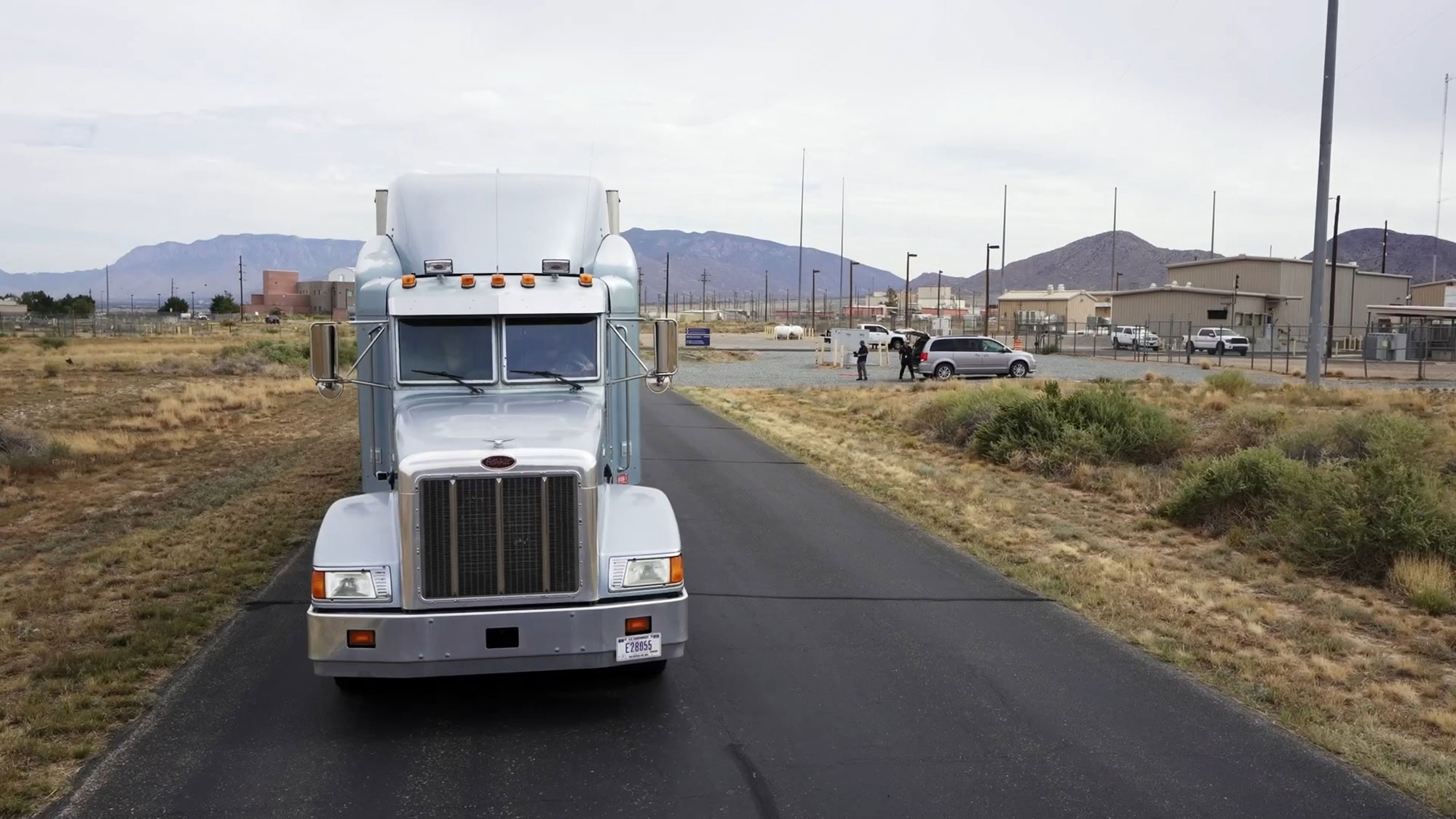
With rockets propelling it down Sandia’s sled track, a semitrailer loaded with mock nuclear weapons slammed into a barrier. It took mere moments to complete the second and final full-scale crash test of the Mobile Guardian Transporter, a next-generation system that will carry nuclear weapons and other sensitive materials for the DOE’s Office of Secure Transportation.
The tests are designed to demonstrate that, if a trailer were ever involved in an accident on a public road, the cargo inside would remain secure and pose no danger to nearby communities, a key tenet to the Office of Secure Transportation mission and vision.
“This was our last opportunity to understand how the trailer performs in a crash,” said Jason Berger, the program’s crash test lead for the second test asset. “The results will help qualify the design, a critical step before production can begin.”
Sandia conducted a side-impact crash that evaluated the first Mobile Guardian Transporter test asset in 2020. The second test completes the full-scale crash series and gives engineers a more complete picture of how the trailer performs in severe accidents.
“The second prototype crash test is a critical step in showing that the trailer and its cargo do not pose a hazard to the public,” Jason said.
“We are extremely proud of the commitment and dedication of teams across Sandia and our external partners, who applied their knowledge to make this a successful test,” said Kelly Neely, the senior manager overseeing the Mobile Guardian Transporter program. “It’s taken focus, determination and technical expertise to get us to this point.”
Test planning and execution
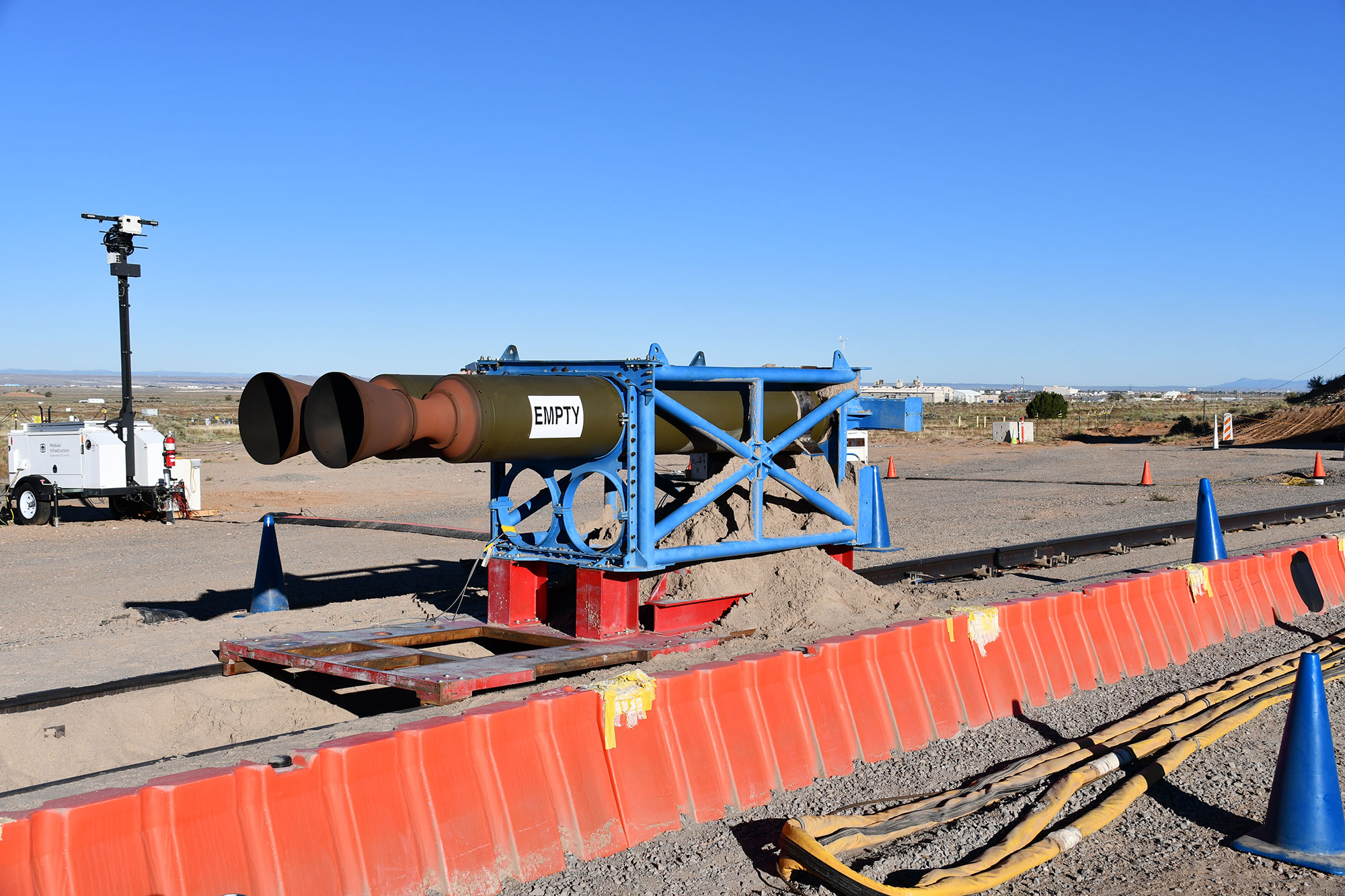
While the test itself lasted only a few moments, planning and preparation took about a year and a half. For a test of this scope, that’s not very long.
“This was a very heavily instrumented test and the overall scope of it was very large,” said James Dykes, the test director. “These kinds of large-scale, high-consequence tests don’t come along very often because of the complexity. It was the largest data collection effort in the history of Sandia’s rocket sled track facility.”
A test with 100 channels of data collection and a few cameras would already be considered complex. In this test, the trailer was equipped with nearly 500 data channels for acceleration, strain, force and temperature, plus about three dozen cameras, when rockets propelled it down Sandia’s sled track in the fall 2025.
As part of the planning process, the team created redundant pathways and backup channels to ensure they could capture the most critical data if some equipment failed.
“With this test, we’ve gone beyond the bounds of what is understood commercially and inside Sandia for data collection and acquisition,” Jason said. “To accomplish this, Sandia’s sled track test team stood up a temporary multiacre facility with a control center, data collection trailers and console trailers near the sled track. Working at a remote, undeveloped site introduced many challenges. Strong monsoon storms caused flooding at the sled track multiple times, but the teams worked through these challenges to ensure the test occurred on schedule.”
Impact on weapons programs
Several nuclear weapons modernization and stockpile programs provided hardware for the test, including Los Alamos and Lawrence Livermore national laboratories. These systems represent different types of nuclear weapons that must be transported.
“Nuclear deterrence programs need to assess safe and secure transportation for each weapon type,” said Tara Olivier, a Sandia senior manager working in nuclear deterrence. “Gathering the environmental data from the crash will help qualify those systems on the Mobile Guardian Transporter.”
Test coordination
With so many partners, a large task in test planning was getting everyone on the same page.
“It’s a huge effort to coordinate all of the teams, and then to ensure we’re doing the right test and collecting the right data,” Jason said.
As part of the test, the trailer, restraints and the shipping containers for the weapon systems were pushed to their limits. Capturing the right data was essential for understanding how this hardware performed and for supporting future design qualification.
Validating the models
With the test complete, the team is now focused on analyzing the data.
“We met all our testing objectives, including the speed at which the trailer crashed. We’re where we wanted to be with data acquisition and collection,” James said.
The Mobile Guardian Transporter team will continue working closely with modeling and simulation teams to compare the test results with pretest predictions and refine their computer models.
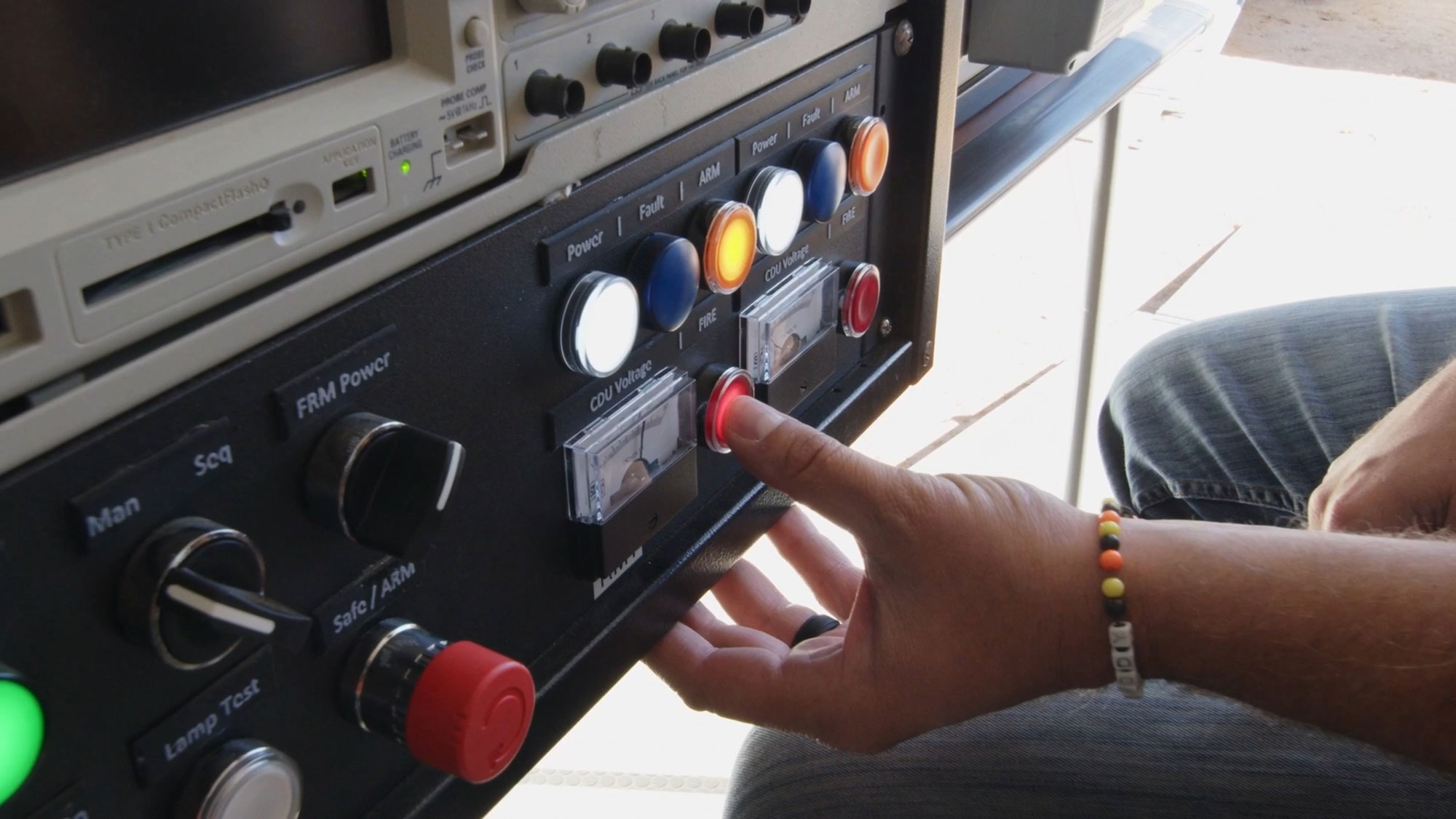
“Using the crash test data, we’ll build a modeling and simulation tool that will allow us to analyze many different crash environments,” Jason said. “The modeling and simulation tool will be our enduring tool to assess trailer performance, assess safety of our weapons systems during transport, and assess nuclear safety of the trailer.”
Key partnerships
Strong partnerships across the nation’s nuclear security enterprise were essential to executing a successful test.
“Executing this crash test is a shining example of Sandia integration and what we can do,” Jason said. “Large-scale systems-of-systems tests involve many stakeholders and, specific to the crash test, it was critical that the Office of Secure Transportation, NNSA and Sandia, Los Alamos and Lawrence Livermore national labs were all in lockstep for funding, delivery of test hardware on schedule and development of a complex technical basis and data collection design.”
At Sandia, the design agency for Office of Secure Transportation’s Mobile Guardian Transporter and the lead systems integrator for nuclear weapons programs, about 200 employees worked on the test.
“Completing the crash test for the Mobile Guardian Transporter is a significant accomplishment, thanks to the dedication and commitment of many Sandians and our exceptional partners,” Labs Director Laura McGill said. “Safe and secure transport is a key element of maintaining a credible deterrent.”
The Kansas City National Security Campus’s New Mexico Operations location is the production agency for the Mobile Guardian Transporter. The crash test data will help inform final design decisions and support future production of the new transporter fleet.