
The electric grid is the backbone of our nation’s critical infrastructure, powering everything from hospitals and military installations to communication networks and water systems.
Yet, as the nation faces unprecedented cyber, physical and natural threats, the grid’s vulnerabilities have never been more apparent or dangerous.
“The U.S. grid has been under consistently growing risk of attack since 2010 — particularly cyber and kinetic attacks,” said Alex Haddad, manager of the Resilient Energy Systems Mission Campaign.
The RES Mission Campaign is a seven-year, $50 million investment through Sandia’s Laboratory Directed Research and Development program. The mission campaign is focused on coordinated foundational research and development to secure the grid from intentional attacks that could cripple the nation. Science and technologies that the mission campaign produces will help create an energy infrastructure that is more resilient to intentional threats.
“Over the last few decades, utilities have been digitizing the grid,” Alex said. “These rapid changes have made it more vulnerable to cyberattacks. We now must balance that vulnerability with the need for increasing demand. We, as a nation, are having to address existing issues and think about future ramifications, impacts, load needs and risks.”
Creating resilience with a systems approach
In an era marked by strategic global competition and growing threats, securing the electric grid is critical to national security. The RES Mission Campaign leverages deep expertise, cross-disciplinary collaboration and proactive threat anticipation to ensure the nation’s energy infrastructure remains robust, reliable and resilient.
“The goal is to prepare the U.S. to have a resilient system that handles a plethora of threats,” said Brian Pierre, manager of the Electric Power Systems Research department. “The campaign explores the spatial and temporal threat landscape, from threat characterization to impact on energy systems, to development of novel components and systems to reduce impact, to better modeling and understanding the consequences, to optimizing the recovery to restore critical infrastructure quickly.”
Resilient energy systems are defined by their ability to prepare for, adapt to and rapidly recover from disruptions. By integrating these research efforts, the campaign creates a cohesive set of capabilities that industry and federal agencies can use to effectively address threats and enhance overall energy resilience.
“Resilience is a very complex subject which cannot be measured and assessed directly, partly because it is situational, and also because it means different things to different people,” said Charles Hanley, senior manager of Electric Grid Security Programs. “A systems approach addresses this complexity by identifying metrics for particular scenarios in which resilience can be addressed and optimizing for the best ways to meet related needs.”
The work goes beyond technological development. It offers a systems-level perspective that recognizes how cyber events, physical disturbances, control actions, operator decisions and AI-driven analytics intersect.
“A research-and-systems approach is critical for building a truly cohesive resilience framework because energy systems do not fail, recover or get attacked in isolated ways,” said George Fragkos, a researcher with the campaign.
Identifying and addressing threats
The mission campaign research is organized around key areas that address fundamental questions related to the resilience of the U.S. electrical energy system.
“Our main areas of research focus include cyber-physical, kinetic attacks and electromagnetic pulse,” Alex said. “These areas address the most profound intentional threats to grid resilience and security.”
Cyber-physical
(Photo by Bret Latter)
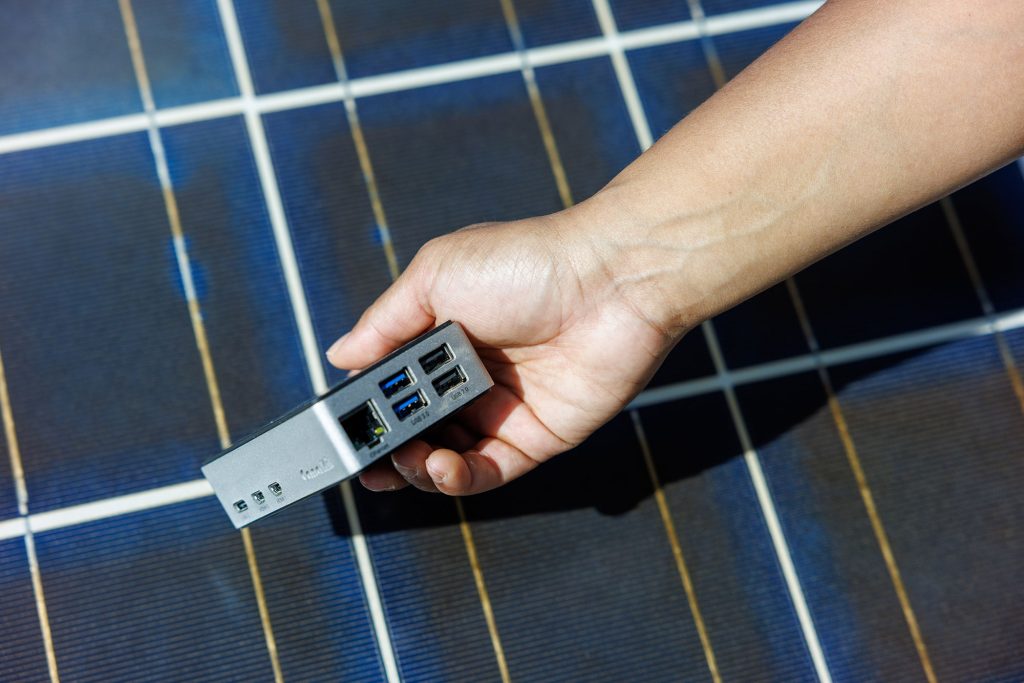
Cyber-physical work focuses on protecting the grid by supporting interoperable monitoring and defense capabilities to increase cyber-physical situational awareness across legacy and modern power systems. The ability to monitor the entire system also enables real-time detection and coordinated response to events.
“Energy systems are inherently cyber-physical and interconnected,” said Shamina Hossain-McKenzie, a researcher for the campaign. “Thus, it is important that the tools used to operate and secure these systems are integrated to achieve a more cohesive resilience framework that achieves cyber-physical situational awareness. This resilience framework can then be used not only to respond to disturbances or attacks but also find ways to plan and operate the system more efficiently.”
The scalable modeling, analysis and control tools equip utilities and industry with rigorous, quantifiable methods to enhance the planning and operation of the power grid, enabling them to better anticipate, withstand and recover from disruptions. Most notably, the cyber-physical vulnerability toolset — designed to meet utility needs and adaptable by commercial manufacturers — identifies critical vulnerabilities and supports proactive risk management and mitigation strategies.
“RES advances new ways to understand the cyber-physical behavior, interdependencies and vulnerabilities by combining cutting-edge AI, cybersecurity and power system analytics to strengthen the resilience of critical infrastructure,” George said.
Kinetic attacks

The mission campaign’s kinetic work focuses on ways to incorporate advanced technologies and mitigation of vulnerabilities for power distribution systems, including solid-state transformers. By hardening the grid to potential attacks and understanding how solid-state transformers impact the larger grid system, the team can predict robustness and flexibility against both physical and cyber threats.
“The work on solid-state transformers is planting the seed for new U.S. industrial opportunities that will enhance grid stability, reliability and resilience while growing a U.S.-sourced industry,” Charles said.
Electromagnetic pulses
The mission campaign team is also identifying solutions that protect the grid from electromagnetic pulses and coordinate a response to potential events caused by them. Among these innovations is a new, faster E1 Arrestor technology, a critical advancement in protecting the grid from electromagnetic pulses, which can cause widespread and long-lasting damage.
Together, these products create a comprehensive framework that strengthens the nation’s energy infrastructure against evolving and urgent threats, ensuring reliable and secure power delivery.
“While the risk of an EMP attack is slightly less than cyber or kinetic, the potential for complete nationwide disruption is significant,” Alex said.
Powerful partnerships
Mission campaign efforts have already yielded significant outcomes, including 140 peer-reviewed publications, 25 technical advances and a robust patent portfolio, including 10 provisional and 9 nonprovisional applications. These achievements underscore the campaign’s commitment to translating research into real-world solutions that protect the nation’s energy future.
“The thing that makes our mission campaign so unique is our many stakeholder partnerships — academic, industry, utilities, government and others — that ensure we are creating products that fill critical needs today,” Alex said. “With the stakes higher than ever, the nation cannot afford to delay. Modernizing the grid is essential to keeping the lights on and keeping us safe.”