
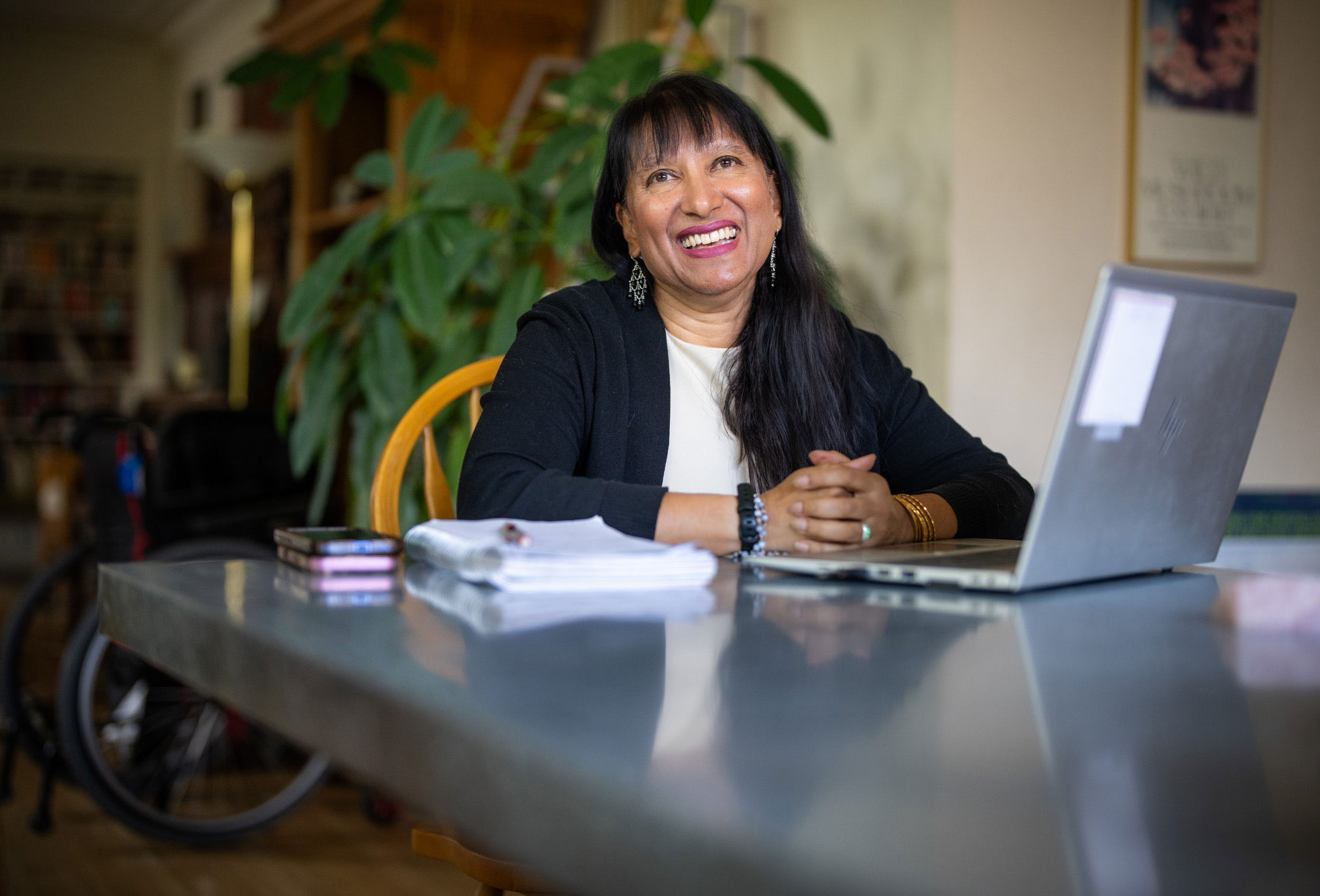
Rekha Rao thrives on solving complex scientific problems. She’s been doing it to help Sandia meet the nation’s needs for 35 years.
This year, her work earned her dual recognitions, as she was elected a fellow of two professional societies: the Society of Rheology and the International Association for Computational Mechanics.
She is the first Sandian to ever be elected a fellow of the IACM. She is also the first woman to serve as president of the U.S. Association for Computational Mechanics.
Rekha accepted her IACM fellowship at the World Congress on Computational Mechanics in Munich, Germany, in July. The event brought 5,000 researchers together from around the world.
“Being the first Sandia fellow at IACM and getting international recognition was just really amazing,” Rekha said. “Especially because this is not only for my service but also for my technical achievements.”
Rekha will receive her fellowship recognition from the Society of Rheology in late October.
How she started
Rekha discovered her passion for research and problem-solving during her undergraduate studies at the University of California, Berkeley.
“I saw a talk on using molecular dynamics to predict material properties such as viscosity,” Rekha said. “It was magical how mathematical equations could be used to predict physical properties given the correct numerical algorithm. I found it fascinating and wanted to learn more.”
Rekha went on to hone her skills in graduate school.
“I had several projects to choose from. One was a computational project in polymer flow modeling. I jumped at the chance to join the project,” Rekha said.
“I knew some programming from coursework, but I was a terrible typist and a mediocre programmer. Graduate school taught me about numerical methods, computers, large finite element codes, adaptive remeshing and how to type faster. I have been using what I learned in graduate school my entire career.”
An enduring career
That entire career has been at Sandia. Rekha joined the Labs in 1990 with a doctorate in chemical engineering, specializing in computational fluid dynamics.
Rekha’s first stop was Sandia’s nuclear waste disposal group.

(Photo by Tara Upchurch, International Association for Computational Mechanics)
After a year, Rekha moved to engineering sciences, where she could better apply her experience and background.
There, she found her professional home.
“My sister tells me that I am really lucky to go to a job that I love every day,” Rekha said. “I enjoy doing research, technical challenges and mentoring. I like being able to build something, writing proposals and trying to develop new research programs. It’s kind of amazing,”
Much of Rekha’s research supports Sandia’s nuclear deterrence work, including the B-61. Her models have been used to design products and processes at Sandia and the Kansas City National Security Campus.
“Every time they build a new encapsulated part, they will run the models to make sure the molds fill well with minimal defects,” Rekha said. “You have specific foam parts that need to be high-quality structural supports. We have developed multiphysics models to understand the fluid flow, solidification and aging. Electronic components are encapsulated, so the foam must survive drops or bumps. These models help do that.”
Accomplishments and goals
Rekha’s work has earned her numerous awards and honors over the years.
She was named a fellow of the U.S. Association for Computational Mechanics in 2023 and received a 2013 R&D 100 Award for Goma, a software program for which she was a key developer.
Goma is an open-source software program that models complex fluids and processes. The program helps supplement physical testing, saving industry time and money. Along with Sandia, Proctor and Gamble, 3M and other major companies have used Goma to virtually test and optimize manufacturing processes.
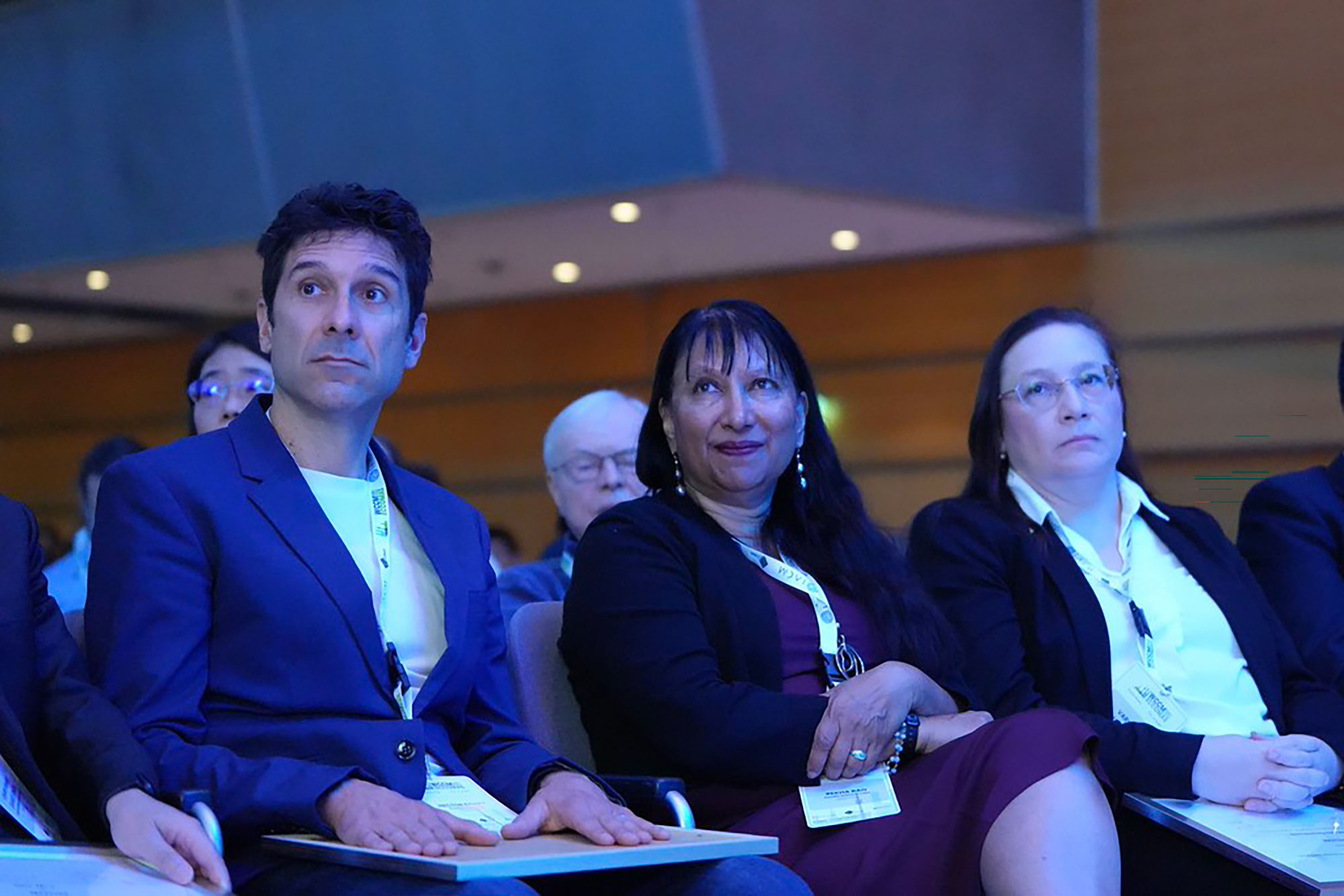
(Photo by Tara Upchurch, International Association for Computational Mechanics)
Goma is just one of many models that Rekha has developed over the years.
“We use these modeling capabilities every day. We help optimize manufacturing processes or decrease defects in manufacturing. It’s exciting,” Rekha said.
Her love for her work at Sandia has led Rekha to author 130 peer-reviewed journal articles, technical reports and proceedings on topics ranging from manufacturing and energy-production to environmental issues and polymer processing.
But one of her biggest passions is supporting others in her field. Rekha supports conferences and mentoring at IACM and several Sandia employee resource groups.
Rekha said one of her proudest accomplishments is being the first woman to serve as the president of the U.S. Association for Computational Mechanics. “That was a defining moment in my career,” Rekha said. “It gave me experience in leading a large national organization and setting the direction and capturing a vision for the future of USACM. I worked hard on initiatives to keep the organization healthy such as extra funding streams, new research thrusts and an educational initiative, and developed a new network of collaborators from universities and national labs.”
Being elected a fellow of IACM and the Society of Rheology offers Rekha new opportunities to lead by example.
In her 35 years at Sandia, Rekha said she has been able to work with some of the best researchers in the world and contribute to Sandia’s national security mission. She looks forward to many more years at Sandia.
“Every year I am challenged. I get to solve problems, and I get to learn new things. I have had the opportunity to support hiring new Sandians and to mentor graduate students, postdocs and junior researchers. This has been another enriching part of my job. Sandia is an engineering lab, and we have exceptional people who can work together to achieve great things.”