
Mission-critical systems often operate in extreme conditions such as exposure to radiation that can damage electronic components. Designing reliable electronics for such conditions requires fully understanding how transistors and other devices behave when exposed to radiation. Sophisticated computer modeling of the physics involved is key to this understanding.
RAMSES-Charon is one such modeling and simulation tool, also known as a technology computer aided design tool. This code solves two-or three-dimensional partial differential equations for electrical transport to understand and predict electrical characteristics of semiconductor devices. Compared to commercially available technology computer aided design tools, RAMSES-Charon is an open-source, Sandia-developed code, and focuses on modeling various radiation effects in semiconductor devices that are important to support Sandia’s core mission. Due to the physics-based nature of RAMSES-Charon modeling, many physical parameters may be involved and need to be determined. In this context, uncertainty quantification tools and methods become very useful in analyzing parameters’ sensitivity and calibrating parameters when used in combination with RAMSES-Charon.
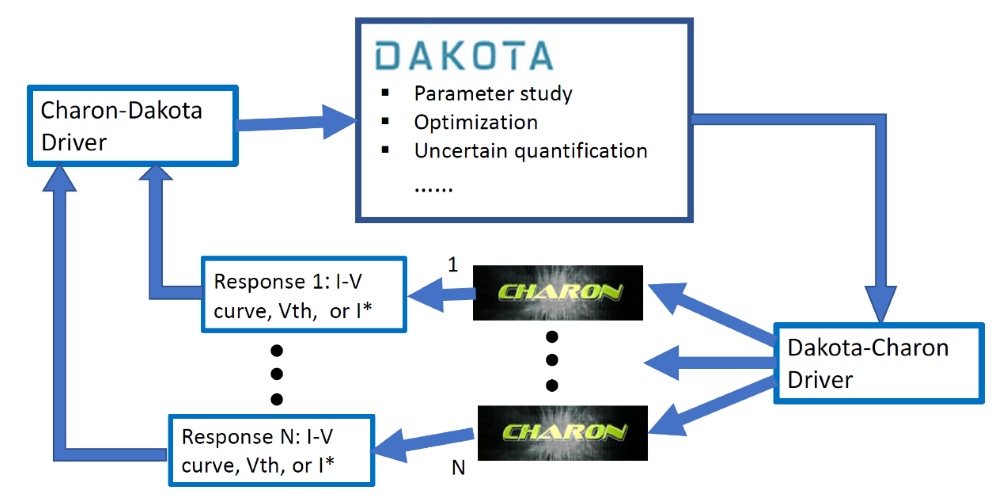
Dakota is a state-of-the-art software for optimization and UQ. Broadly, the Dakota software’s advanced parametric analyses enable design exploration, model calibration, risk analysis, and quantification of margins and uncertainty with computational models. To leverage the UQ capabilities in Dakota, we have developed a coupling scheme that integrates RAMSES-Charon with Dakota as shown in Figure 1. This coupling makes it possible to generate thousands of physics-based RAMSES-Charon simulation results that can be used for parameter calibration and sensitivity analysis for many applications. In this report, we highlight two such examples: (1) develop data-driven surrogate models and perform Bayesian calibration to calibrate physics-based total ionizing dose model parameters that allow for accurate predictions of total ionizing dose induced threshold voltage shifts; and (2) divide parameters into groups and perform sensitivity analyses iteratively to reduce the number of parameters for RAMSES-Charon’s displacement damage clustering model containing 114 parameters.
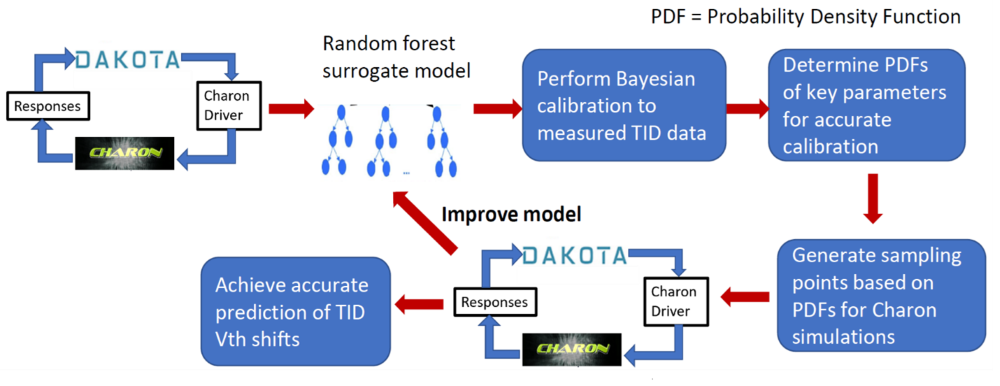
Total ionizing dose radiation can cause significant shifts in the voltage that a transistor turns on in metal-oxide-semiconductor field-effect transistors, which are the fundamental building blocks for modern microelectronics. Shifts in threshold voltages caused by total ionizing dose can lead to malfunction of MOSFETs, which can result in catastrophic failure of an integrated circuit. Hence it is very important to be able to accurately model total ionizing dose effects in MOSFETs such that we can mitigate the detrimental effects. Our example device is a silicon-carbide-based power MOSFET that can withstand 3.3 kV voltage before electrical breakdown. This device is a commercially available part, hence key device geometry and doping values are not known, but they are very important for accurate technology computer aided design simulations. To address this issue, we ran hundreds of simulations by combining RAMSES-Charon with Dakota. Utilizing simulation results and the knowledge of device physics, we determined those necessary key device parameters through matching simulation results to measured current-voltage curves collected in non-radiation environments. Thereafter, we proceeded to model and calibrate the measured shifts in threshold voltages caused by total ionizing dose in the commercial MOSFET. Figure 2 shows the flow chart of calibrating total ionizing dose model parameters for the MOSFET. Most of the compute time in Figure 2 is spent on RAMSES-Charon simulations. For the total ionizing dose calibration, we ran a total of about 15,000 RAMSES-Charon simulations on one of Sandia’s high-performance computing machines, called Amber. Each RAMSES-Charon simulation takes about 448 cores × 0.5 hours = 224 core-hours.
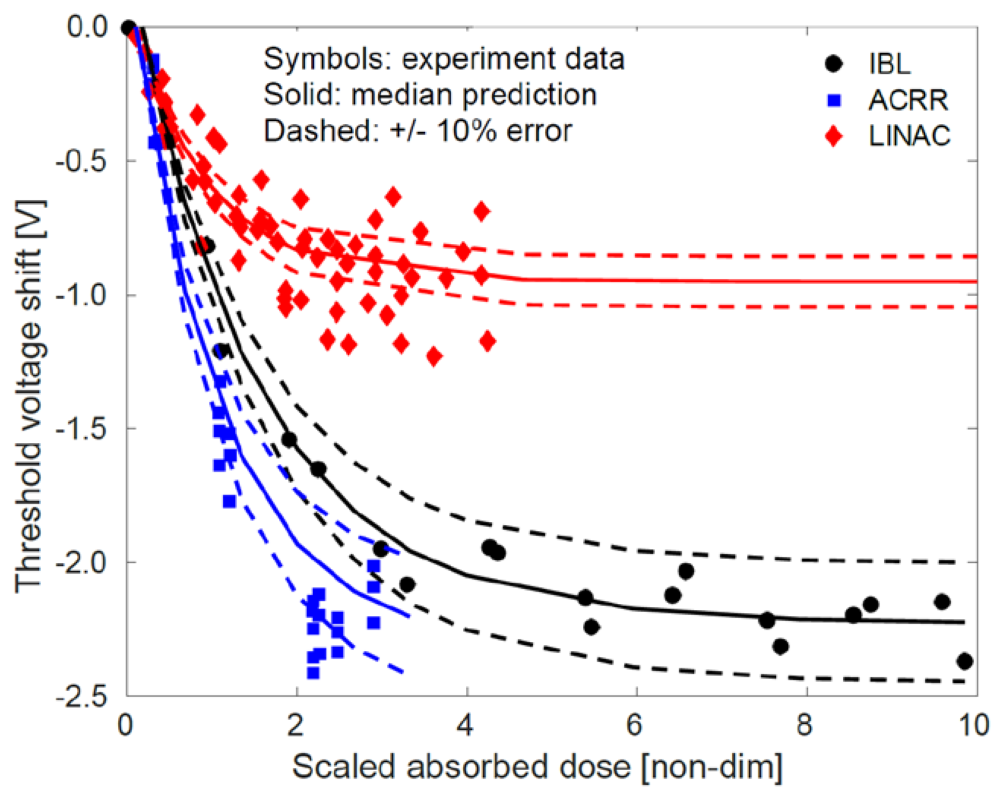
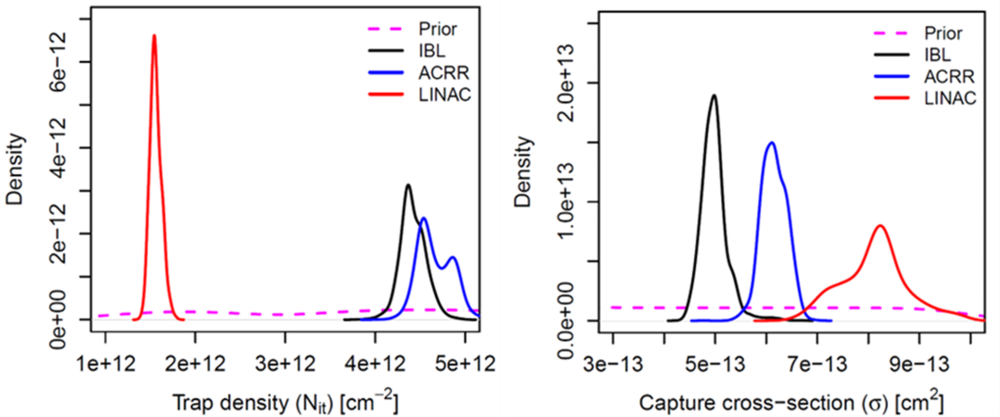
The calibrated simulation results and experimental data are shown in Figure 3. Clearly, the experimental data show relatively large variations, especially for the data data from the linear accelerator. These variations could be due to several reasons, including different radiation sources among the three facilities, inconsistent measurement times between data points, and device-to-device variations. All these uncertainties could not be included in RAMSES-Charon simulations but were included in the surrogate models. Despite the variations, we observe that simulation results capture the average behavior of the measured data and the saturation at high doses very well for all three facilities. Furthermore, calibrated total ionizing dose model parameters were determined with well quantified uncertainties. Figure 4 shows the probability distribution functions for two key model parameters, which were calibrated separately for the three datasets.
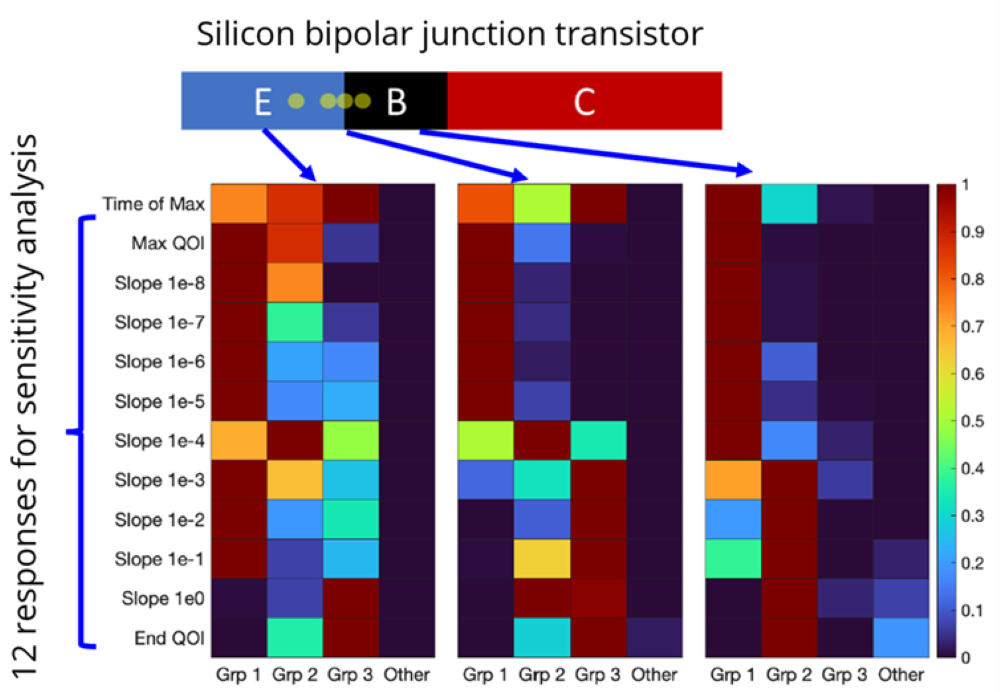
The second application of the RAMSES-Charon-UQ coupling method is parameter sensitivity analysis for displacement damage clustering model. Radiation induced displacement damage can cause device performance degradation. An example is that displacement damage leads to gain degradation in bipolar junction transistors. Displacement damage is known to cause cascade damage and form terminal clusters in sensitive regions of a semiconductor device. To model such clusters, a spherical shape for each cluster is assumed; within a cluster, displacement damage is modeled by solving partial differential equations for electrons, holes, and tens of defect species. Our exemplar device for this application is a silicon bipolar junction transistor, for which displacement damage model involves 39 defect species and 114 parameters. This large parameter space makes it necessary to perform sensitivity analysis to reduce the number of parameters before any attempt of calibration. Figure 5 shows the first round of GSA results at three locations of the selected bipolar junction transistor device. We observe that group 1 parameters are always important, group 2 and 3 parameters’ sensitivities depend on the locations, while group 4 parameters are not important. This first round of GSA allows us to reduce the number of parameters from 114 to 82. Through parameter regrouping and more rounds of GSA, we can further reduce the number of parameters.
RAMSES-Charon-UQ coupling provides a versatile framework for parameter calibration and sensitivity analysis. We show two such examples: (1) calibrate technology computer aided design total ionizing dose model parameters with determined uncertainties that achieve accurate prediction of total ionizing dose induced threshold voltages shifts; and (2) reduce the number of displacement damage clustering model parameters via group sensitivity analysis. High-performance computing resources enable us to apply the coupling approach to model important radiation effects in semiconductor devices.