
World leading large-scale systems and full brain modeling
In a significant leap toward the future of computing, Sandia Labs has embraced large-scale neuromorphic computing, welcoming two groundbreaking systems: Intel Loihi 2 and SpiNNaker 2. These systems, designed to mimic the brain’s architecture and functionality, promise to revolutionize how complex computational problems are approached in national security and artificial intelligence.
The arrival of Hala Point
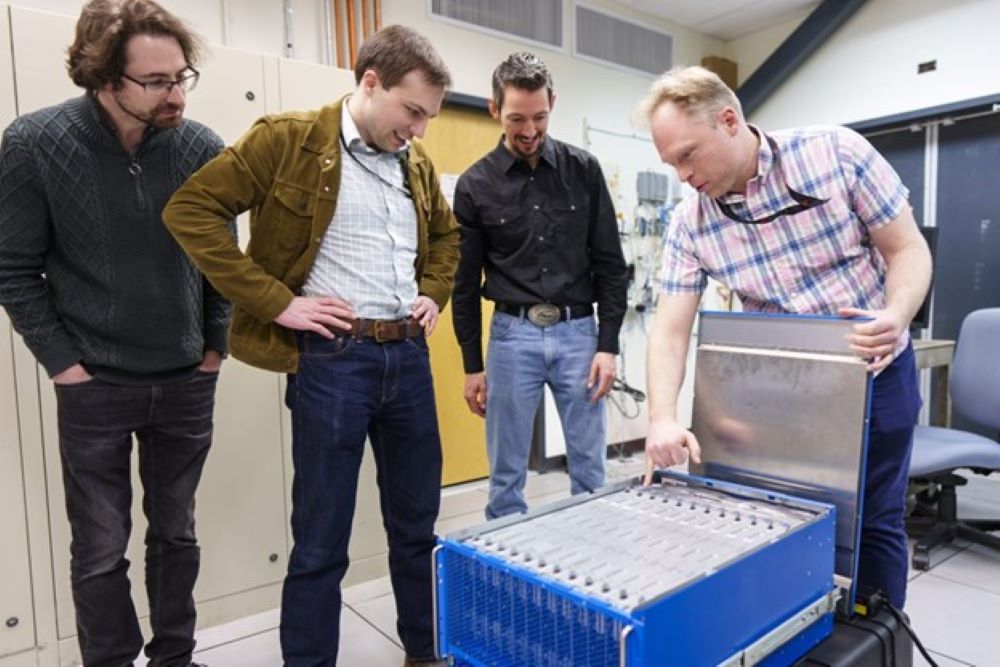


Intel’s Loihi 2 is a second-generation neuromorphic processor designed to mimic brain-inspired computing principles such as asychronous, event-based spiking neural network-based computing; the integration of memory and processing; and sparsity of operation. In early 2024, Sandia researchers received the Loihi 2-based Hala Point system, featuring an astounding 1.15 billion artificial neurons. This system, believed to be the largest brain-based computing system, packages 1,152 Loihi 2 processors in a single six-rack-unit chassis about the size of a microwave oven shown in Figure 1. Complementing the 1.15 billion neurons, the system also comprises 128 billion synapses and over 140,000 neuromorphic processing cores.
Hala Point has the potential of paving the way for innovative applications across various scientific domains. The system’s unique architecture allows for energy-efficient computations by mimicking the brain’s method of processing information through parallel circuits of active neurons, rather than the sequential processing characteristic of conventional computing.
Modeling the fruit fly connectome
An exciting exemplar for the Loihi 2 platform is the simulation of the Drosophila melanogaster, or fruit fly, connectome — a comprehensive map of neural connections in the brain, consisting of roughly 140,000 neurons and 50 million synapses shown in Figure 2. This effort marks the first ever nontrivial, biologically realistic connectome simulated on neuromorphic hardware. The challenge lies in the complex connectivity structure of biological networks that exhibit sparse, recurrent, and irregular connections — attributes that are poorly suited for traditional computing methods.
Figure 2. An entire fruit fly brain can be simulated on neuromorphic chips.
Although neuromorphic hardware is architecturally better suited to accelerate discrete event-based biological communication, mapping this connectivity structure to frontier systems still faces challenges from low-level hardware constraints, such as fan-in and fan-out memory limitations.
Utilizing efficient mapping, the Sandia team successfully fit the entire FlyWire connectome onto 12 Loihi 2 chips. Doing so, the neuromorphic implementation achieved speeds over 100 times faster than numerical simulations on conventional hardware. This performance advantage is particularly noticeable in sparser-activity networks, demonstrating the capability of scalable neuromorphic platforms to implement and accelerate biologically realistic models. Such advancements are crucial for the development of neuro-inspired AI and computational neuroscience.
SpiNNaker 2: a new frontier
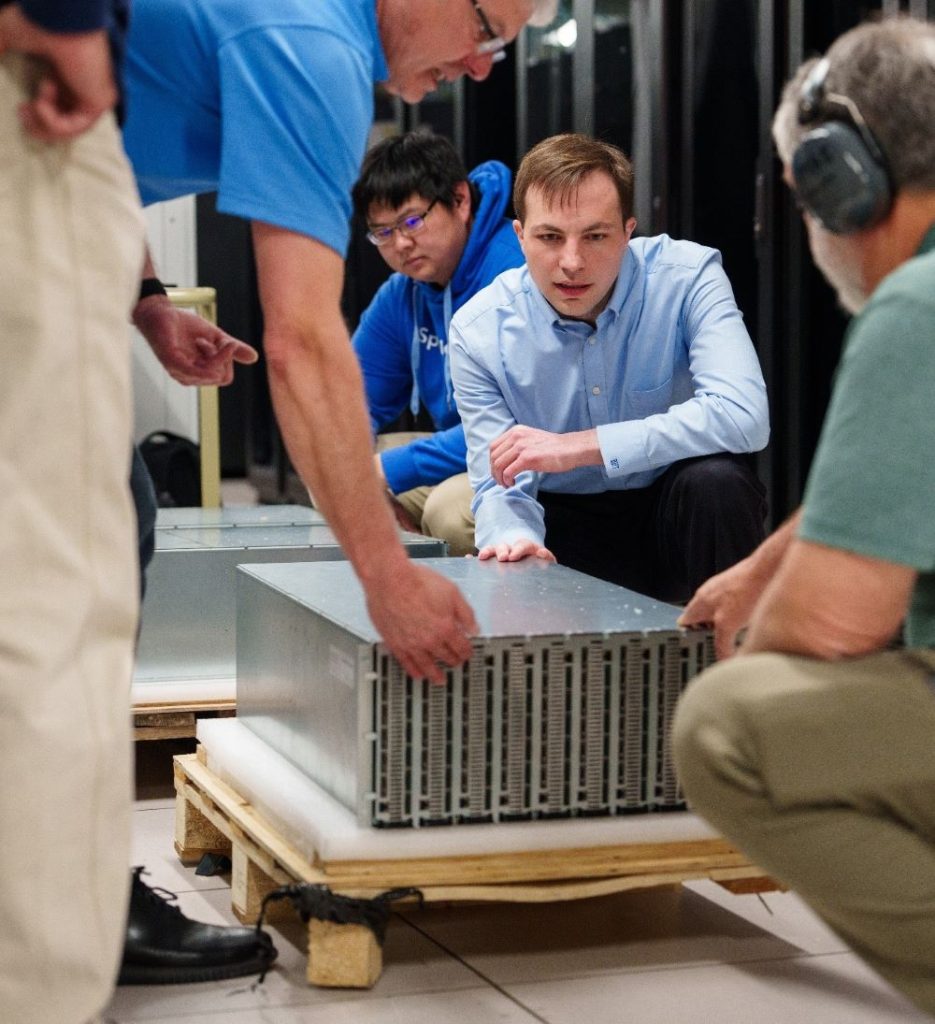
In addition to Hala Point, Sandia has also integrated a SpiNNaker 2 system into its research arsenal. SpiNNaker is a contraction of Spiking Neural Network Architecture, which is a brain-inspired neuromorphic computer for large-scale, real-time modeling of brain-like applications. This computing platform was accomplished by building a neuromorphic architecture using a large-scale mesh composed of ARM cores. These small and lightweight central processing units are most notably used in cell phones due to their low-power footprint.
SpiNNaker 2 builds upon this scalable, brain-like mesh and enhances the architecture with state-of-the-art distributed acceleration. The flexibility provided by its reconfigurability, scalability afforded by its real-time, large-scale mesh, and native support for hybrid acceleration of spiking and deep neural networks makes SpiNNaker 2 a unique computing platform.
In early 2025, Sandia received a three-chassis, or three-frame, SpiNNaker 2 system named NERL Braunfels in a collaboration with SpiNNcloud. Consisting of 24 boards, each with 48 chips, the system can model 175 million neurons and is designed to tackle complex, large-scale computing problems.
Initial collaboration to explore what can be done with such a system has focused on numerical simulation codes. This includes random walks to calculate heat flow throughout a system, factoring in different materials and the geometry of a design. This sort of computation can be applied in a range of national security applications such as vehicle design, turbulence modeling, mathematical predictions and chemical reactions.
Exploring national security applications
Sandia’s Neural Exploration and Research Laboratory enables researchers to explore the boundaries of neural computation. The research conducted in the lab evaluates what is possible with neural hardware and software for national security benefit and the advancement of basic research.
The arrival of the Hala Point and NERL Braunfels systems at Sandia Labs marks a transformative moment in the field of neuromorphic computing. Sandia is now equipped with two of the largest neuromorphic systems in the world. These state-of-the-art neuromorphic systems allow Sandia researchers to explore innovative applications across various national security domains and advance the fundamental science of neuromorphic computing. These endeavors include innovations in terms of what neural algorithms can compute as well as how to do so efficiently and at scale.
With their ability to simulate complex biological networks and tackle large-scale computational problems, these systems are poised to drive innovation across multiple domains. As Sandia continues to explore the capabilities of these advanced architectures, the future of computing is not just being imagined, it is actively being built.
Shaping the future with brain-inspired computing
Through the integration of brain-inspired computing, Sandia is leading the charge in developing solutions that promise to reshape our understanding of artificial intelligence, scientific computing, and national security. The journey has just begun, and the potential for breakthroughs in these fields is immense.