
New role will inform implementation of AI across Labs
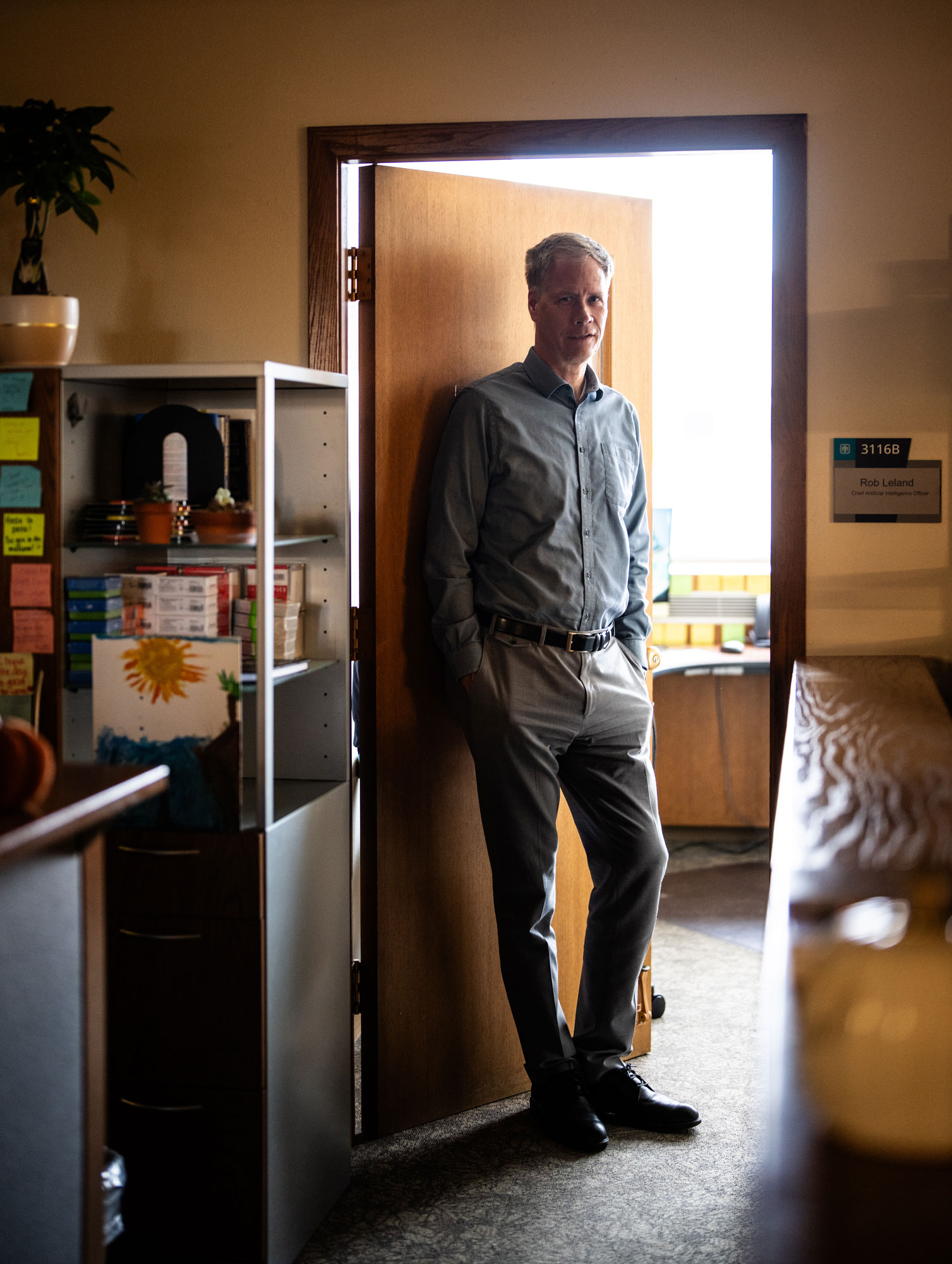
Sandia is embracing AI as a critical tool to accelerate delivery across our national security missions. Recognizing the importance of artificial intelligence to Sandia, Labs Director Laura McGill appointed Rob Leland as Sandia’s first chief artificial intelligence officer.
In this role, Rob will work to ensure Sandia implements AI rapidly and responsibly across the Labs.
“If we can adopt this technology effectively, we can have a profound effect on the national security posture of the country,” Rob said.
Rob has a long history at Sandia, rising through the ranks in computing research and IT, two capabilities that underpin AI. In his most recent role, he led Sandia’s Nuclear Deterrence Systems Center, where he spearheaded an effort to demonstrate how AI can accelerate the engineering design of nuclear weapons components and systems.
“I have had the privilege to work with teams on the leading edge of mission delivery in a variety of contexts around the Labs, including computing, energy and, most recently, nuclear deterrence,” Rob said. “I see my role, in part, as helping to connect those communities and facilitate conversations that will make our adoption of AI more fluid and effective.”
He appreciates strategy-related assignments that require thinking about important problems, like computing or cybersecurity, from a forward-looking Labswide perspective.
“I enjoy seeing how all the pieces can come together toward some bigger outcome,” Rob said.
Those pieces go back at least 10 to 15 years, with AI-related work originating in Sandia’s high-performance computing, machine learning and cognitive science programs.
In the past few years, the Labs has stood up several organizing efforts around AI, including strategic initiatives led by Cindy Phillips, the AI Board of Directors and Tina Nenoff.
“There’s no lack of engagement in this space,” Rob said. “In fact, there’s really important stuff we’re doing in research and development that I think will pay off substantially over the next three to five years. And I also think there are opportunities for us to bring some of these efforts into greater coherence and direct them over time toward the most strategic outcomes.”
Big-picture thinking
One of Rob’s first goals as the chief AI officer is to identify those opportunities. First, Sandia needs AI to accelerate engineering for national security.
“I think of engineering for high-consequence systems as the core of what Sandia does,” Rob said.
The potential for using AI to create new weapon components and systems was recently demonstrated through the Aires Tide project. Sandia partnered with NNSA, the Kansas City National Security Campus, Los Alamos National Laboratory and Lawrence Livermore National Laboratory to develop an AI-designed, 3D-printed concept flight test vehicle more quickly and at a substantially lower cost than current production methods.
“I would really like to see us leverage the Aires Tide capability into some program of record,” Rob said.
His next objective is to use AI to increase the productivity of Sandia’s supporting operations. Rob views those efficiency gains as a way to empower the workforce to achieve faster progress on the mission.
“There is a huge amount of national security work that the nation would like us to do,” Rob said. “AI can help ease the normal burden of work and allow people to be in a space that’s more productive and creative — for them and for the nation.”
That push toward higher productivity aligns with the last priority objective, which is to enhance every individual’s experience of AI at work. Sandia is scaling up infrastructure, providing access to cutting-edge tools and expanding training opportunities to ensure staff have safe and secure access to AI resources.
“A major pain point has been access to tools,” Rob said.
Responding to this feedback, Sandia has started a pilot to provide automated coding tools and plans to give the broader workforce access to those tools early next year.
“My hope is that the scientist, the engineer, the business analyst, the communication specialist, etc. will feel like, ‘Oh, I got a better work product more quickly and easily than I would have been able to in the past, and that makes me feel able to contribute more to the mission.’”
Risk versus reward
Even as Sandia seeks to gain a competitive edge with AI, it also must understand and reduce the risks that come with adopting new technology.
“There is a lot of concern in the news about unleashing technologies that can’t be adequately monitored or supervised,” Rob said. “We need to figure out how to deploy AI in a safe and secure way, especially in these high-consequence environments.”
That’s exactly where Sandia may have an edge over other organizations. Sandia is a leader within the U.S. government on cybersecurity and has already started applying those capabilities to AI security. While industry may prioritize moving fast over addressing safety concerns, Sandia has a responsibility to understand the technologies it uses, including how they can fail or be manipulated.
“We should be leaders in articulating the right approach to secure AI use,” Rob said.
While there are risks that come with using AI, Rob said Sandia must also consider the risks of deploying it too slowly.
“What are the risks that come with getting out-competed as a nation in this domain? Perhaps quite high,” he said. “We need to figure out ways to deliver on our mission ever more quickly in the current geopolitical environment, and I believe AI will play a critical role in that effort.”