
Sandia research helps realize potential of subsurface energy
New Mexico is known for bringing the heat with its famous green chiles, but a new report points to another source of heat that’s causing excitement. Project Innerspace’s report titled “Future of Geothermal in New Mexico” lays out the opportunities — and challenges — to harnessing the state’s geothermal resources as a reliable, sustained domestic source of energy.
One of the report’s lead authors is Travis Broadhurst, a geomechanics doctoral student at UNM and an intern with Sandia’s Geothermal Research department. Travis called the report “seminal,” saying he expects it to “kick-start a lot of things.”
The report’s nine chapters range from characterizing the state’s subsurface resources and potential applications to the regulatory, environmental and stakeholder factors that must be considered in the development of geothermal projects. “For geothermal developers, having one single document that includes all that up-to-date information is really helpful,” Travis said.
Barriers to entry
Despite the enthusiasm generated by the report, geothermal energy still faces multiple barriers to development in New Mexico and beyond. Geothermal systems traditionally require three things: hot rocks, water and permeability within the rock so the water can flow. According to Giorgia Bettin, manager of Sandia’s geothermal research group, it is a challenge to find resources that meet these conditions.
“Discovering and developing geothermal resources can be very expensive. Traditionally, half the cost of development has just been drilling,” said Giorgia, who was a contributing author on the report.
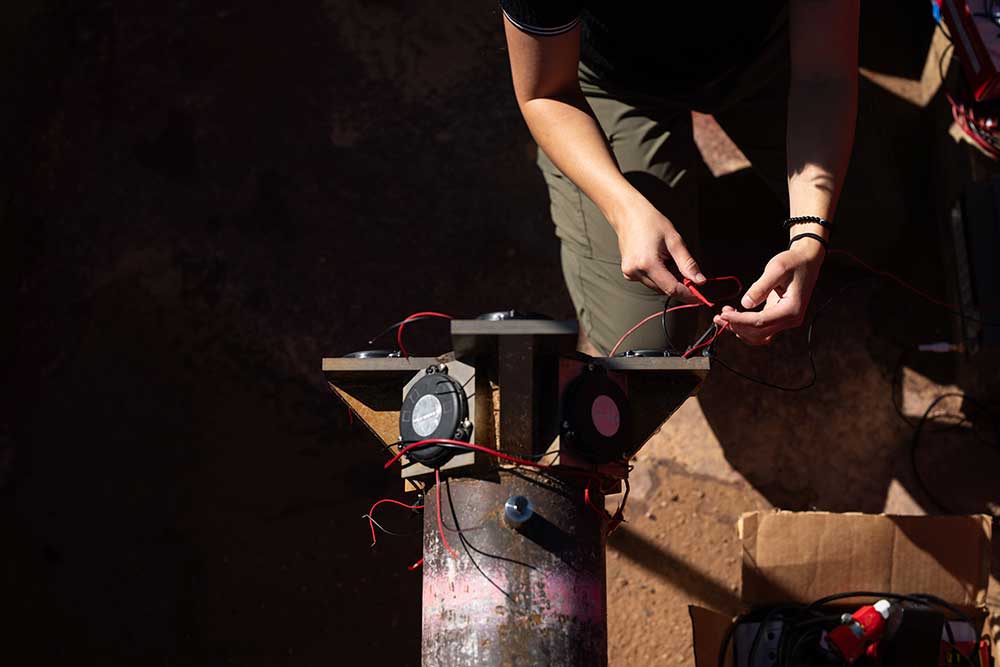
Geothermal wells are typically located in harder, more abrasive rock formations with higher temperatures than oil and gas wells. These conditions impede the use of many traditional oil and gas tools used for drilling, as well as for sensing the environment and monitoring operations. Having suitable tools could help to reduce the risk of failure, and ultimately, lower costs for geothermal development.
Further, sometimes the conditions are not quite right for a conventional geothermal system. Enhanced geothermal systems can fill this gap by injecting fluid into hot rocks to stimulate permeability and heat production, but more research is needed to optimize their performance.
Even with these challenges, New Mexico has several advantages over other states in pursuing geothermal, Travis said.
“New Mexico’s got great subsurface potential,” he said, adding that the state ranks among the highest for possible power generation. Geologic features like the Rio Grande rift and Jemez Lineament — the most active volcanic feature in the Southwest — have resulted in hotter temperatures closer to the surface, providing abundant subsurface heat across the entire state.
Travis also noted that New Mexico has a strong base of technical expertise developed through the oil and gas industry. Additionally, the state is home to multiple leaders in geothermal research and development, including Sandia.
Building on a rich history
Sandia’s geothermal research group has been actively working to remove these barriers to geothermal development since the 1970s.
“We are the longest continuously operating geothermal program in the whole national lab complex,” Giorgia said. “Many national security applications require drilling expertise, so we leverage a lot of those investments for our geothermal work and vice versa.”
Notably, Sandia scientists helped advance the diamond-based drill bits instrumental to the U.S. shale revolution. That research originally began in support of geothermal systems and is now being used to inform geothermal well drilling to reduce costs.
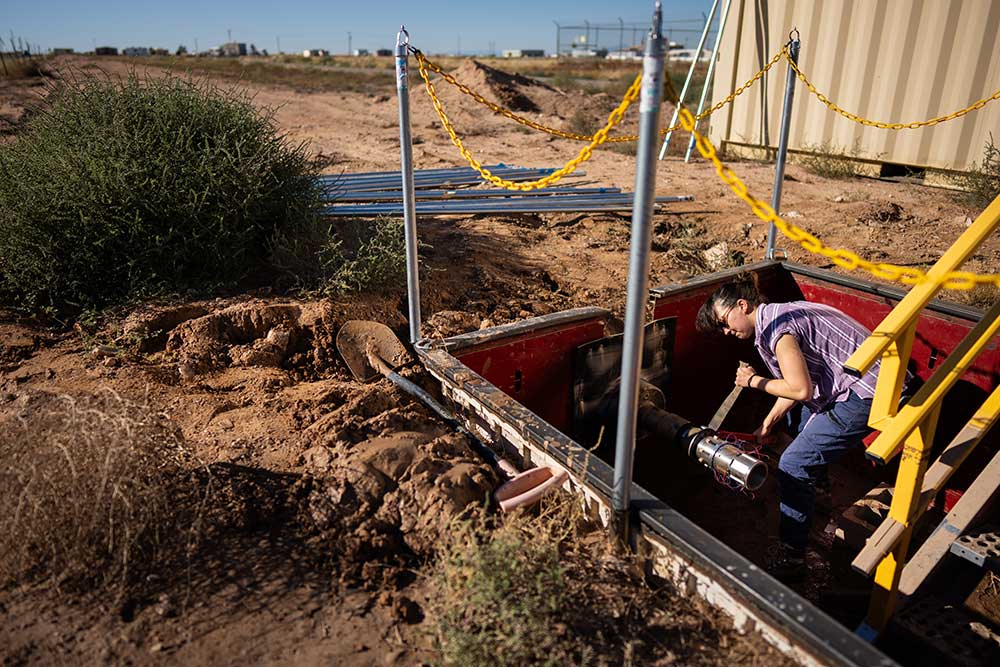
Giorgia’s team also develops instrumentation that can withstand the harsh conditions associated with drilling for geothermal resources. “A lot of the work we do is changing the oil and gas tools to make them more robust,” Giorgia said.
These sensors can be applied alongside experimental work and modeling and simulation to understand, predict and control the creation of engineered reservoirs for enhanced geothermal systems.
“Sandia has done a lot of work in understanding fracture development and fracture mechanics, particularly in geothermal environments,” Travis said. “We’ve done studies using novel techniques to try to understand how to best create fractures and then evaluating the fractures that you do create. The insights gained from this work are facilitating enhanced geothermal systems projects not just in New Mexico but across the country.”
Partnering for impact
The geothermal research team prides itself on partnering with other national laboratories, government agencies, universities and industry to ensure their innovations have real world impact.
Sandia, for example, worked with the geothermal equipment, instrumentation and testing company Thermochem to build a prototype high-temperature, high-pressure sensor for downhole electrochemical assessment. This tool fills a gap in the geothermal industry by enabling the measurement of downhole chemistry to better understand the lifespan of a well.
In another lifespan-related project, Sandia is leading a working group of national laboratories to model and validate the economics of technologies across the entire well life cycle. “People tend to look at just the cost of drilling and completing wells. We’re trying to look holistically to see the risks and costs of new technologies from planning all the way to decommissioning,” Giorgia said.
Sandia has three current geothermal research projects based in New Mexico, and the team anticipates that number will continue to increase. “There’s a big push in the U.S. right now to develop geothermal and the report really brought some excitement and visibility to New Mexico at the right time,” she said.