
Project leads give a sneak peek at new features that could arrive over the next year
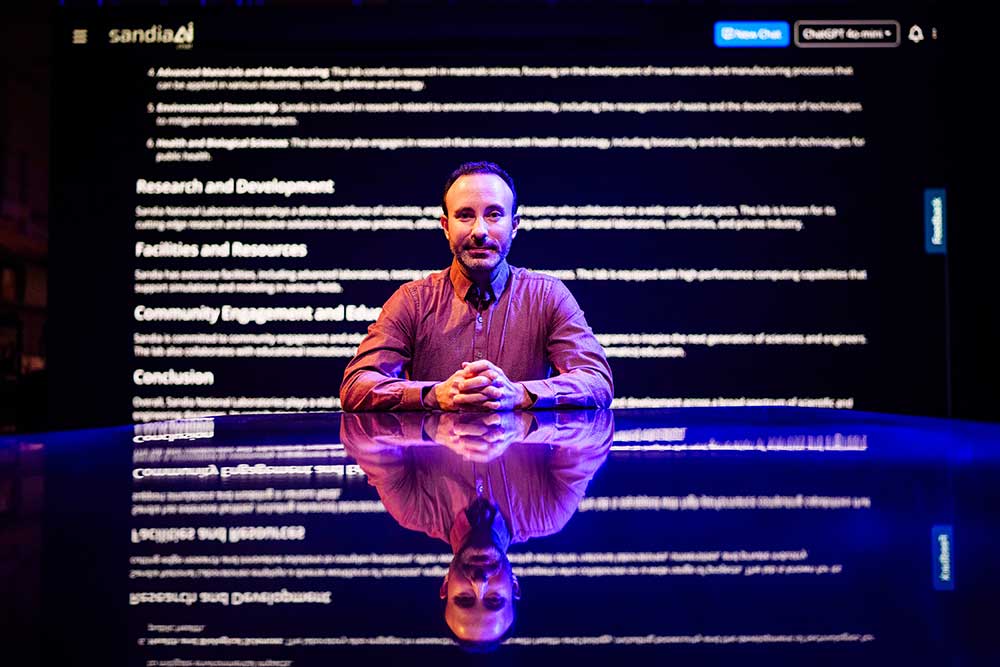
More than 1,500 feedback comments have been received about SandiaAI Chat. Together, Erica Grong, Mike Vigil and their team have read every single one.
“We really rely on feedback,” Erica said.
Erica and Mike oversee the operation and upkeep of the flagship chat tool, which has garnered more than 15,200 unique users, an average of 5,600 weekly users and nearly 4 million inquiries since its introduction in May 2024.
But a big part of the job is planning future upgrades.
“Every reasonable suggestion gets reviewed by the team,” Mike said.
In collaboration with management, the pair of project managers and their team — comprising a solutions architect, three full-stack developers and one student intern — prioritize these ideas and then get to work implementing them.
Bringing on “Bring Your Own Data”
One of top requests, Erica said, was to be able to upload documents. This was fully released to the Labs in August as the Bring Your Own Data function, which appears now as a paperclip icon at the bottom of the chat window.

This new capability saves users the hassle of copying and pasting data into the chat window, but some Sandians have gotten creative with it.
Stefan Domino, a fluid dynamics expert formerly supporting NNSA’s Advanced Simulation and Computing program, said Bring Your Own Data lets him use SandiaAI Chat as a testbed to try out ideas for a different large language model being developed jointly with Lawrence Livermore and Los Alamos national laboratories.
“I have crafted a set of prompts that we know an LLM can and cannot answer,” because it deals with specific information not included in the AI model’s training. Then he tests how well the model answers the prompts before and after he uploads the critical, missing data.
Stefan said the experience has pointed him to better ways to evaluate the tri-labs model. It also has given him insights into how large language models can be corrupted with nefarious or misleading documents.
When Mike was asked what he’d most like to add to SandiaAI Chat, he pointed right back to Bring Your Own Data.
“I’m really happy with it,” he said.
A look at the wish list
But the chat team is far from done. Funding permitting, they have planned out several major improvements that could roll out over the next year.
“Hands down,” Mike said, “the most requested feature since day one has been the ability to use our API.”
Short for application programming interface, API is the connection between SandiaAI Chat and the OpenAI large language model that powers it. Many researchers have asked to bypass the chat interface and get direct access to the model.
It’s a versatile feature, Mike said, and the SandiaAI team is working on it.
API access could empower researchers’ projects when a general-use chat isn’t efficient, like with coding, or when it doesn’t return the data users need, Erica said.
Another new feature the team plans to test is vision, or the ability to use SandiaAI Chat to interpret images.
“I’d be excited to give it an image of a Gantt chart,” Erica said, “and have the tool analyze and interpret the data, and provide me recommendations for improvement.”
But Mike said it could be an even more powerful tool for engineers, too, saying that some large language models can calculate the yield of an explosion based on pictures of the blast damage.
Yet another feature Sandians may see in the future is the ability to search internal Sandia information, which is now being tested by some divisions.
The feature adds a new icon called Ask About Sandia Policy and HR Data. Toggle it on, and SandiaAI Chat will limit its knowledge to Sandia knowledge bases. This lets users, for example, ask a question about Sandia’s rules on social media and get back verifiable answers that link directly to the official policy.
“Most people believe what generative AI tells them, and that’s bad,” Mike said.
He added that a new feature could potentially be tailored to individual teams, letting users query information from their specific process documents or shared data.
Erica cautioned that all these features are still only ideas being tested and subject to future funding. But in the meantime, Mike had a suggestion for the workforce.
Keep hitting that feedback button.
Want to learn more about SandiaAI Chat and other AI tools to make your work life easier? Visit the Artificial Intelligence at Sandia website for training, resources and more.