
Sandia scientist says heliostats can be valuable at night
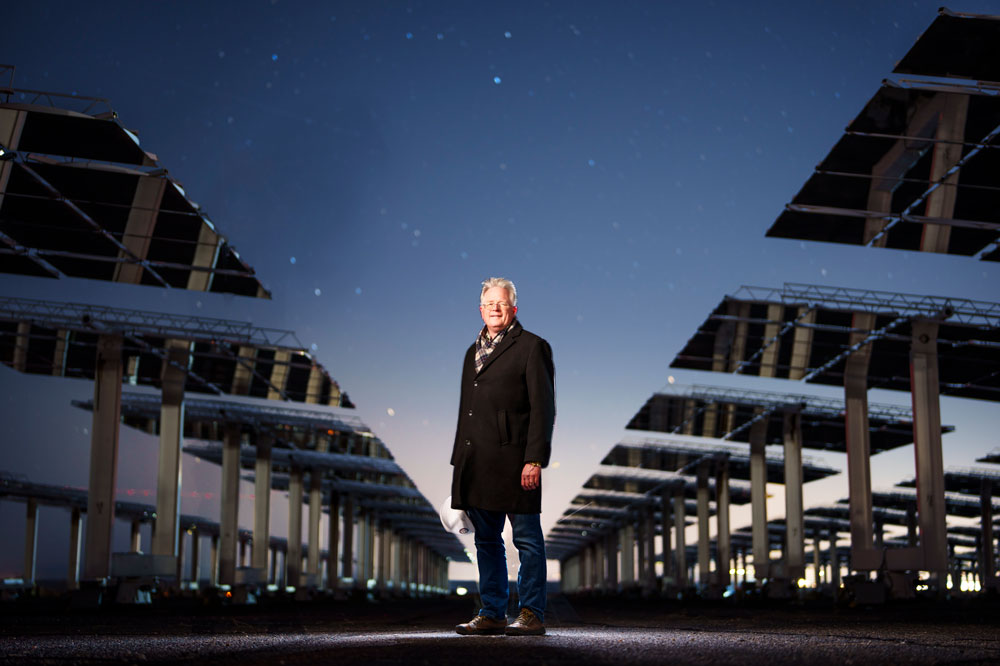
Sandia scientist John Sandusky believes he has found a way to put heliostats, which typically turn solar energy into electricity, to work in the dark.
He proposes that these large mirrors could help find asteroids at night.
“The heliostat fields don’t have a night job. They just sit there unused. The nation has an opportunity to give them a night job at a relatively low cost for finding near-Earth objects,” John said. “If we knew ahead of time that an asteroid was coming and where it might hit, we’d have a better chance to prepare and reduce the potential damage.”
Most planetary defense efforts use observatory-grade telescopes to produce images of the stars. Within those images, computational methods identify streaks, which are asteroids. This process is precise but time-consuming, and building new observatories is expensive.
The nighttime experiment
As part of a Laboratory Directed Research and Development project, John spent summer nights working at the National Solar Thermal Test Facility. He used one of the 212 heliostats in the field for his experiment.
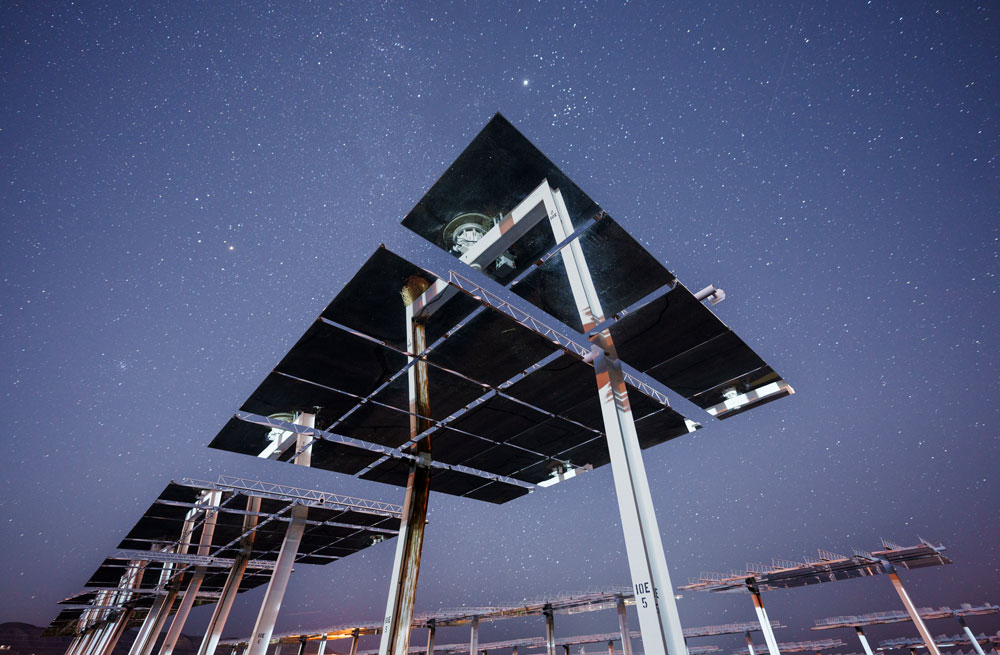
“Solar towers collect a million watts of sunlight,” John said. “At night, we want to collect a femtowatt, which is a millionth of a billionth of a watt of power of sunlight that’s scattered off of asteroids.”
In simpler terms, he believes the heliostats can measure the speed at which asteroids pass by the stars, rather than using conventional imaging methods.
“I’m trying to detect the asteroid by its speed relative to the stars,” John said.
The heliostat he used was not retrofitted with any new equipment for the experiment. John used existing software to oscillate the heliostat’s direction relative to the stars.
“We changed the direction the heliostat was pointing gradually so it would sweep back and forth about once per minute,” John said.
As dusk turned to night, John sat up on the solar tower, 200 feet above the ground, and used standard optical instruments to detect the light the heliostat was concentrating on the solar tower.
“You spend a lot of time waiting. There was about 20 minutes between the collection of data points. I would collect data until dawn,” John said. “We did not set out to find asteroids. We demonstrated the heliostat can be swept back and forth and that it can see stars.”
More advantages
John said this is early-stage technology. In addition to being more cost-effective than building new observatories, this method may offer other advantages.
“It may help the U.S. Space Force with its job of trying to find spacecraft, especially in the cislunar area. Orbits near the moon can be difficult to track from the ground,” he said.
John presented his findings at a conference for the International Society for Optics and Photonics, and a paper was published. At this stage, he said, feedback is important.
“We want to hear from our peers in optics and the asteroid hunting community,” John said. “Getting peer feedback provides an opportunity to understand what the concerns are about how this technology will work.”
He said the next step might involve using the heliostat to find a known planet, which would help understand the technology’s limitations.
“We’re looking for opportunities to scale up from one heliostat to many and try to demonstrate that we can help find near-Earth objects,” John said. “We also want to demonstrate we can scale up the technology to detect even smaller asteroids.”