
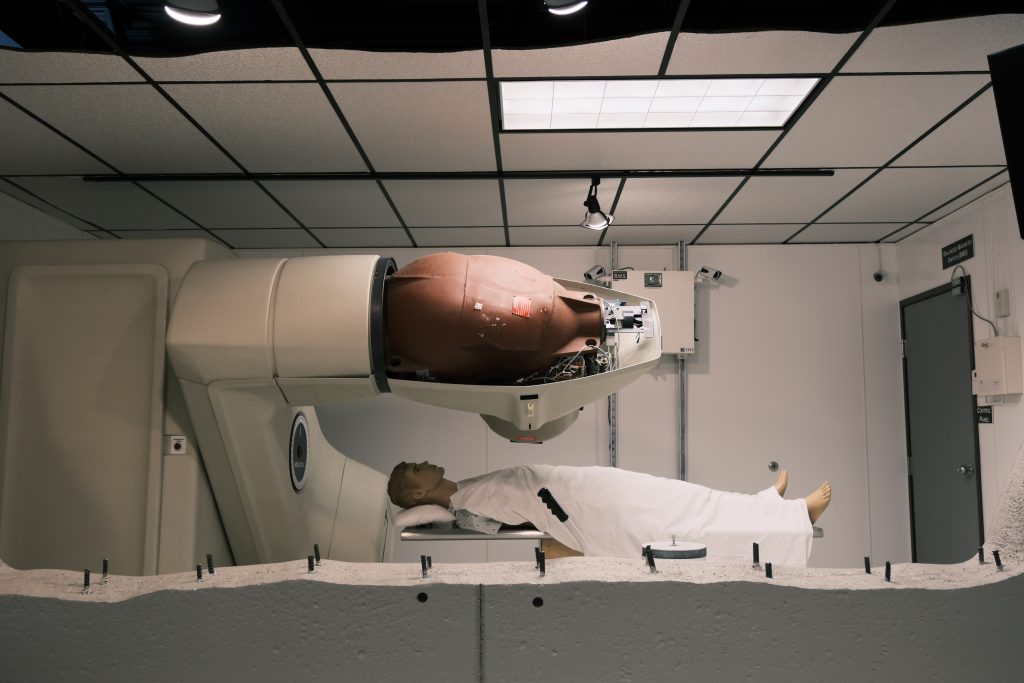
Sandia has been an important part of radiation source security since the threat was identified as important by the IAEA in 1998.
Sandia developed protocols for attack testing for radiation source irradiators. Using these methodologies, Sandia has been able to define the risk in terms of time needed to liberate sources which feeds into the design of protective security systems. Sandia designs appropriate systems and works with other Department of Energy laboratories to ensure that those systems are installed and working properly. Sandia also works with device vendors to manufacture delay technologies, typically in the form of metal plates with uncommon fasteners, that can be added directly to devices providing additional device protection. This In-device Delay Program also works with vendors to implement security by design, including similar features in devices when they are manufactured.
Sandia has developed and evaluated detection systems for the detection of source material outside of regulatory control. Such projects include portal monitors that use germanium detection for precise identification of radionuclides, detectors that can identify fluorescence of nitrogen from radiation interactions at distances of hundreds of feet, and Gamma Detector Response Analysis Software (GADRAS), software that models detectors and detection geometries allowing for analysis of gamma spectra that can effectively identify small peaks in high backgrounds.
Sandia works with NNSA to identify and evaluate non-source technologies that can be used as part of a general strategy to replace source-based technologies, thereby eliminating the risk from malicious use of radiation sources.