
Saturn accelerator updated for reliability and performance
TRIP TO SATURN — Technologists prepare a shot under Saturn’s core. (Video by Joel Ortiz)
After nearly 40 years of service and 4,726 firings, called “shots,” Sandia’s Saturn accelerator finally got a spa day.
Of course, a rejuvenating break for one of the nation’s brightest X-ray generators did not involve a deep-tissue massage, a mani-pedi or a seaweed wrap. Instead, the accelerator received redesigned switches, a new core section and a reengineered X-ray source.
“The goal was to figure out what needed to be right, where the big knobs are, to improve the reliability and performance of Saturn,” said Mark Savage, an electrical engineer and technical lead for the refurbishment. “A lot of things have to go right for a really good shot on any big machine. It doesn’t take many things going wrong to affect it seriously.”
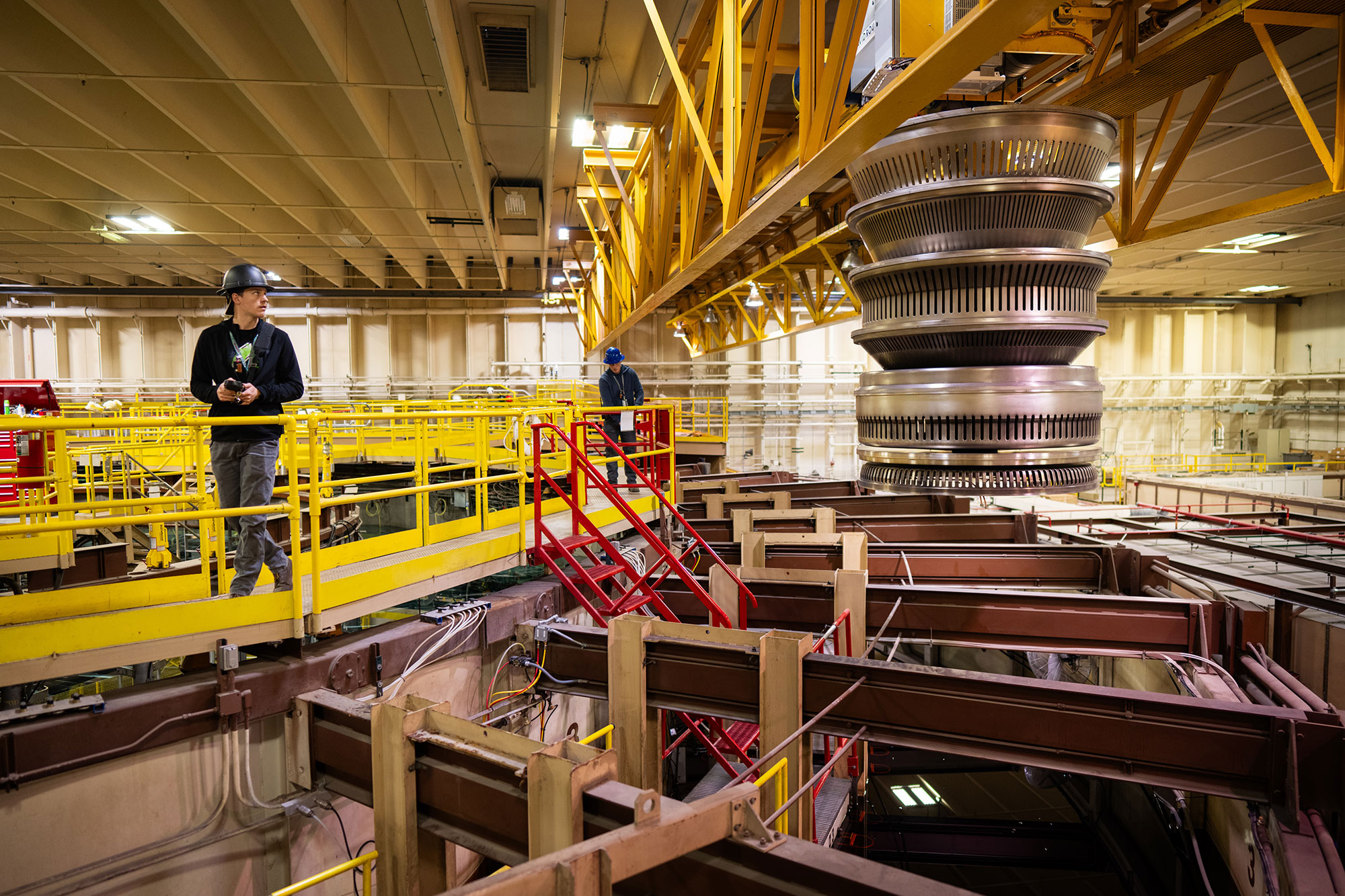
Saturn began operating in 1987. It produces intense, hard X-rays, primarily to test and qualify national security electronics, subsystems and materials against X-ray radiation.
Planning for the first phase of the refresh began in 2018 and the machine was shut down from January to October 2024. Recently, the team completed fine-tuning the new X-ray source to ensure it performs as needed, said Jeff Tunell, the team lead for Saturn operations who was involved in the refurbishment.
Super-synchronized switches
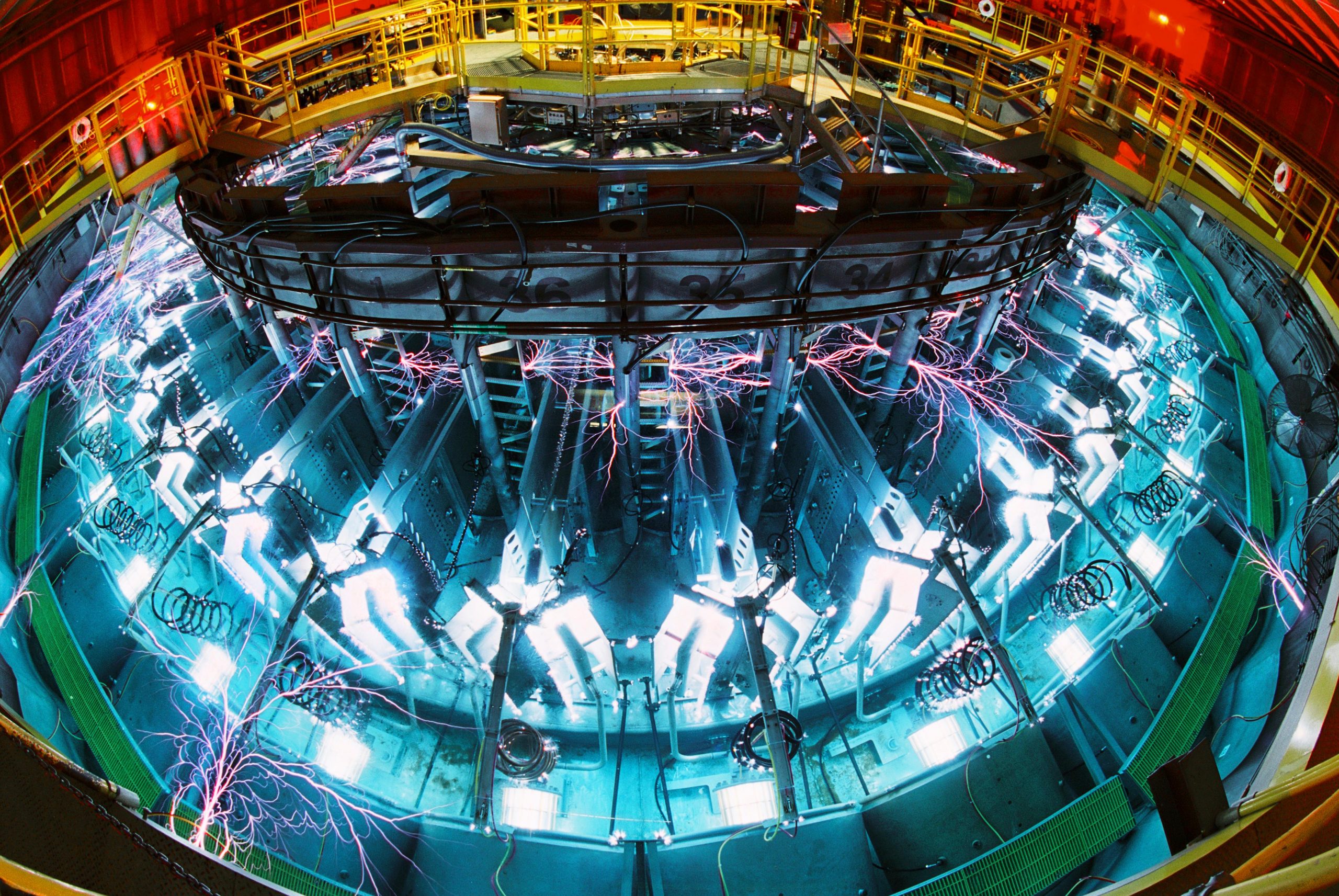
From above, Saturn looks like a wagon wheel with 36 spokes that lead to a center hub. It would just fit within two side-by-side college basketball courts. The center hub is a 6-foot-diameter chamber under vacuum where the X-rays are generated.
Each spoke contains complex equipment to store electricity and then release it in a fraction of a second. One factor that determines how reproducible a shot is how well synchronized the spokes are; a billionth of a second — a nanosecond — matters.
One key part of the refresh was redesigning Saturn’s gas switches, which are critical for synchronizing the spokes.
“The gas switches were replaced because we wanted to improve the accuracy of their timing,” said Mark, who designed the new gas switches. “The gas switches were a hard problem because they’re switching millions of volts and hundreds of kiloamps with nanosecond precision.”
In addition, the timing of a gas switch can now be adjusted in place. Previously, divers had to remove a switch from the water tank to adjust it, a process that slowed troubleshooting significantly. The new gas switches were also designed to last longer and handle higher voltages if operators decide to increase Saturn’s voltage in the future, Mark said.
Shiny new core
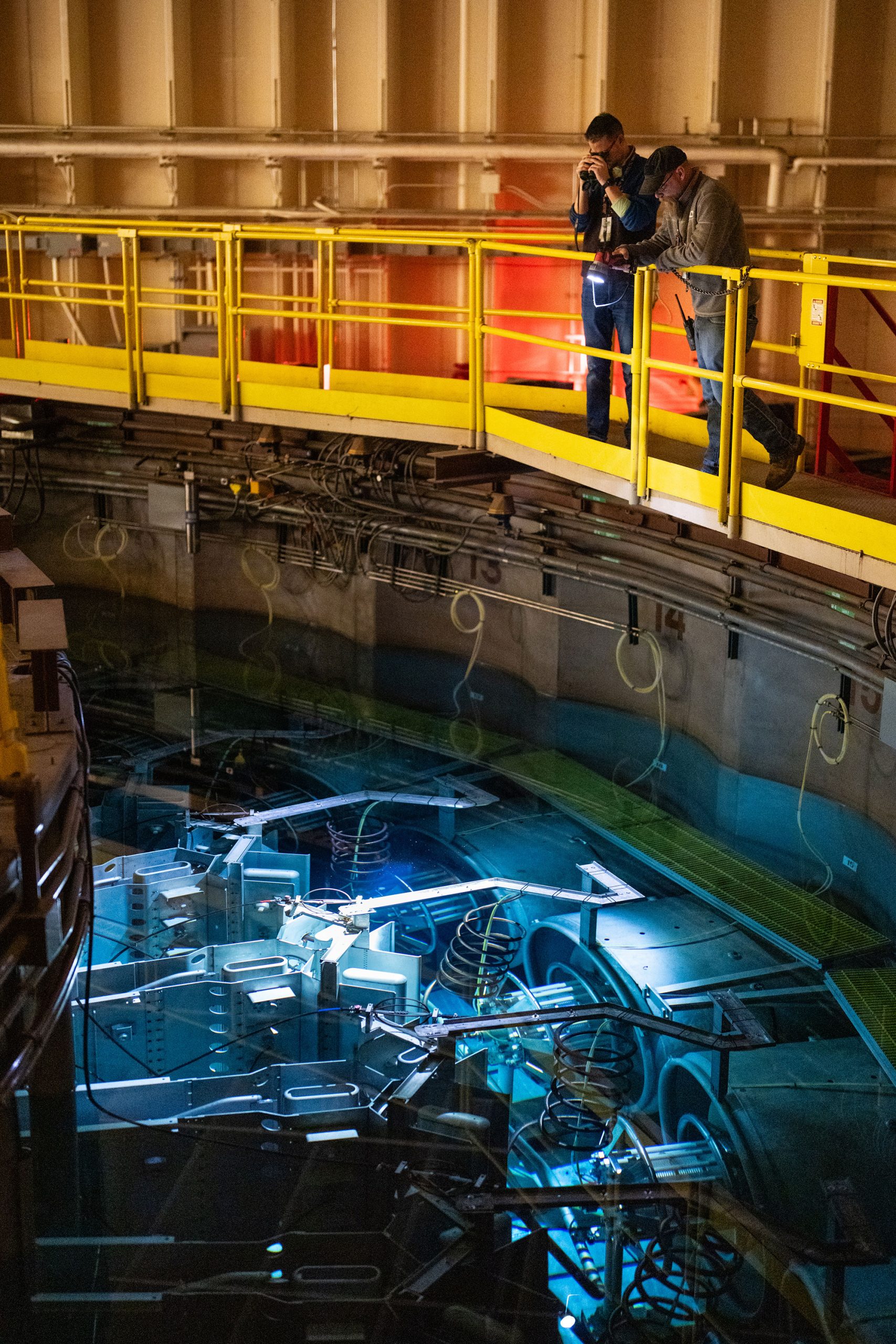
Saturn’s hub, also known as the vacuum insulator stack, was replaced to improve diagnostic monitoring of the energy flow toward the center, Mark said. This helps operators understand what happened if a shot doesn’t produce the expected level of X-rays.
Saturn’s magnetically insulated transmission lines — conduits for the millions of volts traveling from the spokes into the vacuum-insulated hub and X-ray source — were also replaced. Originally, they were mounted in a flexible way, which made sense because Saturn was the first machine of its kind. But this came with the tradeoff that they were hard to install and align consistently, Mark said.
The new transmission lines are less adjustable, making alignment easier and improving performance. They were also designed with better connections between components to reduce arcing.
The updated magnetically insulated transmission lines were inspired by those on the Z machine, the world’s most powerful pulsed-power machine and a descendant of Saturn. Computer modeling of power flow through the new system was done by Sandia physicists Peggy Christenson and David Sirajuddin before any parts were ordered, Mark said.
Jeff’s operations team needed to ensure the parts received were machined to specification and that everything had arrived before Saturn was shut down.
“We had some early issues where we weren’t receiving exactly what we needed, so we ended up putting a team together to travel out to the machine shops and catch issues before the parts were shipped,” said Alex Nash, a technologist involved in both phases of the refurbishment.
The team worked with specialized machine shops across the country to manufacture one-of-a-kind parts for Saturn’s core section and other redesigned components.
More reliable X-rays
Saturn’s X-ray source was reengineered to improve reliability and reproducibility because, over decades of use, the machine’s X-ray production had become less consistent, said Ben Ulmen, who led development of the new X-ray source.
The new source includes design elements that allow technicians to partially preassemble it on a benchtop instead of inside the machine, where they must work overhead. It is also easier to align.
Saturn’s X-ray source is a vacuum diode with an anode, a cathode and a small vacuum gap. When extremely high-voltage electricity from Saturn’s spokes reaches the diode, it arcs across the gap and hits a thin metal foil that converts the electricity into X-rays. The concept is similar to how a dental X-ray works.
“Saturn works a lot like a dental X-ray, except it is billions of times more powerful and its X-ray pulse is about a million times faster,” Ben said.
Planning and design for the second phase of the Saturn refresh is underway. That work will focus on updating the triggering system for the Marx bank generators — parts of the spokes that store electricity to produce a high-voltage burst — to improve timing accuracy even more. Phase two will also include redesigning five systems on each spoke that will compress and conduct the electrical pulse better. The phase is expected to be completed in the next three to four years, Mark said.
“This was a huge project,” Jeff said. “It took many people from different organizations to make this work. Everyone coming together to solve problems, modify parts, put them into the machine and then prove it could work as designed was a huge accomplishment.”